Field of Science

Writing Science: Poetic Movements

Paul Dirac (Nobel Prize in physics, 1933) once said: "In science one tries to tell people, in such a way as to be understood by everyone, something that no one ever knew before. But in poetry, it's the exact opposite."

Is it? Can or should poetry and science mix? Should we teach scientists how to write poetry as a matter of course?


Writing Prompt

Using 2 to 5 words from the list write a poem. Stuck for form? Try haiku.
(5 syllables, 7 syllables, 5 syllables)

protein, atom, diffuse, drosophila, phylum, differential, set, scalar, momentum, graphite, ionized, equilibrium, eutrophic, entropy, catalyst, precipitate

Reading
When Science and Poetry Were Friends, an essay by Freeman Dyson
The Future of Science is Art, Jonah Lehrer, Seed Magazine
Roald Hoffman (Bio here) Individual poems here.
Sabrina Vourvoulais Fata Morgana
Karl Kirchewey, Propofol
J.C. Todd, Instant of Turbulence and Endless Caverns, in What Space This Body
Photo is from surrealmuse, used under a Creative Commons license.

Scientists should blog about their pets

My latest Thesis column is out in March's Nature Chemisty: Blogging on the sidelines (subscription needed). In part a response to Royce Murray's editorial in Analytical Chemistry last fall, the column considers what the role of blogging critically about the primary literature might be. Does blogging by scientists about science help researches? My short answer is yes, it's an effective post-publication filter, a niche that has been filled at other times in other ways.

But I also think that scientists writing about life in the lab or their pets or commute has a role to play in making better science. That wouldn't fit in the column, so the delightful editors at Nature Chem have posted it on their blog.

Writing Science: Fact in Fiction

Can you communicate science via fiction? What are the risks? the benefits? Are there signals in a fiction piece that mixes fact and fiction that help you sort? Should there be?

Writing Prompt
Write a (very) short story using the following three words: planet, curry, madman. Don't like these words? Generate a set using a random word generator.

Reading
  • "A Little Heart" Baruch, Jay. Fourteen Stories: Doctors, Patients, and Other Strangers. Kent State University Press, 2007.
  • "Dissections" Baruch, Jay. Fourteen Stories: Doctors, Patients, and Other Strangers. Kent State University Press, 2007.
  • Rothman, Claire Holden. The Heart Specialist. Cormorant Books, 2009. Ch. 13
  • "Carbon: Part One" by Justina Robson and Andrew Bleloch in Ryman, Geoff. When It Changed: 'Real Science' Science Fiction. Comma Press, 2010
  • "Moss Witch" by Sara Maitland and Jennifer Rowntree in Ryman, Geoff. When It Changed: 'Real Science' Science Fiction. Comma Press, 2010
  • "Without a Shell" by Adam Marek and Vinod Dhanak in Ryman, Geoff. When It Changed: 'Real Science' Science Fiction. Comma Press, 2010
  • “A History Lesson” Robert Scherrer, Nature, 469, 574 (2011).
  • “A Question of Breeding” Jeff Hecht, Nature, 453, 562 (2008).
  • “All of Me” Ed Rybicki, Nature, 454, 1028 (2008).
  • “The Last Laboratory” John Gilbey, Nature, 469, 126 (2011).

Photo is from Wikimedia.

Writing Science: Gee-Whiz


How do great science writers engage their readers? How do they get into - and out of - a piece?

Writing Prompt
The article is titled "The Case of the Orange Flake". Start writing it. Five minutes.

Read
  • "Writing Well About Science" in Blum, Deborah, Mary Knudson, and Robin Marantz Henig. A Field Guide for Science Writers: The Official Guide of the National Association of Science Writers. Oxford University Press, USA, 2005. pp 26-33
Read at least one from A and at least one from B

A
  • "Narrative Writing" in Blum, Deborah, Mary Knudson, and Robin
    Marantz Henig. A Field Guide for Science Writers: The Official Guide of
    the National Association of Science Writers. Oxford University Press,
    USA, 2005. pp 138-144
  • "Gee Whiz Science Writing" in Blum, Deborah, Mary Knudson, and Robin
    Marantz Henig. A Field Guide for Science Writers: The Official Guide of
    the National Association of Science Writers. Oxford University Press,
    USA, 2005. pp 126-130
  • "The Science Essay" in Blum, Deborah, Mary Knudson, and Robin
    Marantz Henig. A Field Guide for Science Writers: The Official Guide of
    the National Association of Science Writers. Oxford University Press,
    USA, 2005. pp 145-150

B
  • "Withering Heights: Bailing out from Space," in Roach, Mary. Packing for Mars: The Curious Science of Life in the Void. W. W. Norton & Company, 2010. pp 247-264
  • "Of lice and men: An itchy history" Emily Willingham, SciAm blog
  • "The Case of the Wide-Eyed Boy," in Edlow, Jonathan A. The Deadly Dinner Party: and Other Medical Detective Stories. Yale University Press, 2009. pp 116-128
  • "Radium (Ra) 1928-29," in Blum, Deborah. The Poisoner's Handbook: Murder and the Birth of Forensic Medicine in Jazz Age New York. Penguin (Non-Classics), 2011. pp 176-195
  • "The Case of the Red Leg," in Gawande, Atul. Complications: A Surgeon's Notes on an Imperfect Science. Metropolitan Books, 2002. pp 228-252
Writing assignment
Write your own version of "The Itch" (but not about itching), a 300-400 piece on the science of some common experience, using a strong narrative.

Writing Science: Science-speak - jargon or dialect?


How good is your ear? How does scientific language play in a piece written for a broad popular audience?

Writing prompt
You are headed for Mars, you may take 2 kg (not quite 4 and a half pounds) of personal gear. What would you take and why? Bear in mind that you will have varying gravity conditions during the trip. What could you not bear to run out of?

Reading
  • "Avoid Fancy Words" in Strunk, William, and E.B. White. The Elements of Style Illustrated. Penguin (Non-Classics), 2007. pp 111-113
  • "Do not use dialect unless your ear is good" in Strunk, William, and E.B. White. The Elements of Style Illustrated. Penguin (Non-Classics), 2007. pp 113
  • "Avoid Foreign Languages" in Strunk, William, and E.B. White. The Elements of Style Illustrated. Penguin (Non-Classics), 2007. pp 115
  • Carl Zimmer's list of words that should be banned from science writing (H/T ejwillingham)

Writing Science: Itchy Writing


We're moving onto looking at science journalism.

Writing out of the lab - how well does translation work between the scholarly scientific literature and the newspaper or magazine? What is most likely to get lost? What gets added? Should popular science writers be/have been scientists? Should scientists have editorial control over articles written about their work? Should there be (are there) ethical rules for how science can be popularized?

Questions on the table How does the narrative work in that piece versus the shorter pieces? How is scientific language deployed? is it decorative or iconic or instructive? The titles? What did they promise versus deliver?

Several of my students began Atul Gawande's piece thinking it was fiction - what are the clues that suggest this is science reporting embedded in a riveting narrative? Several others had read it almost three years ago (when it appeared in June of 2008) and still remembered the article (as did I!) - what is so compelling about The Itch?


Read
Writing prompt
Write about a time you itched. The itch could be literal or metaphorical. Five minutes.

Up next? Do not use dialect unless your ear is good


"Clipping" was generated by fodey.com from this blog post: Sex and the scientist

Writing Science: The Short and Sweet of It, Titles and Tweets


We're thinking about writing short bits of science with style and precision: titles and tweets, abstracts and blog posts.

What makes a great title? One theory (here) suggests great book titles should be PINC ("pink"): make a promise, create intrigue, identify a need, and/or describe content.

Are there other things that titles should do in a science piece (be it blog post, tweet or scholarly article)? How would you prioritize these for different audiences, different genres?

Should an abstract tease? Is there a place for wit in the formal scientific literature? When? How? Who? Is it OK for someone of Paul Wender's stature to indulge?

Readings

Writing assignment #3
Write 5 tweets pointing colleagues to recent articles in the field (give me title/ref for the article); In 50-100 words comment on the construction of your tweet in light of the criteria you have developed for a good science tweet.

Writing Prompt for the day
Write a series of possible titles for the abstracts below. When you get stuck, move to the next abstract! Five minutes. (Click on the links to see the title the authors chose.)

A. Human infants face the formidable challenge of learning the structure of their social environment. Previous research indicates that infants have early-developing representations of intentional agents, and of cooperative social interactions, that help meet that challenge. Here we report five studies with 144 infant participants showing that 10- to 13-month-old, but not 8-month-old, infants recognize when two novel agents have conflicting goals, and that they use the agents’ relative size to predict the outcome of the very first dominance contests between them. These results suggest that preverbal infants mentally represent social dominance and use a cue that covaries with it phylogenetically, and marks it metaphorically across human cultures and languages, to predict which of two agents is likely to prevail in a conflict of goals. Science 331, 477-480 (2011)
B. The effect of environmental change on ecosystems is mediated by species interactions. Environmental change may remove or add species and shift life-history events, altering which species interact at a given time. However, environmental change may also reconfigure multispecies interactions when both species composition and phenology remain intact. In a Caribbean island system, a major manifestation of environmental change is seaweed deposition, which has been linked to eutrophication, overfishing, and hurricanes. Here, we show in a whole-island field experiment that without seaweed two predators—lizards and ants—had a substantially greater-than-additive effect on herbivory. When seaweed was added to mimic deposition by hurricanes, no interactive predator effect occurred. Thus environmental change can substantially restructure food-web interactions, complicating efforts to predict anthropogenic changes in ecosystem processes. Science 331, 461-463 (2011)

Cooling trends


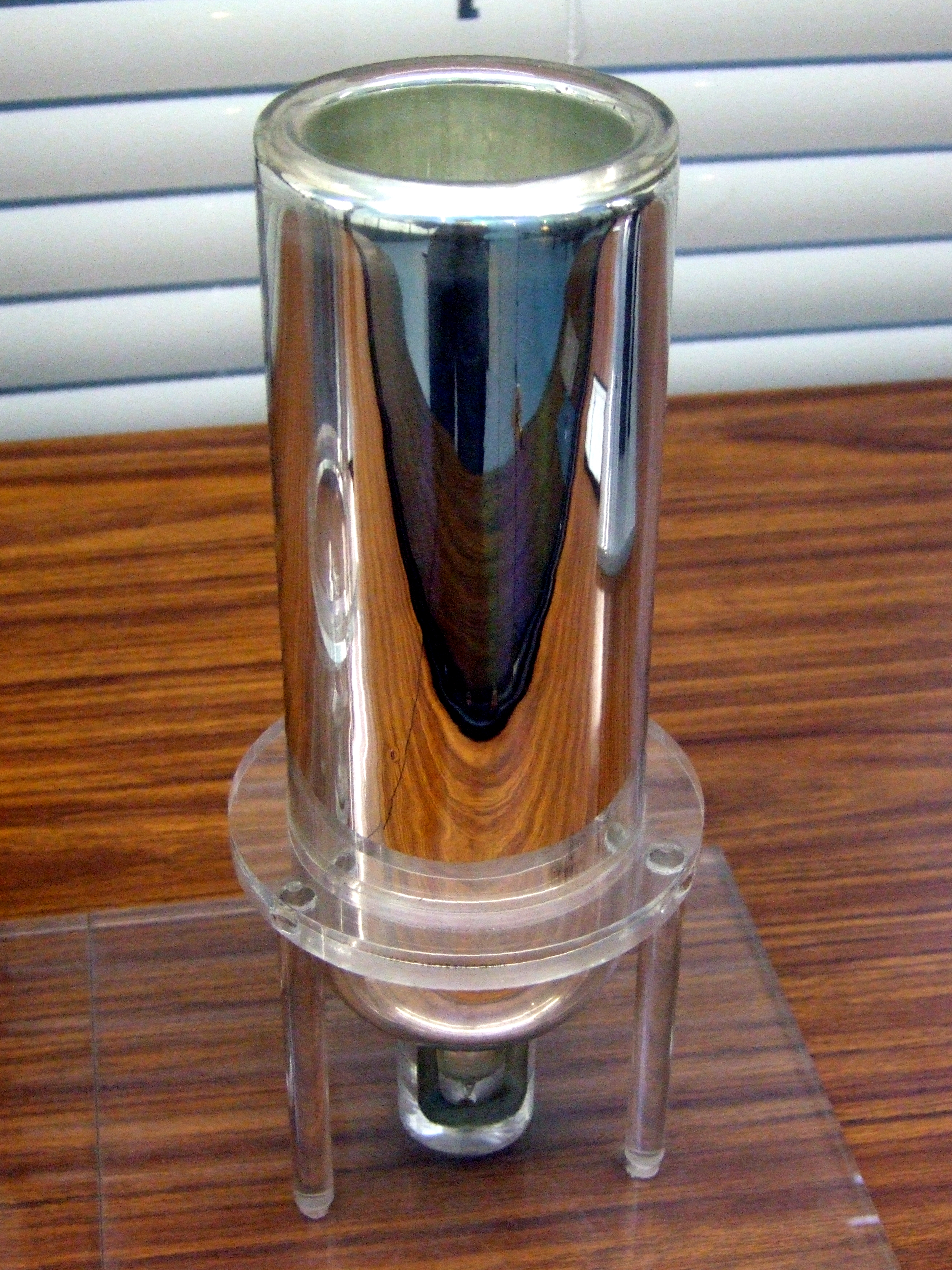
In a previous piece about density and the insulating power of whipped cream, I mentioned that trapped "nothingness" was even better at insulating things than the trapped air in the whipped cream.

A hot object can transfer heat to its surroundings by conduction and convection, in other words by having molecules (or atoms) in the surroundings collide with the surface of the object, pick up some of its energy and move off. Imagine a little bucket brigade, stepping up to the object, grabbing a piece of heat (energy, really) and heading off to dump it elsewhere. Air doesn't conduct heat very well, and trapping it reduces convection (the bulk movement of the air - air currents), hence trapped air is an effective insulator.

If you halt the bucket brigade - prevent any molecules from walking off with a chunk of energy, all the energy stays in the object and voila my cocoa stays hot. So if I could envelop my cocoa in a bubble of nothingsness — a vacuum — I could keep it from cooling via conduction and convection. (Of course, I'd have to put a vacuum tight lid on the thing, lest it instantly boil off — but that's another post…) A convenient way to do this is to use a vacuum flask, where a 'layer' of vacuum is enclosed between two walls. Originally glass walls were used. If you're my age, you might remember dropping your lunch box, and then opening your thermos at lunch to find shard of glass inside. These days stainless steel or plastic walls make lugging your milk to school a less risky proposition.

Chemists still use the glass walled version of a thermos. We call it a Dewar (for James Dewar, who invented the contraption in 1892).

But an object untouched by other molecules can still lose heat by radiation, by emitting infrared photons - light at wavelengths longer than visible light. Reflective wrappings, like metalized Mylar, keep the light - and the warmth - inside.

A friend recently wondered why clear weather was cold weather. The earth radiates some of its heat back out into the universe as infrared radiation. Clouds act as insulating wraps for the earth, the water molecules grabbing the heat before it radiates out into space and re-emitting some of it back toward the planet's surface. (This is the greenhouse effect — it's not up for debate.) On a clear night, no clouds, so less heat is retained. Suddenly the temperatures are well below freezing.

(Other molecules besides water help trap infrared radiation within the atmosphere, including carbon dioxide and methane.)


Photo is from Wikimedia.

Writing Science: What do journal articles and romance novels have in common?


The anatomy of a scientific paper. What do scientists mean when we say "the literature" (in hushed reverent tones)? What role does it play? Is a journal article as formulaic as a romance novel? Is this a bad thing? Where is the drama packed into a scientific paper? The introduction? The conclusion? Or are articles (as one of my students put it) "stripped of all their drama"?

Writing prompt of the day

Pick one of the titles below and write an introduction to this paper. If you don't know the meaning of a particular term, create a meaning. Five minutes.

• Kinetic Isotope Effects for the Reactions of Muonic Helium and Muonium with H2
• Enhanced lithium depletion in Sun-like stars with orbiting planets
• One small step for a mouse
• Transient Hoogsteen base pairs in canonical duplex DNA

Next up?

What sets the tone in an article? Grab a journal article at random and start circling all the qualifiers - are they "needless words" (as William Strunk of Elements of Style fame would have it) or careful bounding on the part of the authors as to their claim?

And would a set of journal covers look as similar to an untutored eye as these romance novel covers?

Romance novel covers art from http://www.flickr.com/photos/wackystuff/2551278302/

Writing Science: The. Article.


Yes, the is an article, but "the article" is considered by many to be the best, the most important, the only way to communicate about science (at least to other scientists). Yes? No?

Who should be writing about science? What kinds of writing about science constitute scientific communication? Who should be writing them?

Writing prompt
"All I want is a proper cup of coffee, made in a proper copper coffee pot." —Trout Fishing in America

Describe how your perfect cup of coffee is made. Start where you wish - with the beans, or with pouring it from a pot, or buying it at a cafe. Be specific and detailed. Don't drink coffee? (I don't!) Do the same with tea or hot chocolate or a favorite sandwich. Five minutes.

Alternate:
Pick a routine prep you do in lab. Describe the perfect process. Be specific and detailed. Five minutes.

Next up
The anatomy of a scientific paper: what does one of those all important journal articles look like?

What we're reading
  • Anatomy of a Scientific Paper, Excerpted from Anatomy of a Scientific Paper
  • Abstract, Communicating Science: A practical guide, Pierre Laszlo, Springer, 2010.
  • How to write a scientific paper (book review), R.W. Guillery, J. Anat. (2008) 213, 629–630.
  • Whitesides' Group: writing a paper, George Whitesides, Adv. Mater. 2004, 16, 1375-1377.
  • Writing Summaries and Abstracts, Margot Northey & Judi Jewinski, Making Sense: A student's guide to research and writing, Oxford 2009. pp 31-38
  • Writing a scientific paper, From Research to Manuscript: a guide to scientific writing, Michael Jay Katz, Springer, 2006. pp 53-124
  • Instructions for authors, Journal of the American Chemical Society
ADDENDUM: A chemist muses about coffee here....