Field of Science

Showing posts with label climate debate. Show all posts

Unbending the bends


Sometime before dawn this morning, we took our oldest son to the airport. He's bound for the Caribbean for a pre-orientation trip for college (learning to sail with a team of other freshmen). They will get the chance to do a little snorkeling, but when his dad asked him about whether or not they'd be doing any scuba diving, he replied enigmatically,"There is no hyperbaric chamber in the Virgin Islands. They'd have to fly you to Puerto Rico, I guess."

My first response was to wonder how they would do that, given that most aircraft are pressurized to something around 10,000 to 15,000 feet, which would certainly exacerbate the bends - the outgassing of nitrogen from the blood, which can cause embolisms (blockages) in your blood vessels and painful swelling in your joints.

Henry's law governs the amount of gas dissolved in a liquid: the amount of dissolved gas depends on the external pressure of the gas. For example as the pressure of carbon dixoide increases, so does the amount of dissolved carbon dioxide. Some portion of that dissolved CO2 turns into carbonic acid (H2CO3), and lowers the pH, which gives soda water it's characteristic bite. It also means that acidification of the ocean is a risk of fossil fuel burning, and the resultant carbon dioxide in the atmosphere. Climate deniers will say that there is no data linking CO2 levels with changes in the ocean pH, suggesting it's because the oceans aren't plain water, and that this will complicate the chemistry. True. But your blood is pretty chemically complicated, and this is essentially the system that is used to control your blood's pH.

So why would flying make the bends worse? As the external pressure of nitrogen falls with altitude, more nitrogren comes out of solution in your blood stream and joints. Neither are places where you want more bubbles. If possible, victims of the bends are evacuated on planes that can be pressurized to lower altitudes (an expensive proposition, and one often not covered by travel insurance).

Bariatric chambers allow the external pressure to be increased, and then slowly decreased to prevent the formation of large bubbles. It can take several "dives" to assuage the symptoms. I sat with my mother while she underwent treatment in a hyperbaric chamber, it's not for those with claustrophobia is all I will say.


Photo is from Wikimedia.

Cooling trends


In a previous piece about density and the insulating power of whipped cream, I mentioned that trapped "nothingness" was even better at insulating things than the trapped air in the whipped cream.

A hot object can transfer heat to its surroundings by conduction and convection, in other words by having molecules (or atoms) in the surroundings collide with the surface of the object, pick up some of its energy and move off. Imagine a little bucket brigade, stepping up to the object, grabbing a piece of heat (energy, really) and heading off to dump it elsewhere. Air doesn't conduct heat very well, and trapping it reduces convection (the bulk movement of the air - air currents), hence trapped air is an effective insulator.

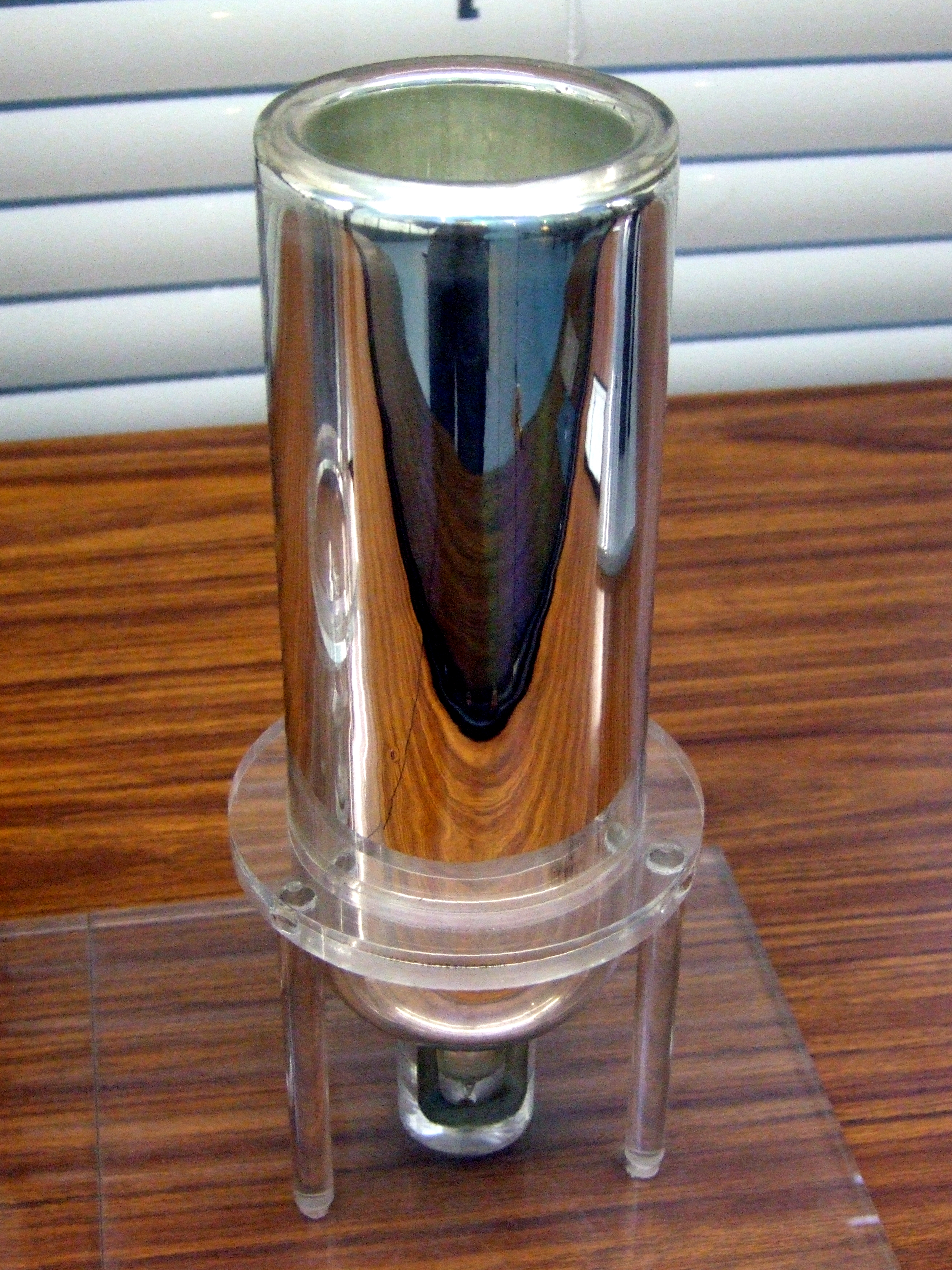
If you halt the bucket brigade - prevent any molecules from walking off with a chunk of energy, all the energy stays in the object and voila my cocoa stays hot. So if I could envelop my cocoa in a bubble of nothingsness — a vacuum — I could keep it from cooling via conduction and convection. (Of course, I'd have to put a vacuum tight lid on the thing, lest it instantly boil off — but that's another post…) A convenient way to do this is to use a vacuum flask, where a 'layer' of vacuum is enclosed between two walls. Originally glass walls were used. If you're my age, you might remember dropping your lunch box, and then opening your thermos at lunch to find shard of glass inside. These days stainless steel or plastic walls make lugging your milk to school a less risky proposition.

Chemists still use the glass walled version of a thermos. We call it a Dewar (for James Dewar, who invented the contraption in 1892).

But an object untouched by other molecules can still lose heat by radiation, by emitting infrared photons - light at wavelengths longer than visible light. Reflective wrappings, like metalized Mylar, keep the light - and the warmth - inside.

A friend recently wondered why clear weather was cold weather. The earth radiates some of its heat back out into the universe as infrared radiation. Clouds act as insulating wraps for the earth, the water molecules grabbing the heat before it radiates out into space and re-emitting some of it back toward the planet's surface. (This is the greenhouse effect — it's not up for debate.) On a clear night, no clouds, so less heat is retained. Suddenly the temperatures are well below freezing.

(Other molecules besides water help trap infrared radiation within the atmosphere, including carbon dioxide and methane.)


Photo is from Wikimedia.