Field of Science
-
-
Change of address1 year ago in Variety of Life
-
Change of address1 year ago in Catalogue of Organisms
-
-
Earth Day: Pogo and our responsibility1 year ago in Doc Madhattan


Sweet leads

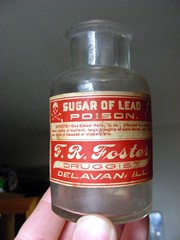
Horror of horrors - the Romans used lead to sweeten their fruit. No wonder Rome fell! Except that I was willing to read a 1883 paper (in German with healthy helpings of Greek and Latin) to discover that it may be lead and it may be sweet, but the lead doesn't lead it to be sweet.
In a time when mercury was regularly used as a remedy for maladies as serious as syphilis and as commonplaces as constipation, it doesn’t surprise me that lead compounds were in the pharmacopeia. (In all fairness, some modern antibiotics and most chemotherapy agents are at least as toxic as these less old remedies; they just have a better risk-benefit ratio.) Sugar of lead, or as it’s called in the 19th century medical literature, saccharum saturni, is lead acetate: Pb(CH3COOH)2. It was once prescribed for intestinal troubles, an odd choice, since one symptom of acute lead poisoning is an upset stomach. Lead poisoning is also known as painter's colic.
Sugar of lead really is sweet, roughly as sweet per spoonful as sugar. In the 18th and 19th century, lead shot was often dropped into bottles of port, purportedly to make it sweeter - though the more likely effect is anti-bacterial. Why? Lead does dissolve well in alcohol and juices (crystal decanters to store your port are a bad idea) - but I can't find anything that suggests solutions of lead ions are sweet.
The Romans were reputed to use lead acetate as a sweetener. They produced a syrup called sapa by boiling down mildly fermented grape juice in kettles made from lead alloys. (The hydrates of lead acetate are far less soluble in alcohol solutions - you are more likely to get a suspension of crystals in the syrup.) I am suggesting that it’s unlikely that the syrup was sweet because of the lead acetate it certainly contained. An 1883 analysis of sapa produced according to recipes dating from the classical Roman period, in kettles of similar metallic content to those found at Pompeii and other sites, suggested that the lead content of sapa was roughly 850 mg per liter. The equivalent amount of table sugar would be roughly a teaspoon - hardly enough to taste sweet in a liter of liquid. On the other hand, the sugars (glucose and fructose) in the concentrated grape must are the equivalent of 1 cup of table sugar per liter and would certainly swamp any sweetness coming from the lead acetate. It's still not all that sweet. To get a sense of how sweet this is, simple syrup, which has similar culinary uses to sapa, has about 4 cups of sugar in a liter.
I still wouldn't use sapa to poach my pears, but I think it unlikely that the sweet taste of sapa has much to do with lead.
Photo is c. 2009 John4kc. Used with permission.
Sweet Stones
 I was wandering the Cape Anne historical museum this winter and noticed in a 19th century ship's medical kit a vial labeled "sugar of lead." This is lead acetate, which tastes sweet -- and is reputed to have been used as a sweetener is days past. Other metal salts are sweet as well - yttrium salts and beryllium salts can both taste sweet.
Beryllium was first identified in 1798 by chemist Louis Vauquelin as an oxide in beryl and emeralds (emeralds are beryls with a bit of chromium added!). Since the chloride salt of the new element tasted sweet, the editors of the journal which published Vauquelin's findings suggested he call the oxide (or earth) glucina from the Greek, glyks (γλυκυς) for sweet. The elemental symbol used was Gl.
Beryllium was suggested as alternative once other sweet metal salts were found, for the gemstones in which the element was first identified. It took until 1949 for this to become the official IUPAC name of the element with four protons.
Beryls were used to make "reading stones," magnifying glasses, then eventually ground into lenses for eyeglasses.
Anti-Archimedes
The recipe for pulled pork called for 1/2 cup of brown sugar to be dissolved into 1 1/2 cups of apple cider vinegar. What I had in the cabinet was solid as a rock - there was no way I was packing this into a measuring cup. (Yes, I know I could have done this in the microwave...) My scale came to the rescue. I hacked off chunks until I had the correct mass of brown sugar (110 grams more or less). I dumped the three large hunks into the vinegar in a 2 cup glass measure, and noted that the total volume was just about 2 cups. Nice job.
Then I stirred it to dissolve the sugar. And watched the volume decrease to just over 1 1/2 cups of solution! Have I just proved Archimedes wrong? The volume of sugar at first seemed to have displaced the equivalent volume of liquid, but then seemed to vanish...well not exactly into thin air, but vanish nonetheless. As my 15-year old might say, "What's up with that?"
Yes, Archimedes was correct, but his theory did not address substances that dissolve in the liquid. This is a good demonstration of how much "empty "space is in a liquid. The sugar molecules (and other things in brown sugar, which is not terribly pure as chemicals go) insert themselves between water molecules, without needing to push the water molecules further apart. To a good first approximation the volume of a solution made from a solvent and soluble solid is the volume of the solvent used, not the sum of the two volumes.
Try it...it's fun to watch, and it still intrigues me to think about the amount of unused space there is in a liquid that seems so substantial at the macroscopic level!
The pulled pork was a keeper...though the kids found the BBQ sauce too spicy for their taste. Try it on challah rolls!
Then I stirred it to dissolve the sugar. And watched the volume decrease to just over 1 1/2 cups of solution! Have I just proved Archimedes wrong? The volume of sugar at first seemed to have displaced the equivalent volume of liquid, but then seemed to vanish...well not exactly into thin air, but vanish nonetheless. As my 15-year old might say, "What's up with that?"
Yes, Archimedes was correct, but his theory did not address substances that dissolve in the liquid. This is a good demonstration of how much "empty "space is in a liquid. The sugar molecules (and other things in brown sugar, which is not terribly pure as chemicals go) insert themselves between water molecules, without needing to push the water molecules further apart. To a good first approximation the volume of a solution made from a solvent and soluble solid is the volume of the solvent used, not the sum of the two volumes.
Try it...it's fun to watch, and it still intrigues me to think about the amount of unused space there is in a liquid that seems so substantial at the macroscopic level!
The pulled pork was a keeper...though the kids found the BBQ sauce too spicy for their taste. Try it on challah rolls!
Cold as Ice
This article in the Atlantic monthly caught my eye, if only because it included an experiment and less because of my refined palate. Wayne Curtis is writing about the unsung hero or villian of mixed drinks: ice.
 Take a mixture of ice and water that has been thermally isolated (put in a thermos!) and allow it to come to thermal equilibrium (let it sit until the temperature doesn't change any longer). When the contents of the thermos reach equilibrium, if there are both ice and water present, the temperature is 32 degrees (Fahrenheit). It does not matter how cold the ice was to start, how much water is present, how warm or cold the water was - it will be 32 degrees. Not 40. Not 34.
Also known to those who know how to read a phase diagram, ice at normal pressures will not start to melt until it reaches 32 degrees, and its temperature will not rise above 32 degrees until it has all melted. Curtis' experiment isn't quite as sophisticated as the thermos one I've sketched out, but assuming that the rate of heat loss to the room was small (air - or any gas - isn't a very good thermal conductor, so over the short term this is not a bad assumption), and that the ice and water used were pure, and that a very large amount of water was used relative to the ice - I find it untenable that the "cheater-ice" cocktail is different in temperature than the one made with less porous ice. More watery, yes, colder, no.
Photography by Sue Stafford. Used under Creative Commons license.
"I went into the kitchen with another bartender, Stephen Cole, who hunted up a scale and thermometer. He placed the two kinds of ice into separate cups filled with water. We let them sit for 10 minutes. The cheater-ice water proved to be colder (34 degrees compared with 40 degrees), but the ice had lost a full quarter of its weight, compared with just a 14 percent loss in the chunk ice. A cheater-ice cocktail is thus chillier (numbing the taste buds) and more watery (making it flat)."He describes a bar which stocks eight different types of ice - though the classification system is not quite what a physical chemist might use - or even Kurt Vonnegut. I suspect, however, a serious flaw in the experiment, and therefore in the conclusions drawn about the effect of ice type on a drink.
 Take a mixture of ice and water that has been thermally isolated (put in a thermos!) and allow it to come to thermal equilibrium (let it sit until the temperature doesn't change any longer). When the contents of the thermos reach equilibrium, if there are both ice and water present, the temperature is 32 degrees (Fahrenheit). It does not matter how cold the ice was to start, how much water is present, how warm or cold the water was - it will be 32 degrees. Not 40. Not 34.
Also known to those who know how to read a phase diagram, ice at normal pressures will not start to melt until it reaches 32 degrees, and its temperature will not rise above 32 degrees until it has all melted. Curtis' experiment isn't quite as sophisticated as the thermos one I've sketched out, but assuming that the rate of heat loss to the room was small (air - or any gas - isn't a very good thermal conductor, so over the short term this is not a bad assumption), and that the ice and water used were pure, and that a very large amount of water was used relative to the ice - I find it untenable that the "cheater-ice" cocktail is different in temperature than the one made with less porous ice. More watery, yes, colder, no.
Photography by Sue Stafford. Used under Creative Commons license.
Weird Words of Science: Hypsometer

Every time I write an exam, I think about this story, where a physics professor asks on an exam how to measure the height of a building using a barometer. A student answered that he would tie a string to the barometer, lower it down, then measure the length of the string. Given no credit, he protests, and the professor offers him a second chance to provide an answer that is both correct and demonstrates some knowledge of physics taught in the course. The student goes on to give several answers (in some versions the student is averred to be Niels Bohr - though the origin of the story is apparently in a textbook on the teaching of math and science by Alexander Calandra, and unrelated to Bohr) all demonstrating a knowledge of physics, and none the one he seems to know the professor is fishing for (which has to do with the - probably unmeasurably small - pressure differential between the ground and the top of the building).
Here is a chemistry exam question I sometimes ask - how would you measure the height of a mountain with a thermometer? This is a well-known technique,not a trick question, the apparatus is called a hypsometer, from the Greek for "height-measure". The underlying science is that the boiling point of a liquid changes in a known way with altitude. Hypsometers were used before portable aneroid barometers became widely available, and were used in high altitude balloon measurements of pressure as late as the 1960s.
Bonus question: Is it easier to drink a liquid using a straw at the top of Mt. Everest or on the beach in Florida? (Disregard temperature differences and explain your answer for full credit!)
Nano-meter
The Nano Song from nanomonster on Vimeo.
This song certainly has rhythm as well as meter...and does give you a sense of what "nano" means. My non-musical attempt of a couple of years ago is not so jazzy!
Table Manners in Nature Chemistry

The second issue of Nature Chemistry appeared online today, with my musings about the shapes the periodic table can take, and why I think chemists like to keep their elements in boxes.
"Chemists have created hundreds of variations in search of the perfect periodic table. The periodic table has been mapped onto spirals, circles, triangles and elephants. The first such “alternative” periodic table, based on a sprial, was proposed by Gustavus Hinrichs of the University of Iowa in 1867, two years before Mendeleev published the forerunner to the current blocked tabular form. Still, open 50 random introductory chemistry texts and it is a fair bet that all 50 of them have IUPAC’s standard periodic table inside, or its generic sister. Chemists are stuck in the box." Read the rest of the column here (requires a subscription...).Or if my Table Manners are not to your taste, this article in the same issue on syntheses of Moebius molecules might be.
All that glitters...may be tin

While medieval alchemists were searching for the secrets of turning base metals, such as lead and tin, into gold, medieval artists had already figured out how to do this. Gold was often applied to manuscripts in medieval Europe and the Middle East to “illuminate” them, an illuminated page would have the functional equivalent of little mirrors scattered across it, making the most of dim interior lighting. In addition to being reflective, gold does not corrode or oxidize, so gold will not discolor with time. There is a fine collection of medieval illuminated manuscripts at a library near me, and as you turn the pages of Book of Hours that is half a millenia old (wearing gloves, of course), the golden decorations wink at you as brightly as the day they were applied.
Gold is expensive, and hard to handle, particularly in the thin sheets necessitated by the cost. One alternative is to use a tin base, then brush on a saffron oil glaze. Polish it up and you might not notice. The glaze blocks out the oxygen and moisture in the air, preventing many of the chemical reactions which can cause the metal to discolor. The resulting preparation is called auripetrum - Peter’s gold. Peter had a good idea - whoever he was.
Does anyone know more about the source of this name? I'd love to know.
Weird Words of Science: Lemniscate Elemental Landscapes
 In reading an older paper about periodic tables, the author referred to the "lemniscate table of Gooch and Walker" - but didn't provide a figure, and I had to admit lemniscate was an unfamiliar descriptor. (It's not in the abridged Oxford English Dictionary on my iPod, either - so I don't feel all that ignorant!) Even a Google search was not particularly enlightening.
The full OED came to the rescue - "ribbon like", from the Latin for a ribbon. The term dates to the 17th century when Bernoulli used it to describe a set of curves. The term was new, the curves were not - Bernoulli's lemniscate was a special case of a set already described by Cassini.
 Once I located a figure of Gooch and Walker's table, I would agree "ribbon-like" is a good description and it is certainly reminiscent of Cassini's figure eight curves (to give credit where credit is due).
Figure of the periodic table from Outlines of inorganic chemistry by Frank Austin Gooch, Claude Frederic Walker, Macmillan:New York, 1905. Figure of Bernoulli's lemniscate is from here.

A rose by any other name is poison ivy
In 1865 John Maisch published a short paper "On the Active Principle of Rhus Toxicodendron". For the unsensitized, rhus toxicodendron is the botanical name for poison ivy. Maisch isolated a fraction he considered to be the "active principle" responsible for the misery that is poison ivy and dubbed it toxicodendric acid. Are you itchy yet? (I am and Maisch surely was, he and various visitors to his lab suffered with outbreaks of poison ivy.)
By 1897 Franz Pfaff of Harvard had weighed in. Toxicodendric acid extracted from poison ivy turned out to be acetic acid - yes, vinegar, by another name, CH3COOH. He showed the itch was in the oil.
By 1897 Franz Pfaff of Harvard had weighed in. Toxicodendric acid extracted from poison ivy turned out to be acetic acid - yes, vinegar, by another name, CH3COOH. He showed the itch was in the oil.
Subscribe to:
Posts (Atom)