Field of Science

Showing posts with label sugar. Show all posts

Chemistry by accident


I just finished another Thesis column for Nature Chemistry, this one on the notion that chemistry sets are an essential part of turning kids into chemists — more particularly, what I called the Uncle Tungsten trope: risky chemistry is more fun and makes better chemists. As part of the article, I wondered how many accidents there are in home labs (not counting home meth labs). It turns out that in the US, the Agency for Toxic Substances and Disease Registry (ATSDR) keeps track of hazardous substance events. The data suggests there are around 1000 chemical incidents in private homes each year, and the vast majority involve carbon monoxide (nearly all the fatalities are caused by CO) or inappropriate mixing of common household chemicals (usually of bleach and something else: ammonia, pool acid, pesticides). As far as I can tell, none of the accidents were part of amateur chemistry gone awry.

There are no narratives linked to the data, but a chemist can read between the lines. When the primary chemical listed in a chemical accident is sucrose — table sugar — (a) what is the secondary chemical likely to be? (b) What was the intended goal of the experiment?

Answers: (a) potassium nitrate (or potassium chlorate) and (b) solid rocket fuel (or sparklers or smoke bombs or...). Sucrose oxidizes readily (toasted marshmallows, anyone?), and potassium salts (KNO3, KClO3) are good oxidizing agents.

It should go without saying, but do not try this at home. Especially do not try mixing bleach with anything. It will not make a stronger cleaner, bug killer, or weed killer. But it might kill you.
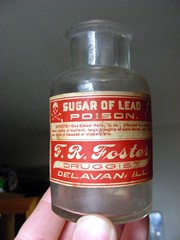
Sweet leads


Sugar of Lead Poison Bottle
Originally uploaded by john4kc


Horror of horrors - the Romans used lead to sweeten their fruit. No wonder Rome fell! Except that I was willing to read a 1883 paper (in German with healthy helpings of Greek and Latin) to discover that it may be lead and it may be sweet, but the lead doesn't lead it to be sweet.

In a time when mercury was regularly used as a remedy for maladies as serious as syphilis and as commonplaces as constipation, it doesn’t surprise me that lead compounds were in the pharmacopeia. (In all fairness, some modern antibiotics and most chemotherapy agents are at least as toxic as these less old remedies; they just have a better risk-benefit ratio.) Sugar of lead, or as it’s called in the 19th century medical literature, saccharum saturni, is lead acetate: Pb(CH3COOH)2. It was once prescribed for intestinal troubles, an odd choice, since one symptom of acute lead poisoning is an upset stomach. Lead poisoning is also known as painter's colic.

Sugar of lead really is sweet, roughly as sweet per spoonful as sugar. In the 18th and 19th century, lead shot was often dropped into bottles of port, purportedly to make it sweeter - though the more likely effect is anti-bacterial. Why? Lead does dissolve well in alcohol and juices (crystal decanters to store your port are a bad idea) - but I can't find anything that suggests solutions of lead ions are sweet.

The Romans were reputed to use lead acetate as a sweetener. They produced a syrup called sapa by boiling down mildly fermented grape juice in kettles made from lead alloys. (The hydrates of lead acetate are far less soluble in alcohol solutions - you are more likely to get a suspension of crystals in the syrup.) I am suggesting that it’s unlikely that the syrup was sweet because of the lead acetate it certainly contained. An 1883 analysis of sapa produced according to recipes dating from the classical Roman period, in kettles of similar metallic content to those found at Pompeii and other sites, suggested that the lead content of sapa was roughly 850 mg per liter. The equivalent amount of table sugar would be roughly a teaspoon - hardly enough to taste sweet in a liter of liquid. On the other hand, the sugars (glucose and fructose) in the concentrated grape must are the equivalent of 1 cup of table sugar per liter and would certainly swamp any sweetness coming from the lead acetate. It's still not all that sweet. To get a sense of how sweet this is, simple syrup, which has similar culinary uses to sapa, has about 4 cups of sugar in a liter.

I still wouldn't use sapa to poach my pears, but I think it unlikely that the sweet taste of sapa has much to do with lead.


Photo is c. 2009 John4kc. Used with permission.

Anti-Archimedes

The recipe for pulled pork called for 1/2 cup of brown sugar to be dissolved into 1 1/2 cups of apple cider vinegar. What I had in the cabinet was solid as a rock - there was no way I was packing this into a measuring cup. (Yes, I know I could have done this in the microwave...) My scale came to the rescue. I hacked off chunks until I had the correct mass of brown sugar (110 grams more or less). I dumped the three large hunks into the vinegar in a 2 cup glass measure, and noted that the total volume was just about 2 cups. Nice job.

Then I stirred it to dissolve the sugar. And watched the volume decrease to just over 1 1/2 cups of solution! Have I just proved Archimedes wrong? The volume of sugar at first seemed to have displaced the equivalent volume of liquid, but then seemed to vanish...well not exactly into thin air, but vanish nonetheless. As my 15-year old might say, "What's up with that?"

Yes, Archimedes was correct, but his theory did not address substances that dissolve in the liquid. This is a good demonstration of how much "empty "space is in a liquid. The sugar molecules (and other things in brown sugar, which is not terribly pure as chemicals go) insert themselves between water molecules, without needing to push the water molecules further apart. To a good first approximation the volume of a solution made from a solvent and soluble solid is the volume of the solvent used, not the sum of the two volumes.

Try it...it's fun to watch, and it still intrigues me to think about the amount of unused space there is in a liquid that seems so substantial at the macroscopic level!


The pulled pork was a keeper...though the kids found the BBQ sauce too spicy for their taste. Try it on challah rolls!

Relishing Osmosis

Tomorrow is a day for iconic cooking. Turkey. Stuffing. And of course, cranberry sauce. At a dinner a few years ago, a friend produced an odd silver implement and asked the gathered group of foodies just what we all thought it might be. Would you believe a jellied cranberry server - just the right size, she pointed out, to cut the canned jelly! Turns out that serving pieces for jellied sauces, like tomatoes and cranberries pre-date the Ocean Spray cans, but it was a fun puzzle regardless.

For me, the whole question of canned or homemade sauce is moot, since I prefer cranberry relish. I make it by running a bag of cranberries and a whole orange through the food processor, then adding sugar to taste. Since it's best made ahead, so the flavors can blend, I made a batch yesterday afternoon when I went home for lunch between office hours. Straight from the food processor the relish is whitish, dry and pretty bitter. Stir in the sugar and not only does it become sweet, but a ruby syrup begins to appear.

This is a (literally) beautiful example of osmosis in action. The high concentration of sugar outside the cell walls of the finely chopped orange and cranberry mixture encourages the water within the cells to pass through the cell membrane to bring the concentrations inside and out into equilibrium. The sugar and cellular contents are too big to cross the membrane, so the best the poor cells can do is to dump their water out creating that lovely syrup. The process intensifies the flavors of the berry and orange bits as well, since they are essentially "dried".

After a day of cooking and now kitchen scrubbing, my fingers are wrinkled. [This is an osmotic process as well, in this case, the water is crossing the cell membranes into my cells, causing the out layer of skin to get larger, and wrinkle.] Or perhaps, not! As David Bradley points out in the comments to this post, the wrinkling of the skin on your fingers after prolonged immersion in water is not particularly well understood. My reading of the literature suggests that osmosis plays at most a small role.

Weird Words of Science 12: A need for speed

The nectar busily gathered by the bees outside my window has a high sucrose content. The bees add the enzyme invertase to the nectar to catalyze the inversion of the sucrose to glucose and fructose that are the major sugars in honey. Humans can speed up the same reaction by heating the syrup or by adding a touch of acid.

Both enzyme and catalysis are lofty words lifted by scientists in the 19th century to serve more prosaic ends.

Enzyme's first meaning in the bread used for the Eucharist in the Greek Orthodox tradition. It means "leavened". It's not such a stretch to borrow the word to describe stuff that encouraged cellular reactions to proceed, what had been called the ferment.

Catalysis was originally used to describe the collapse of a nation, its origins can be traced to the mid 17th century. It comes from the Greek "to loosen". In the 19th century, Berzelius suborned the term to describe the process by which chemical reactions are facilitated. Catalysts participate in a reaction, but are in the end are restored to their original form, like molecular Phoenixes. Why did Berzelius settle on this term? Did he hope to imply that the constraints which bound the reaction to a slow pace are loosened by a catalyst?

Turning Sugar Inside Out

This week's worksheet in general chemistry asks my students to analyze the chemical kinetics (the speed) of this reaction:

C12H22O11 (sucrose or table sugar) + H2O (water) -> C6H12O6 (glucose) + C6H12O6 (fructose).

It's called the inversion of sucrose, and the resulting mix of glucose and fructose is tagged invert sugar. The name suggests that table sugar has been turned inside out or perhaps upside down, but in fact it's simply been split into two simpler sugars. The inversion is not of the sugar itself, but of the way it bends polarized light. If you pass a beam of polarized light through a solution of regular table sugar, the light will "rotate" or bend to the left. The mixture of glucose and fructose "inverts" the rotation, and bends the beam to the right.

Invert sugar is less like to crystalize than regular sugar, making it ideal for sweetening candy or jams. The reaction in the absence of a catalyst is slow at room temperature, but can be completed . The simplest way to catalyze the reaction is with an acid, often citric acid or ascorbic acid (Vitamin C), and many jam recipes call for one or the other.

So why do these compounds "bend" polarized light? Like many biological molecules, they are chiral or handed. The right handed or D form bends the polarized light toward the right, the left handed form (denoted L) left.


Another name for the D form of glucose is dextrose, named for the direction in which it bends polarized light.