


I steamed a batch of dumplings for lunch yesterday, which never had time to cool before being wolfed down by the spring break crowd in my kitchen. So I pulled another set from the freezer which someone in the scrum popped into the steamer. In the confusion, no one checked to be sure there was still water in the steamer. Fast forward eight minutes, the dumplings are stuck to the steamer and the smoke alarm is shrieking.
The dumplings were edible, but the bottom of the pan was pretty badly scorched. My mathematician spouse wondered if I had some special chemical that would magically clean the pan. I said I did and that I'd already applied it. "What did you use?" he said, peering into the blackened pot. "Water."
Water is sometimes called the universal solvent, and though many things will dissolve in water, it's not clear that more things are soluble in water than in any other solvent (or how you would undertake such an inventory). And it's absolutely a chemical, though it is so ubiquitous we have a hard time thinking of it as such. Even chemists.
The pot soaked overnight, and with the application of a bit of elbow grease (physics, not a chemical) and a finely ground mixture of low volatility chemicals (feldspar, limestone, sodium carbonates with a dash of soap - aka kitchen cleanser) is as shiny as ever.
Field of Science
-
-
Change of address1 year ago in Variety of Life
-
Change of address1 year ago in Catalogue of Organisms
-
-
Earth Day: Pogo and our responsibility1 year ago in Doc Madhattan
Showing posts with label kitchen chemistry. Show all posts
Showing posts with label kitchen chemistry. Show all posts
Science at Play

The Chemical Heritage Foundation in Philadelphia's latest exhibit is called "Science at Play" — and even if you can't get to Philadelphia, you can browse some of the materials on Tumblr, including animated videos of experiences — good and bad — with chemistry kits.
When my kids were young, I encouraged them to play with science stuff. I wanted them to be willing to get messy, to make mistakes, to think about stuff where it wasn't perfectly clear what was going on and to begin to understand that protective gear wasn't a ritual or a costume, but part of thinking through how to reduce risk. That you could make your own equipment.
Though kits have gotten far more tame over the years — no more uranium ore or instructions for making ammonia in your hand — there are still commercial kits that let kids play not only responsibly, but productively, with chemistry. The new MEL kits that Todd Bookman's piece on chemistry kits for The Pulse (listen here - full disclosure, I was interviewed for this segment) highlights are particularly cool in that they plug into another important skill for budding scientists: how to share your work. The kit comes with a lense that you can snap over a cell phone camera, giving you an up close look at what you are doing, and enabling you to share it via social media.
But as important as kits are, I think the ad hoc experiences of doing science are equally critical. They hone the ability to read instructions (and reveal how much is not revealed in the methods sections of any science communique), encourage a sense of scale and quantitation (how much is 1 gram of something, as opposed to pour in this packet) and help novice scientists get comfortable with tinkering to build apparatus when they don't have exactly what they need. And when tackling a new research problem, do you ever have precisely what you need?
While you can make do with measuring cups and kitchen scales, I'm with the Chemical Heritage Foundation's Erin McLeary, who notes the appeal of having the real stuff in your hands. These days you can easily and inexpensively acquire a few real beakers, graduated cylinders and other lab equipment -- along with gloves and other protective gear.
So if you're looking for an interesting and unique gift for a kid interested in science, try assembling a small kit and including the instructions and materials for a couple of experiments. For starters, extracting DNA from dried peas or copper electroplating (yes, it uses something you shouldn't eat - don't and wash your hands) or even the infamous water electrolysis (sans smoldering splint and thereby less risk of singed eyebrows). Offer to help supervise or be the videographer.
To read more of what I've written about chemistry kits and doing chemistry outside the laboratory see:
"Homemade Chemists" in Nature Chemistry
"Felony Science" at Slate
"Handheld Chemistry" on the blog, about the making of ammonia in your hand
Building scientists #istandwithahmed #kierawilmot

"What's happening?" wants to know the teacher who hears the commotion from the hallway. "I'm testing a fog machine I built for the class play."
Yes, at first glance the situation looks potentially perilous. But a quick question, followed by a bit of common sense and the teacher is reassured that all is well.
Now that everyone is sure that there is no bomb, what should happen to the kid?
A. Pull the child into the principal's office and demand that he sign a statement admitting his guilt.
B. Call the police, who will arrest him and charge him with building an explosive device.
C. Call the police, who will arrest him and charge him with building a "hoax bomb"
D. Nominate him for a theater award for special effects, for having designed and built an inexpensive fog machine to use for the school's upcoming production of Grease.
 The kid is my kid and the school's response was D. But imagine if my kid wasn't white and male. If his name were Ahmed Mohamed or Kiera Wilmot? There might have been handcuffs, felony charges, letters home to parents about "the incident". If someone had called the police, would they have arrested him because he couldn't explain why he'd built one, when they could have rented a fog machine? (The police thought it suspicious when Ahmed Mohamed couldn't tell them anything more than his device was a clock.) Why would you build a fog machine, or a clock? He must have built it for a purpose, nefarious almost certainly.
 Perhaps the purpose was to understand how these machines work? There is an amazing amount of joy in showing that you understand something well enough to build a working apparatus. To tweak and fix.
As a parent, I want the school to exercise an abundance of caution. But once you're sure it's just a clock — or a fog machine — perhaps it's time to slow down, and engage some common sense. Is there anything else that suggests this kid would build anything danger? Besides his name, or the color of her skin, or his religion.
Scientists and engineers are not hatched full grown from eggs in labs. As kids, they tinker and think and build and design, with Legos and parts from Radio Shack and Home Depot. They are in theater and on robotics and Science Olympiad teams. We need to get as excited about what they do as we are about how the football team is doing.
A chemistry decoder
 |
| A basic guide to decoding organic compound names © Andy Brunning/Compound Interest |
Noymer's results suggest that damping down the spread of rumor requires both persistent debunking and increased resistance among the susceptible population. Though at first glance it seems counterintuitive, just periodically debunking rumors leads to a steady state situation, where there is always a (not so small) part of the population who believe. Debunking needs to be strong and regular, and even then, if you don't have a resistant population, you land in a steady state regime. The best you can do is to reduce a rumor to something that periodically breaks out. Like the "Mars will be as big as the Moon in the sky!" meme which you see circulating on social media every summer like clockwork. (Spoiler alert: It wasn't. It won't be. Ever.)
What does it take to make a population resistant to pseudoscience? Some tactics are not unique to the pseudoscience issue: teaching critical thinking (as Phil Plait points out and Joel Achenbach implies here). Slower fingers when it comes to hitting "share." But it also means giving the population some basic tools for reading science. After the Royal Society of Chemistry released a large study of the public awareness of chemistry, I wrote that it might be helpful if instead of periodic tables, chemists handed out a cheat sheet for decoding chemical names. I wished and voilà, the brilliant Andy Brunning of Compound Interest created this graphic. Print it out and post it in your kitchen. Link to it on Facebook. Browse the rest of his collection. Buy his forthcoming collection about the chemistry of food and give it to the family member who keeps sending you links to the Food Babe.
Most all, talk about what you do as chemist, debunk garbage science when you hear it, swiftly and without mocking, and grab as many opportunities as you can to help people learn to decode chemistry on their own.
Eating periodically: is there thallium in your wasabi?
 |
| Wasabi, Iwasaki Kanen 1828 via Wikimedia Commons |
Could your wasabi peas be poisoning you? Short answer. Maybe.
Delish recently posted an article on thallium — a highly toxic metal — in kale, the quintessential healthy green. The Internet relished the irony of finding toxic metals in the highly touted greens. The piece points to an article in Craftsmanship magazine, which attempts to make a link between consumption of kale and thallium levels. This is not new news. There are dozens of reports, going back two decades, in the scientific literature of thallium in cruciferous vegetables, such as kale and brussell sprouts — and wasabi.
Thallium is definitely a nasty element, and has an infamous history of use as a poison in fact and fiction, starting with Ngaio Marsh's Final Curtain. Read Deborah Blum's hair-raisingly fascinating Poisoner's Handbook (or her short article at Wired about a recent murder case in Princeton). But as with everything, dose makes the poison, and the amounts of thallium in plants vary widely depending on the concentrations in the soil. In highly contaminated soils, plants can contain enough thallium to be hazardous. But if such highly contaminated soils were widespread, we'd have seen the effects already. (See this paper for some background.) (Also, you can leverage this ability and use it to clear out the thallium from a contaminated area.)
So how does thallium get into the plants? There is some evidence that thallium ions travel the same pathways as potassium ions (which play key roles in plant metabolism), and so might find their way into plants (and animals) though similar processes.
Thallium is also in the same column as boron, and elements in the same column of the periodic table often have similar behaviors, because their electrons are arranged in similar patterns. For example, strontium, which is underneath calcium, sneaks into the body by way of the same processes calcium does. Boron is found in plants (coffee is a good source, and plants in the same family as kale are also heavy absorbers of boron); it is believed to be critical to cell wall formation.
And if there is boron and thallium, indium - in the same column is another likely companion. And yes, indium has been detected in plants in the cabbage family.
As always, eating a wide variety of things is good advice, and it's key to remember that "natural" is not the same as "safe."
Eating periodically (not a quantum diet)

Answer #1
Carbon (Chocolate)
Hydrogen (CHocolate)
Oxygen (ChOcolate)
Holmium (CHocolate)
Cobalt (ChoColate)
Lanthanum (ChocoLate)
Astatine (Chocol(ChocolAte)
Tellurium (ChocolaTe)
So you could have: CHoCoLaTe or CHOCOLate or....
Answer #2
(Presuming the letters are not required to be used in order - and yes, I wrote a piece of code to give me this for any word)
All of the above and
aluminum (Al), chlorine (Cl), calcium (Ca), cerium (Ce), helium (He), actinium (Ac), Technetium (Tc), thorium (Th), thallium (Tl) and tantalum (Ta)
Answer #3
Elements that have been detected in chocolate (in this case dark chocolate, rough percent of my recommended dietary allowance in parentheses assuming I eat only a 100 gram bar).
Carbon, hydrogen, nitrogen, oxygen, potassium (why cocoa is detectably radioactive), calcium (about 5% of my RDA), iron (125%), magnesium (70%), phosphorous, potassium (almost a gram, 20%), sodium, zinc (40%), nickel, sulfur, silicon, cadmium, lead (yep, lead, mostly from dust contamination during transport), mercury, arsenic, uranium (trace amounts, but yes, more radioactivity), aluminum, copper (from pesticides, but on the plus side gives you your RDA for this element), and manganese
Nearly one fifth of the known elements have been detected in chocolate, which clearly should be the backbone of any periodic diet.
What other elements are you eating?
Just in case your chocolate doesn't have enough radioactivity for you:

Say that again? Why chemical names tangle on the tongue
Michael Pollan's Food Rules famously advises not eating anything with an ingredient a 3rd grader can't pronounce. The rule is more about eating closer to the production point, about consuming things that are familiar to 3rd graders (like broccoli and eggs), than it is that chemicals that are hard to pronounce are inherently hazardous, though in some corners it's taken on just that sort of magical thinking.
Why are chemical names so weird looking? Take 2-Methyl-5-(6-methylhept-5-en-2-yl)cyclohexa-1,3-diene for example. It certainly doesn't sound like anything you would want to eat, but it is just the formal name for the compound that is the main component of ginger oil, and responsible for much of ginger's characteristic bite. Like crystallized ginger, ginger tea, or a good stir fry? You've eat this compound in significant quantities.
Chemical names can look like alphabet soup, but they are a way for chemists to paint a compact picture of the structure, or at least to point out key structural features. Why is it so important to know what a molecule looks like? The structure of a chemical is what determines its behavior, how it will react, in the body and in the environment. It's key to understanding how things work on the molecular level: structure determines function. Period.
Formal chemical names, called IUPAC names (for the International Union of Pure and Applied Chemists, the body that decides on everything from what new elements will be called to the standards for drawing molecules), are in fact a code from which the full structure of the molecule can be unraveled. Most of the time chemists call chemicals by a common name, which also gives clues to the structure, though not so many that the molecule could be unambiguously drawn.
So back to 2-Methyl-5-(6-methylhept-5-en-2-yl)cyclohexa-1,3-diene, which looks like

 with the methyls at either end. The little red dots count off a seven membered chain, the "hept" in the name. The "cyclohexa" (sigh-clo-HEX-uh) points to a six membered ring, while "diene" (DIE-een) means it has two double bonds in it. The numbers tell you where to attach methyls and draw the double bonds. The little "2-yl" (too-ill) means the seven membered chain is linked to the six membered ring at the second carbon in line.
So these tangled names to a chemist are codes, and once you can read the code, even a bit, you can begin to see a molecule taking shape in your mind when you read its name.
This pronounces as 2-METH-ill / 5, 6-METH-ill-hept 5 een 2 ill cyclo HEX uh 1 3 DIE-een.
There's probably a reason this is better known as zingiberene, which suggests its common origin (ginger or zingiber), but not much about its structure.
Why are chemical names so weird looking? Take 2-Methyl-5-(6-methylhept-5-en-2-yl)cyclohexa-1,3-diene for example. It certainly doesn't sound like anything you would want to eat, but it is just the formal name for the compound that is the main component of ginger oil, and responsible for much of ginger's characteristic bite. Like crystallized ginger, ginger tea, or a good stir fry? You've eat this compound in significant quantities.
Chemical names can look like alphabet soup, but they are a way for chemists to paint a compact picture of the structure, or at least to point out key structural features. Why is it so important to know what a molecule looks like? The structure of a chemical is what determines its behavior, how it will react, in the body and in the environment. It's key to understanding how things work on the molecular level: structure determines function. Period.
Formal chemical names, called IUPAC names (for the International Union of Pure and Applied Chemists, the body that decides on everything from what new elements will be called to the standards for drawing molecules), are in fact a code from which the full structure of the molecule can be unraveled. Most of the time chemists call chemicals by a common name, which also gives clues to the structure, though not so many that the molecule could be unambiguously drawn.
So back to 2-Methyl-5-(6-methylhept-5-en-2-yl)cyclohexa-1,3-diene, which looks like
The "methyl"s (METH-ill) in the name refer to a CH3 group. What, you don't see any CH3's here? This is a chemical line structure, where each intersection point (or end of a line) is a carbon atom, and the hydrogen atoms have almost all been left off. A chemist sees this structure as
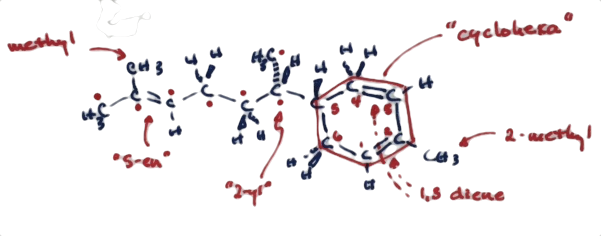
So these tangled names to a chemist are codes, and once you can read the code, even a bit, you can begin to see a molecule taking shape in your mind when you read its name.
This pronounces as 2-METH-ill / 5, 6-METH-ill-hept 5 een 2 ill cyclo HEX uh 1 3 DIE-een.
There's probably a reason this is better known as zingiberene, which suggests its common origin (ginger or zingiber), but not much about its structure.
Formaldehyde: not just for dead things
Next spring I'm teaching a course on the physical chemistry of food while a colleague is teaching a course on the analytical chemistry of foodstuffs. Among other science texts we'll be using John Coupland's Introduction to the Physical Chemistry of Food, but I'm also collecting short pieces to put some of the work into a historical and social context.
Though these days we tend to think of chemists as the untrustworthy creators of toxic, artificial everything, the systematic training of chemists was driven in part by the desire for the public to know what was in their food and water. In 19th century Britain, hundreds of chemists made their living testing the purity of everything from butter to well water. So when the Food Babe tells you there is something "yucky" in your food, the reason we know it is there is some chemist developed a careful protocol for its analysis, and other chemists tested the material.
I've been thinking about formaldehyde, one of the simplest organic molecules (to a chemist, organic means made up mostly of carbon and hydrogen atoms, and has nothing to do with whether the molecule is synthetic or natural or...). Last year, formaldehyde, which is a preservative, was in the news because Johnson & Johnson had agreed to remove it from baby shampoo, though as Matt Hartings and Tara Haelle clearly pointed out in a piece at Slate, it was in such low concentrations that it posed no risk to babies (who, they point out, themselves contain substantial amounts of formaldehyde.)
Pepsi is reformulating Diet Pepsi to take out the artificial sweetener aspartame. The Food Babe is crowing that she and her army have forced Kraft to remove the so-called coal tar dyes (e.g. tartrazine/FD&C Yellow 5), to be replaced by natural colorings from spices. What does all this have do do with formaldehyde?
To start with those natural colorings - at least one of them used in the UK version of mac and cheese, beta-carotene, isn't extracted from natural sources but synthesized from petroleum feedstocks (just like those coal-tar dyes). One of the starting materials: formaldehyde. The other natural colorings on the table — annatto, turmeric and paprika — are not quite what you might think either. While you might imagine shaking in some spices from a quaint bottle, the spices themselves are not used as colorants, the colorants are extracted using organic (not that kind of organic, the chemist's kind of organic) solvents, such as ethyl acetate. It's unclear to me why these colorants, particularly beta-carotene pass muster with the Food Babe.
Aspartame is sometimes vilified because it is metabolized into methanol and formaldehyde in the body. Which it is. You already contain a lot of formaldehyde, about 12 milligrams per liter of fluid in your cells. One source is metabolism of the amino acids, particularly, serine and glycine (in naturally occurring proteins), from which your body scavenges methyl groups (CH3) to pop on to various structures. Aspartame is a very tiny protein, so the same pathways that produce methanol and formaldehyde from natural sources, dismantle aspartame to yield methanol and formaldehyde, though the amounts produced are tens of times lower than what comes from eating apples and fish.
Because formaldehyde occurs naturally in foods (about 5 mg per serving in some fruits, fish is also high, pectin containing fruits such as apples add significantly to the amount of formaldehyde ingested), our bodies have a mechanism for dealing with it, we process about 60 to 100 grams of formaldehyde a day and do so quickly. Formaldehyde has a half-life of about 1 to 2 minutes in the body.
Why are those spices colored? What does it have to do with quantum mechanics, flamingos and canaries? Read this post, the very first one written for the blog, to find out.
References
EFSA report on endogenous versus exogenous sources of formaldehyde.
EFSA review of curcurmin, a component of turmeric, which had been suspected of being genotoxic.
 |
| These aren't actual biological specimens preserved in formaldehyde, but Halloween decorations. |
 |
| Molecular structure of formaldehyde |
I've been thinking about formaldehyde, one of the simplest organic molecules (to a chemist, organic means made up mostly of carbon and hydrogen atoms, and has nothing to do with whether the molecule is synthetic or natural or...). Last year, formaldehyde, which is a preservative, was in the news because Johnson & Johnson had agreed to remove it from baby shampoo, though as Matt Hartings and Tara Haelle clearly pointed out in a piece at Slate, it was in such low concentrations that it posed no risk to babies (who, they point out, themselves contain substantial amounts of formaldehyde.)
Pepsi is reformulating Diet Pepsi to take out the artificial sweetener aspartame. The Food Babe is crowing that she and her army have forced Kraft to remove the so-called coal tar dyes (e.g. tartrazine/FD&C Yellow 5), to be replaced by natural colorings from spices. What does all this have do do with formaldehyde?
 |
| From the Food Babe's 'campaign' literature. |
To start with those natural colorings - at least one of them used in the UK version of mac and cheese, beta-carotene, isn't extracted from natural sources but synthesized from petroleum feedstocks (just like those coal-tar dyes). One of the starting materials: formaldehyde. The other natural colorings on the table — annatto, turmeric and paprika — are not quite what you might think either. While you might imagine shaking in some spices from a quaint bottle, the spices themselves are not used as colorants, the colorants are extracted using organic (not that kind of organic, the chemist's kind of organic) solvents, such as ethyl acetate. It's unclear to me why these colorants, particularly beta-carotene pass muster with the Food Babe.
Aspartame is sometimes vilified because it is metabolized into methanol and formaldehyde in the body. Which it is. You already contain a lot of formaldehyde, about 12 milligrams per liter of fluid in your cells. One source is metabolism of the amino acids, particularly, serine and glycine (in naturally occurring proteins), from which your body scavenges methyl groups (CH3) to pop on to various structures. Aspartame is a very tiny protein, so the same pathways that produce methanol and formaldehyde from natural sources, dismantle aspartame to yield methanol and formaldehyde, though the amounts produced are tens of times lower than what comes from eating apples and fish.
Because formaldehyde occurs naturally in foods (about 5 mg per serving in some fruits, fish is also high, pectin containing fruits such as apples add significantly to the amount of formaldehyde ingested), our bodies have a mechanism for dealing with it, we process about 60 to 100 grams of formaldehyde a day and do so quickly. Formaldehyde has a half-life of about 1 to 2 minutes in the body.
Why are those spices colored? What does it have to do with quantum mechanics, flamingos and canaries? Read this post, the very first one written for the blog, to find out.
References
EFSA report on endogenous versus exogenous sources of formaldehyde.
EFSA review of curcurmin, a component of turmeric, which had been suspected of being genotoxic.
All natural, locally sourced liquid nitrogen?

Nitrogen is “a natural element,” she notes. “It’s all around us.” [The original lead to this NPR blog post.]
I imagine not a few chemists reading this want Robyn Sue Fisher to know that liquid nitrogen is not found in nature on this planet. I suspect if she posted this photo of a cryogenic nitrogen plant in the ice cream shop, she'd have a hard time convincing her customers that liquid nitrogen was natural.
Her comments beg the question of what constitutes a chemical in the mind of a non-chemist. If we take IUPAC's Gold Book as the arbiter of the technical definition, a chemical is a material of "constant composition best characterized by the entities (molecules, formula units, atoms) it is composed of." Everyday language has drifted from the technical. The Oxford English Dictionary offers this definition for the non-technical speaker: "a distinct compound or substance, especially one which has been artificially prepared or purified."
Most people would agree that in common usage chemical carries the connotation of both artificial and noxious, while chemists attach no such presumptions as to source or toxicity to the term. Much as chemists wish it were not so, there is a growing language gap, and I think it unlikely we are going to regain the ground lost. Molecule still comes across as more neutral in tone to a non-chemist. So we are in a moment where we have people who are aghast at chemicals in their food, and others who are fascinated by molecular gastronomy (and likely some overlap in that population).
In principle, I do like the idea of locally sourced ingredients, maybe I should start my own shop and advertise that I use only locally sourced, artisanally produced liquid nitrogen?
I have to say I was also fascinated with how the NPR post morphed throughout the day in response to the comments on the blog. By the end of the day the introduction read:
Robyn Sue Fisher's ice cream shop, Smitten, in San Francisco's Hayes Valley, may at moments resemble a high school chemistry lab, but that's because Fisher uses liquid nitrogen to freeze her product.
Nitrogen is "a natural element," she notes. "It's all around us."_____
Andrew Bissette has a good piece about chemophobia on Carmen Drahl's blog Grand CENtral today (In Defense of Chemophobia) which, along with this post from 2011 by Sciencegeist touch on the language issue.
(H/T to Fran who sent me the link to the original NPR post)
Hurricane Chemistry: Renovating Butter

But coincidently, while breezing through a depression era Chemcraft chemistry set instruction book, I encountered directions for "renovating" rancid butter. Around the same time that margarine made its debut, so did process butter, butter that had been treated to remove the objectionable materials. As near as I can tell, it's an extraction process, presumably the rancid materials (such as butyric acid) dissolve in the cream and the remaining materials can be reworked into a solid mass.
Laws remain on the books in many places forbidding the sale of process butter without making clear to the consumer what is being purchased. In the early part of the 20th century this was widespread enough for the US Department of Agriculture to print a booklet which "enable[s] any housekeeper, with only the usual facilities of the kitchen, to distinguish in the great majority of cases between genuine butter, renovated butter, and oleomargarine."
Next time the power goes out, I'll know how to "renovate" my butter, as long as I don't intend to sell it!
Handheld chemistry
There was a time when chemists regularly reported the taste of newly synthesized compounds as well as other physical data (density, color, etc.). There was also a time when chemistry kits suggested doing chemistry in your hand, for fun. For a piece I wrote for Nature Chemistry (Homemade chemists) I found these instructions in a 1937 manual for a Chemcraft chemistry kit:

I'm a little cautious about using calcium oxide (CaO) as the reaction when it comes in contact with water is famously exothermic (you can cook an egg with it, see the video, and back in the day transporting CaO, or quicklime, by wooden ship, was hazardous duty). I wondered how exothermic was this reaction, and how much ammonia did it make relative to what you might encounter in a barn (the breakdown of urine yield ammonia) or your cat's litter box.
I'll admit to using Hess' law for fun. For those who have not enjoyed (endured?) an introductory chemistry class, Hess' law makes use of the fact that the energy content (heat of formation) of a molecule is a state function. Like altitude, it doesn't matter how you get to the top of the mountain from the valley, climbing straight up the side or meandering up a series of switchbacks, the change in altitude remains the same. So if I know where I am starting (the reactants, in this case calcium oxide (CaO) and ammonium chloride (NH4Cl)) and where I end (the products, calcium chloride (CaCl2, ammonia and water), I can figure out how much energy is used up (endothermic) or given off (exothermic).
The handheld reaction is 2 NH4Cl(s) + CaO(s) → 2 NH3(g) + H2O + CaCl2(s). I looked up the heats of formation in a handy table. To get a sense of magnitude, for 60 grams of CaO, which is about a tablespoon of material, the heat of formation is -635 kJ...or about the same amount of energy you can get from eating 3 Oreos. Overall, this reaction needs about 100 kJ to use up those 60 grams of CaO, in this case the energy comes from your warm hand. [Ed. note: While handheld chemical synthesis is an interesting way to "burn" calories, this is not a recommended weight loss technique!]
So your hand won't melt. Good to know. But if it were me, I'd do this in a test tube and warm it with my hand!
What the reaction does produce a surprising amount of ammonia. If you let the reaction go to completion (and since I don't know how fast the reaction proceeds, I can't tell you how long that will take), using about a 1.5 grams of ammonium chloride, and all the ammonia stays in a 1 cubic meter area around your hand, the concentration would be about 450 ppm. Since the CDC considers the IDLH (immediate danger to life and help) for ammonia to be 300 ppm, this would not be a great experiment to try in the tiny basement bathroom I used as a lab when I was a kid. Still, if you did this just until you could smell the ammonia, for most people that is about 50 ppm, a level considered reasonable for a brief (less than 5 minute) exposure. Levels inside a barn might be around 120 ppm.
Wash those hands.
Cordial Chemistry: Syrup of Violets
Today's talk at the Chemical Heritage Foundation was by one of my fellow Fellows, Rebecca Laroche, on syrup of violets and Robert Boyle. It had long been known that adding an acidic material, such as lemon juice, to syrup of violets turned it a rose color. (More creepily, kids apparently used to hold pansies, also a member of the viola family, over ant hills to watch them change color, presumably from the formic acid produced by the ants.) Boyle is credited with the discovery that this botanical extract also changed color when exposed to alkalis, turning green (see his report here). This led to the development of a panel of pH sensitive indicators, helpful in chemical analysis in Boyle's time and now.
The color changes are due to the anthocyanins in the violets (the same thing that makes red cabbage change color with pH). Syrup of violets is not hard to make, you can find a modern recipe here, not much changed from the older recipes (see an assortment here), and you can buy it.
After Rebecca's talk a group of us went to lunch and, quite serendipitously, on the menu were drinks made with syrup of violets. Since some of us had writing to do this afternoon, we eschewed the vodka versions, but gave the club soda tonics a whirl. I wanted to see what happened when you added acid, would I get a pale rose drink? Alas, it seems not.
Turns out that commercial syrup of violets has citric acid added to it, which turns the pure syrup red, or it would if artificial colors were not added to make it violet again. Since it's already in the red form, adding more acid doesn't change the color.
A fluff piece on density
 We're covering density in my introductory chemistry this week - which prompted this post.
Density is the ratio of mass to volume and often (though not always) one of the easiest physical properties of a substance to measure. Introductory chemistry labs often feature an exercise where the mass of an object is determined using an analytical balance or somesuch and the volume is determined by displacement (often in a graduated cylinder).
In certain of my teen-aged sons' circles it's in fashion to write in public - to take your notebook (computer or spiral bound) and head to the local coffee shop. You can write the scene while being seen. Personally, I write in public as a last resort. Last week, while waiting to meet a friend for coffee I did haul out my iPad to see if I could inhale some of the fumes of caffeine and inspiration wafting around and some first thoughts for a column hammered out. No coffee for me, hot chocolate - with a serious mound of whipped cream on top.
While I'm all for decadence when it comes to chocolate, hot or otherwise, the whipped cream was a practical touch. My friend is notoriously late, and I wanted the chocolate to stay hot until he arrived.
The ability of a material to conduct thermal energy - heat - depends to some extent on its density. On a molecular level, heat transfer is mostly about collisions between molecules. If you are a molecule with lots of thermal energy, you are generally stuck with it all until you collide with another molecule!
Air at 20oC (68oF) feels warm (yes, I know it's about 3oC here right now, but a girl can dream, can't she?) while water at the same temperature feels refreshingly cool. Water is about a thousand times denser than air, so there are many more molecules in contact with your body surface. The more molecules boucing off a surface, the more opportunities there are for energy transfer. If you're hot, you'll get cooler faster by fully immersing yourself than by standing in a cool room. Conversely, if you want something to stay hot, surround it with air, not water. Air is a good thermal insulator, relative to water, because it is far less dense.
The whipped cream atop my hot chocolate is full of air, which lowers the density and so it floats on top of the cocoa. Heat transfer to the airy cream isn't very efficient due to the low density. Since the air trapped inside the cream isn't moving around (and thereby not presenting fresh molecules to take away the energy presently in the liquid in my cup), the system quickly equilibrates, with most of the heat in the system staying there.
Trapped air (or other gas) is a great insulator, but trapped nothingness works even better. Put my cocoa into a vacuum chamber and it should stay nice and toasty (though there would be other complications - but that is another post!).
Pain relief in a cup of tea
 I took a fall skiing last week1, my skis went in one direction, my knees in the other. The audible pop sounded and felt much like what happens when I break the cartilage in the joint of a chicken. Argh.
Not surprisingly my knee hurts (though it's not all that swollen compared to the time I tore the ligament in my ankle, where the swelling was quite spectacular). I'm taking ibuprofen for the pain. NSAIDs, such as aspirin, naproxen, and ibuprofen are effective antinociceptives2 - painkillers. But I'm also adding a dollop of caffeine to each dose. It turns out that caffeine is an effective adjuvant for NSAID (non-steroidal anti-inflammatory drugs).
NSAIDs work by blocking the activity of prostaglandins, molecules that are used by the body in many signaling roles, including the signaling of pain. If the signal from my knee to the brain that says "pain" doesn't get through, it doesn't hurt (though it may still be hurt).
Adding around 100 mg of caffeine (roughly what's in my big mug of FTGFOP3 Assam tea) to 400 mg of ibuprofen makes it 2 to 3 times more effective in relieving acute pain. [Forbes et al. Clin Pharmacol Ther. 1991 49(6):674-84.] Onset of pain relief is faster and the duration is markedly increased as well. Caffeine appears to increase the availability of the NSAID at the signaling site.
So sitting by the fire with a cup of tea (and an ice pack on my knee) is soothing in more ways than one...
1. Full disclosure: I fell in the lift line, my skis got entangled when I tried to retrieve the pole that got stuck in the snow. I'd love to say I did this catching an edge on a glorious powder run.
2. The word nociceptive was coined in 1904 by Charles Scott Sherrington to try to disentangle the psychological perception of pain from the physiological response. Noci- comes from the Latin nocere - to harm (think noxious and innocuous)
3. FTGFOP, Finest Tippy Golden Flowery Orange Pekoe, a description of the leaves, Orange Pekoe has nothing to do with any particular flavor of tea, including orange!
4. Food Research International Vol 29, Nos 3-4, pp. 325-330.
Better Labs and Gardens: Culinary uses for a rotovap
 What kind of lab is this? An anonymous commenter came close with "Biochem/Natural products isolation? "
It's a kitchen. The clue is on the cabinet where it says "3 TBS Sugar". Read here how chef Dave Arnold of the French Culinary Institute in NYC got Buchi to tweak a rotovap for some cool chemistry in the kitchen.
I'm fairly sure the stuff in the beaker is mint.
Chemistry on Holiday: Science Cookies
 'tis the season for baking on the home front. It's been mostly biologically based leavening (yeast) at my house, but some strictly chemical rising has been going on as well. For an interesting mix of chemistry and biology in the kitchen check out Not So Humble Pie's science cookies: zebrafish, drosophila, gel electrophoresis and atoms are on
 the menu. Something to keep in mind for the next snow day around here...
Sweet leads
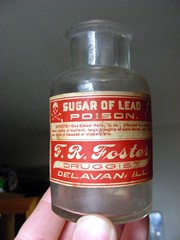

Horror of horrors - the Romans used lead to sweeten their fruit. No wonder Rome fell! Except that I was willing to read a 1883 paper (in German with healthy helpings of Greek and Latin) to discover that it may be lead and it may be sweet, but the lead doesn't lead it to be sweet.
In a time when mercury was regularly used as a remedy for maladies as serious as syphilis and as commonplaces as constipation, it doesn’t surprise me that lead compounds were in the pharmacopeia. (In all fairness, some modern antibiotics and most chemotherapy agents are at least as toxic as these less old remedies; they just have a better risk-benefit ratio.) Sugar of lead, or as it’s called in the 19th century medical literature, saccharum saturni, is lead acetate: Pb(CH3COOH)2. It was once prescribed for intestinal troubles, an odd choice, since one symptom of acute lead poisoning is an upset stomach. Lead poisoning is also known as painter's colic.
Sugar of lead really is sweet, roughly as sweet per spoonful as sugar. In the 18th and 19th century, lead shot was often dropped into bottles of port, purportedly to make it sweeter - though the more likely effect is anti-bacterial. Why? Lead does dissolve well in alcohol and juices (crystal decanters to store your port are a bad idea) - but I can't find anything that suggests solutions of lead ions are sweet.
The Romans were reputed to use lead acetate as a sweetener. They produced a syrup called sapa by boiling down mildly fermented grape juice in kettles made from lead alloys. (The hydrates of lead acetate are far less soluble in alcohol solutions - you are more likely to get a suspension of crystals in the syrup.) I am suggesting that it’s unlikely that the syrup was sweet because of the lead acetate it certainly contained. An 1883 analysis of sapa produced according to recipes dating from the classical Roman period, in kettles of similar metallic content to those found at Pompeii and other sites, suggested that the lead content of sapa was roughly 850 mg per liter. The equivalent amount of table sugar would be roughly a teaspoon - hardly enough to taste sweet in a liter of liquid. On the other hand, the sugars (glucose and fructose) in the concentrated grape must are the equivalent of 1 cup of table sugar per liter and would certainly swamp any sweetness coming from the lead acetate. It's still not all that sweet. To get a sense of how sweet this is, simple syrup, which has similar culinary uses to sapa, has about 4 cups of sugar in a liter.
I still wouldn't use sapa to poach my pears, but I think it unlikely that the sweet taste of sapa has much to do with lead.
Photo is c. 2009 John4kc. Used with permission.
Anti-Archimedes
The recipe for pulled pork called for 1/2 cup of brown sugar to be dissolved into 1 1/2 cups of apple cider vinegar. What I had in the cabinet was solid as a rock - there was no way I was packing this into a measuring cup. (Yes, I know I could have done this in the microwave...) My scale came to the rescue. I hacked off chunks until I had the correct mass of brown sugar (110 grams more or less). I dumped the three large hunks into the vinegar in a 2 cup glass measure, and noted that the total volume was just about 2 cups. Nice job.
Then I stirred it to dissolve the sugar. And watched the volume decrease to just over 1 1/2 cups of solution! Have I just proved Archimedes wrong? The volume of sugar at first seemed to have displaced the equivalent volume of liquid, but then seemed to vanish...well not exactly into thin air, but vanish nonetheless. As my 15-year old might say, "What's up with that?"
Yes, Archimedes was correct, but his theory did not address substances that dissolve in the liquid. This is a good demonstration of how much "empty "space is in a liquid. The sugar molecules (and other things in brown sugar, which is not terribly pure as chemicals go) insert themselves between water molecules, without needing to push the water molecules further apart. To a good first approximation the volume of a solution made from a solvent and soluble solid is the volume of the solvent used, not the sum of the two volumes.
Try it...it's fun to watch, and it still intrigues me to think about the amount of unused space there is in a liquid that seems so substantial at the macroscopic level!
The pulled pork was a keeper...though the kids found the BBQ sauce too spicy for their taste. Try it on challah rolls!
Then I stirred it to dissolve the sugar. And watched the volume decrease to just over 1 1/2 cups of solution! Have I just proved Archimedes wrong? The volume of sugar at first seemed to have displaced the equivalent volume of liquid, but then seemed to vanish...well not exactly into thin air, but vanish nonetheless. As my 15-year old might say, "What's up with that?"
Yes, Archimedes was correct, but his theory did not address substances that dissolve in the liquid. This is a good demonstration of how much "empty "space is in a liquid. The sugar molecules (and other things in brown sugar, which is not terribly pure as chemicals go) insert themselves between water molecules, without needing to push the water molecules further apart. To a good first approximation the volume of a solution made from a solvent and soluble solid is the volume of the solvent used, not the sum of the two volumes.
Try it...it's fun to watch, and it still intrigues me to think about the amount of unused space there is in a liquid that seems so substantial at the macroscopic level!
The pulled pork was a keeper...though the kids found the BBQ sauce too spicy for their taste. Try it on challah rolls!
Cold as Ice
This article in the Atlantic monthly caught my eye, if only because it included an experiment and less because of my refined palate. Wayne Curtis is writing about the unsung hero or villian of mixed drinks: ice.
 Take a mixture of ice and water that has been thermally isolated (put in a thermos!) and allow it to come to thermal equilibrium (let it sit until the temperature doesn't change any longer). When the contents of the thermos reach equilibrium, if there are both ice and water present, the temperature is 32 degrees (Fahrenheit). It does not matter how cold the ice was to start, how much water is present, how warm or cold the water was - it will be 32 degrees. Not 40. Not 34.
Also known to those who know how to read a phase diagram, ice at normal pressures will not start to melt until it reaches 32 degrees, and its temperature will not rise above 32 degrees until it has all melted. Curtis' experiment isn't quite as sophisticated as the thermos one I've sketched out, but assuming that the rate of heat loss to the room was small (air - or any gas - isn't a very good thermal conductor, so over the short term this is not a bad assumption), and that the ice and water used were pure, and that a very large amount of water was used relative to the ice - I find it untenable that the "cheater-ice" cocktail is different in temperature than the one made with less porous ice. More watery, yes, colder, no.
Photography by Sue Stafford. Used under Creative Commons license.
"I went into the kitchen with another bartender, Stephen Cole, who hunted up a scale and thermometer. He placed the two kinds of ice into separate cups filled with water. We let them sit for 10 minutes. The cheater-ice water proved to be colder (34 degrees compared with 40 degrees), but the ice had lost a full quarter of its weight, compared with just a 14 percent loss in the chunk ice. A cheater-ice cocktail is thus chillier (numbing the taste buds) and more watery (making it flat)."He describes a bar which stocks eight different types of ice - though the classification system is not quite what a physical chemist might use - or even Kurt Vonnegut. I suspect, however, a serious flaw in the experiment, and therefore in the conclusions drawn about the effect of ice type on a drink.
 Take a mixture of ice and water that has been thermally isolated (put in a thermos!) and allow it to come to thermal equilibrium (let it sit until the temperature doesn't change any longer). When the contents of the thermos reach equilibrium, if there are both ice and water present, the temperature is 32 degrees (Fahrenheit). It does not matter how cold the ice was to start, how much water is present, how warm or cold the water was - it will be 32 degrees. Not 40. Not 34.
Also known to those who know how to read a phase diagram, ice at normal pressures will not start to melt until it reaches 32 degrees, and its temperature will not rise above 32 degrees until it has all melted. Curtis' experiment isn't quite as sophisticated as the thermos one I've sketched out, but assuming that the rate of heat loss to the room was small (air - or any gas - isn't a very good thermal conductor, so over the short term this is not a bad assumption), and that the ice and water used were pure, and that a very large amount of water was used relative to the ice - I find it untenable that the "cheater-ice" cocktail is different in temperature than the one made with less porous ice. More watery, yes, colder, no.
Photography by Sue Stafford. Used under Creative Commons license.
Grapes of Wrath
My youngest came home from a father-son event with a new interest in healthy foods. I put grapes on the table with dinner. "There are grapes for dinner," he exclaimed. Who are you and what have you done with son? ran through my mind.
At the end of dinner he puts two grapes on his plate and carefully cuts them nearly in half. Then he ducks into the kitchen. "Come on, Mom!" Warm grapes? He'd eaten all the chicken, there was nothing left on his plate to veronique.
He hits the start button and suddenly the grapes start arcing, and one actually bursts momentarily into flame. I'm stunned. No metal, but the arcing is clear. We try various experiments - do you have to leave the grapes connected (no), does it work with other things (carrots), can you char a grape (yes).
What's going on? Hang on, we were producing plasmas in the kitchen. Not the kind that circulates in your veins, but the kind that stars are made out of. Plasma is often called the 4th phase of matter - the iconic triad being solid, liquid and gas. (There are many other phases in which substances can exist, in fact - such as liquid crystals and supercritical fluids.)
Plasmas are gases in which a large number of electron are "free", rather than associated with a molecule or atom.
I'm still trying to come to grips with the idea that I can create a (very tiny) ball of plasma in my kitchen.
(Read more in the paper : "Microwave Mischief and Madness" by H. Hosack, N. Marler, D. MacIsaac of Northern Arizona University, The Physics Teacher 40, 14 (2002).
Subscribe to:
Posts (Atom)