Field of Science

Showing posts with label food chemistry. Show all posts

A chemistry decoder

A basic guide to decoding organic compound names
© Andy Brunning/Compound Interest
The August 17th edition of C&EN — Chemical and Engineering News, the American Chemical Society's weekly newsmagazine — was devoted to the intersection of chemistry and the internet.  I have a piece in there on the ways in which the internet allows pseudoscience to spread and what chemists might do to counteract the spread.  I point to Andrew Noymer's work on the mathematical modeling of rumor spread, which suggests that rumors and autocatalytic reactions such as the classic Lotke-Volterra systems are not dissimilar.

Noymer's results suggest that damping down the spread of rumor requires both persistent debunking and increased resistance among the susceptible population.  Though at first glance it seems counterintuitive, just periodically debunking rumors leads to a steady state situation, where there is always a (not so small) part of the population who believe.  Debunking needs to be strong and regular, and even then, if you don't have a resistant population, you land in a steady state regime.  The best you can do is to reduce a rumor to something that periodically breaks out.  Like the "Mars will be as big as the Moon in the sky!" meme which you see circulating on social media every summer like clockwork.  (Spoiler alert: It wasn't. It won't be.  Ever.)

What does it take to make a population resistant to pseudoscience?  Some tactics are not unique to the pseudoscience issue:  teaching critical thinking (as Phil Plait points out and Joel Achenbach implies here). Slower fingers when it comes to hitting "share." But it also means giving the population some basic tools for reading science.  After the Royal Society of Chemistry released a large study of the public awareness of chemistry, I wrote that it might be helpful if instead of periodic tables, chemists handed out a cheat sheet for decoding chemical names.  I wished and voilà, the brilliant Andy Brunning of Compound Interest created this graphic.  Print it out and post it in your kitchen.  Link to it on Facebook.  Browse the rest of his collection.  Buy his forthcoming collection about the chemistry of food and give it to the family member who keeps sending you links to the Food Babe.

Most all, talk about what you do as chemist, debunk garbage science when you hear it, swiftly and without mocking, and grab as many opportunities as you can to help people learn to decode chemistry on their own.

Eating periodically: is there thallium in your wasabi?


Wasabi, Iwasaki Kanen 1828
via Wikimedia Commons 

Could your wasabi peas be poisoning you?  Short answer. Maybe.

Delish recently posted an article on thallium — a highly toxic metal — in kale, the quintessential healthy green.  The Internet relished the irony of finding toxic metals in the highly touted greens. The piece points to an article in Craftsmanship magazine, which attempts to make a link between consumption of kale and thallium levels.  This is not new news.  There are dozens of reports, going back two decades, in the scientific literature of thallium in cruciferous vegetables, such as kale and brussell sprouts — and wasabi.

Thallium is definitely a nasty element, and has an infamous history of use as a poison in fact and fiction, starting with Ngaio Marsh's Final Curtain.  Read Deborah Blum's hair-raisingly fascinating Poisoner's Handbook (or her short article at Wired about a recent murder case in Princeton).  But as with everything, dose makes the poison, and the amounts of thallium in plants vary widely depending on the concentrations in the soil.  In highly contaminated soils, plants can contain enough thallium to be hazardous.  But if such highly contaminated soils were widespread, we'd have seen the effects already. (See this paper for some background.) (Also, you can leverage this ability and use it to clear out the thallium from a contaminated area.)

So how does thallium get into the plants? There is some evidence that thallium ions travel the same pathways as potassium ions (which play key roles in plant metabolism), and so might find their way into plants (and animals) though similar processes.

Thallium is also in the same column as boron, and elements in the same column of the periodic table often have similar behaviors, because their electrons are arranged in similar patterns.  For example, strontium, which is underneath calcium, sneaks into the body by way of the same processes calcium does. Boron is found in plants (coffee is a good source, and plants in the same family as kale are also heavy absorbers of boron); it is believed to be critical to cell wall formation.

And if there is boron and thallium, indium - in the same column is another likely companion. And yes, indium has been detected in plants in the cabbage family.  

As always, eating a wide variety of things is good advice, and it's key to remember that "natural" is not the same as "safe."

Eating periodically (not a quantum diet)

What elements are in chocolate?

Answer #1

Carbon (Chocolate)
Hydrogen (CHocolate)
Oxygen (ChOcolate)
Holmium (CHocolate)
Cobalt (ChoColate)
Lanthanum (ChocoLate)
Astatine (Chocol(ChocolAte)
Tellurium (ChocolaTe)

So you could have: CHoCoLaTe or CHOCOLate or....

Answer #2

(Presuming the letters are not required to be used in order - and yes, I wrote a piece of code to give me this for any word)
All of the above and
aluminum (Al), chlorine (Cl), calcium (Ca), cerium (Ce), helium (He), actinium (Ac), Technetium (Tc), thorium (Th), thallium (Tl) and tantalum (Ta)

Answer #3

Elements that have been detected in chocolate (in this case dark chocolate, rough percent of my recommended dietary allowance in parentheses assuming I eat only a 100 gram bar).

Carbon, hydrogen, nitrogen, oxygen, potassium (why cocoa is detectably radioactive), calcium (about 5% of my RDA), iron (125%), magnesium (70%), phosphorous, potassium (almost a gram, 20%), sodium, zinc (40%), nickel, sulfur, silicon, cadmium, lead (yep, lead, mostly from dust contamination during transport), mercury, arsenic, uranium (trace amounts, but yes, more radioactivity), aluminum, copper (from pesticides, but on the plus side gives you your RDA for this element), and manganese

Nearly one fifth of the known elements have been detected in chocolate, which clearly should be the backbone of any periodic diet.

What other elements are you eating?


Just in case your chocolate doesn't have enough radioactivity for you:

Say that again? Why chemical names tangle on the tongue

Michael Pollan's Food Rules famously advises not eating anything with an ingredient a 3rd grader can't pronounce.  The rule is more about eating closer to the production point, about consuming things that are familiar to 3rd graders (like broccoli and eggs), than it is that chemicals that are hard to pronounce are inherently hazardous, though in some corners it's taken on just that sort of magical thinking.

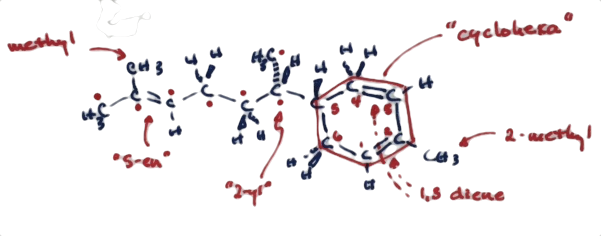
Why are chemical names so weird looking? Take 2-Methyl-5-(6-methylhept-5-en-2-yl)cyclohexa-1,3-diene for example.  It certainly doesn't sound like anything you would want to eat, but it is just the formal name for the compound that is the main component of ginger oil, and responsible for much of ginger's characteristic bite.  Like crystallized ginger, ginger tea, or a good stir fry?  You've eat this compound in significant quantities.

Chemical names can look like alphabet soup, but they are a way for chemists to paint a compact picture of the structure, or at least to point out key structural features.  Why is it so important to know what a molecule looks like?  The structure of a chemical is what determines its behavior, how it will react, in the body and in the environment.  It's key to understanding how things work on the molecular level:  structure determines function.  Period.

Formal chemical names, called IUPAC names (for the International Union of Pure and Applied Chemists, the body that decides on everything from what new elements will be called to the standards for drawing molecules), are in fact a code from which the full structure of the molecule can be unraveled.  Most of the time chemists call chemicals by a common name, which also gives clues to the structure, though not so many that the molecule could be unambiguously drawn.

So back to 2-Methyl-5-(6-methylhept-5-en-2-yl)cyclohexa-1,3-diene, which looks like


The "methyl"s (METH-ill) in the name refer to a CH3 group. What, you don't see any CH3's here?  This is a chemical line structure, where each intersection point (or end of a line) is a carbon atom, and the hydrogen atoms have almost all been left off.  A chemist sees this structure as 

with the methyls at either end.  The little red dots count off a seven membered chain, the "hept" in the name. The "cyclohexa" (sigh-clo-HEX-uh) points to a six membered ring, while "diene" (DIE-een) means it has two double bonds in it. The numbers tell you where to attach methyls and draw the double bonds.  The little "2-yl" (too-ill) means the seven membered chain is linked to the six membered ring at the second carbon in line.

So these tangled names to a chemist are codes, and once you can read the code, even a bit, you can begin to see a molecule taking shape in your mind when you read its name.

This pronounces as 2-METH-ill / 5, 6-METH-ill-hept 5 een 2 ill cyclo HEX uh 1 3 DIE-een.

There's probably a reason this is better known as zingiberene, which suggests its common origin (ginger or zingiber), but not much about its structure.

Formaldehyde: not just for dead things

Next spring I'm teaching a course on the physical chemistry of food while a colleague is teaching a course on the analytical chemistry of foodstuffs.  Among other science texts we'll be using John Coupland's Introduction to the Physical Chemistry of Food, but I'm also collecting short pieces to put some of the work into a historical and social context.

These aren't actual biological specimens preserved
in formaldehyde, but Halloween decorations.  
Though these days we tend to think of chemists as the untrustworthy creators of toxic, artificial everything, the systematic training of chemists was driven in part by the desire for the public to know what was in their food and water.  In 19th century Britain, hundreds of chemists made their living testing the purity of everything from butter to well water.  So when the Food Babe tells you there is something "yucky" in your food, the reason we know it is there is some chemist developed a careful protocol for its analysis, and other chemists tested the material.
Molecular structure
of formaldehyde


I've been thinking about formaldehyde, one of the simplest organic molecules (to a chemist, organic means made up mostly of carbon and hydrogen atoms, and has nothing to do with whether the molecule is synthetic or natural or...). Last year, formaldehyde, which is a preservative, was in the news because Johnson & Johnson had agreed to remove it from baby shampoo, though as Matt Hartings and Tara Haelle clearly pointed out in a piece at Slate, it was in such low concentrations that it posed no risk to babies (who, they point out, themselves contain substantial amounts of formaldehyde.)

Pepsi is reformulating Diet Pepsi to take out the artificial sweetener aspartame. The Food Babe is crowing that she and her army have forced Kraft to remove the so-called coal tar dyes (e.g. tartrazine/FD&C Yellow 5), to be replaced by natural colorings from spices.  What does all this have do do with formaldehyde?

From the Food Babe's 'campaign' literature.

To start with those natural colorings - at least one of them used in the UK version of mac and cheese, beta-carotene, isn't extracted from natural sources but synthesized from petroleum feedstocks (just like those coal-tar dyes).  One of the starting materials:  formaldehyde. The other natural colorings on the table — annatto, turmeric and paprika — are not quite what you might think either.  While you might imagine shaking in some spices from a quaint bottle, the spices themselves are not used as colorants, the colorants are extracted using organic (not that kind of organic, the chemist's kind of organic) solvents, such as ethyl acetate.  It's unclear to me why these colorants, particularly beta-carotene pass muster with the Food Babe.


Aspartame is sometimes vilified because it is metabolized into methanol and formaldehyde in the body.  Which it is.  You already contain a lot of formaldehyde, about 12 milligrams per liter of fluid in your cells.  One source is metabolism of the amino acids, particularly, serine and glycine (in naturally occurring proteins), from which your body scavenges methyl groups (CH3) to pop on to various structures.  Aspartame is a very tiny protein, so the same pathways that produce methanol and formaldehyde from natural sources, dismantle aspartame to yield methanol and formaldehyde, though the amounts produced are tens of times lower than what comes from eating apples and fish.

Because formaldehyde occurs naturally in foods (about 5 mg per serving in some fruits, fish is also high, pectin containing fruits such as apples add significantly to the amount of formaldehyde ingested), our bodies have a mechanism for dealing with it, we process about 60 to 100 grams of formaldehyde a day and do so quickly.  Formaldehyde has a half-life of about 1 to 2 minutes in the body.


Why are those spices colored?  What does it have to do with quantum mechanics, flamingos and canaries?  Read this post, the very first one written for the blog,  to find out.

References
EFSA report on endogenous versus exogenous sources of formaldehyde.
EFSA review of curcurmin, a component of turmeric, which had been suspected of being genotoxic.