Field of Science

Weird Words of Science 8: Ligands, the ties that bind


Many transition metals react with bases (such as ammonia) to produce beautifully colored transition metal-ligand complexes. The word ligand comes from the Latin ligare which means to tie or bind. The same root leads to ligaments, which tie your bones together.

The photo shows green Ni(H2O)62+ and blue green Ni(NH3)62+. The ligands are water and ammonia respectively, "tied" to the Ni(II) center. The ligands form an octahedron around the metal center.

Trojan Horse Molecules: Penicillin


Penicillin was one of the first antibiotics in wide use. It was discovered in the late 19th century by a French medical student (Ernest Duchesne), though his work was never pursued. Fleming independently discovered the antibacterial activity of Penicillium mold derivatives in 1928. The active molecule was difficult to extract. The compound was finally synthesized in 1957 by John Sheehan, a chemist at MIT. This feat was made possible by the determination of penicillin's structure in 1944 by Dorothy Crowfoot Hodgkin, an X-ray crystallographer who won the 1964 Nobel prize in chemistry for that discovery and many others (including B-12 and insulin).

How does penicillin work? It is a Trojan horse molecule. Penicillin disrupts the synthesis of bacterial cell walls, thus inhibiting the bacteria's reproduction. The enzyme responsible for assembling the cell walls picks up penicillin, thinking it can incorporate into the wall. Unfortunately for the bacteria, the penicillin molecule opens up and destroys the enzyme's ability to function.

The key step in this sneak attack is the nucleophilic attack of the enzyme onto an electrophilic site on the four-membered β-lactam ring. We've been discussing these reactions in my general chemistry class this week.


Watch this webcast if you want to see how the reaction works and learn a bit about nucelophilic reactions.

Elemental Tales: Get the lead out!

Workers manufacturing the pigment white lead (Pb(OH)2.2PbCO3 apparently made a habit of adding dilute sulfuric acid to their drinking water to prevent lead poisoning. The reaction of the sulfate ions (SO42-) with the aqueous lead ions (Pb2+) forms an insoluble precipitate of lead sulfate, effectively removing the lead from the water (as long as you let the precipipate settle before drinking!). This risk of lead poisoning in these workers was so high that it was referred to as "painter's colic".

van Gogh's Palette

In an attempt to brighten a dreary Philadelphia day, I pulled out a coffee mug that glows with Vincent van Gogh's sunflowers. Among the most vivid of his favorite pigments is chrome yellow. Chrome yellow was first isolated from a natural source (the mineral crocoite) in the late 18th century by Parisienne chemist Vauquelin. By the late 19th century, when van Gogh's sunflowers took form, the vibrant yellow was one of a series of new and exceptionally vivid colors. Chrome yellow is actually a lead salt, lead chromate (PbCrO4. The pigment isstill used today but it has been replaced in many cases by similarly colored, less toxic organic pigments. Unfortunately chrome yellow degrades over time, so that the once brilliantly glowing sunflowers now appear to be dry, drab ocher shadows of van Gogh's vision.

Perhaps influenced by the mug, this week's webcast general chemistry example problem is based on a simple inorganic synthesis of the chrome yellow pigment. One of my colleague's uses another synthesis. in her course on "The Stuff of Art"


Read more about the history and chemistry of color in Bright Earth: Art and the Invention of Color by Philip Ball.

Making a Mark

My interest in MRI has become less academic. I need an MRI of my hand. The orthopedic surgeon noted in passing that they will mark the spot of interest with a capsule of vitamin E, in the same way that they use lead markers in X-rays. I wondered what was so special about the vitamin E that left a trace in the MRI. Turns out that the spin-lattice relaxation time (T1) of the H's in tocopherol's chain of -CH2s is very short, and provides a high intensity signal which can be used to mark the spot. Mineral oil will work, too, but the vitamin E capsules are convenient.

A Magnetic Moment

The Culture of Chemistry welcomes 2006 - now that the grading is done and vacation has begun for me in earnest.

Graham at "Over My Med Body" notes that the total radiation dose in a year from natural background sources is much larger than the dose from any single test. He notes that ultrasound and MRIs are exceptions: ultrasound uses sound waves, and MRIs use magnets. What exactly do those magnets do?

The nuclei of many atoms have "spin" states. Like quarks which have a property called by physicists "color" but are not actually different colors like socks, spin is an instrinsic property of nuclei but this does not necessarily mean that the atoms are spinning like the earth! Hydrogen atoms, of which there are many in the human body (more than 10 pounds worth) have two spin states. Not every atom has multiple spin states. Carbon-12 (the most common form of carbon) has only one spin state. So what happens in an MRI? Radiation (yes, radiation, just very, very low energy radiation) in the form of radio waves forces the hydrogen nuclei to change state to the higher energy spin state. The time it takes for the hydrogens to relax to their low energy spin state is measured. There are two ways for the hydrogen atom to "lose spin", one is called spin-lattice relaxation (T1), the other is spin-spin relaxation (T2). Hydrogen atoms in different environments relax at different rates. Hydrogens in fatty tissue, for example, have very different relaxation times than watery tissue.

So if the changes happen because of radiation, what are the magnets for? It turns out that the separation between spin states depends on the magnitude of the magnet field, as well as the magnetic moment of the nucleus. In the earth's field, the energy between spin states is too small to do the trick of exciting them up to the higher energy state and watching them fall down. You need a high magnet field to do this.

Mysteries Revealed

We're discussing NMR (nuclear magnetic resonance) in physical chemistry this week. It's a standard technique for determining molecular structure in organic chemistry. (The same quantum mechanics is the basis for MRI.) Bloch and Purcell won the Nobel prize in 1952 for their pioneering work in NMR. The opening to Purcell's Nobel lecture is almost poetic in its intensity:

Professor Bloch has told you how one can detect the precession of the magnetic nuclei in a drop of water. Commonplace as such experiments have become in our laboratories, I have not yet lost a feeling of wonder, and of delight, that this delicate motion should reside in all the ordinary things around us, revealing itself only to him who looks for it. I remember, in the winter of our first experiments, just seven years ago, looking on snow with new eyes. There the snow lay around my doorstep - great heaps of protons quietly precessing in the earth’s magnetic field. To see the world for a moment as something rich and strange is the private reward of many a discovery.


I wonder if I have a richer view of the world for knowing something of its underlying structure? And how often do I stop to think about it?

From the small to the large


Nanoscience deals with the very small - hence the name from the Greek for "dwarf". Dimensions are often given in Angstroms. Interestingly, the man who gives his name to the very small, in fact studied the very large. Anders Angstrom (1817-1874) was a Swedish spectroscopist. In 1853 he published a careful study of the spectral lines for hydrogen, which was subsequently used by Balmer to develop his equation predicting atomic spectra. In 1867 he published a spectroscopic investigation of the aurora borealis (the first such), and a year later a large volume detailing more than 1000 solar spectral lines. Angstrom was the frist to observe hydrogen in the solar atmosphere. 1 angstrom = 0.1 nanometers.

Periodic Tales from the BBC


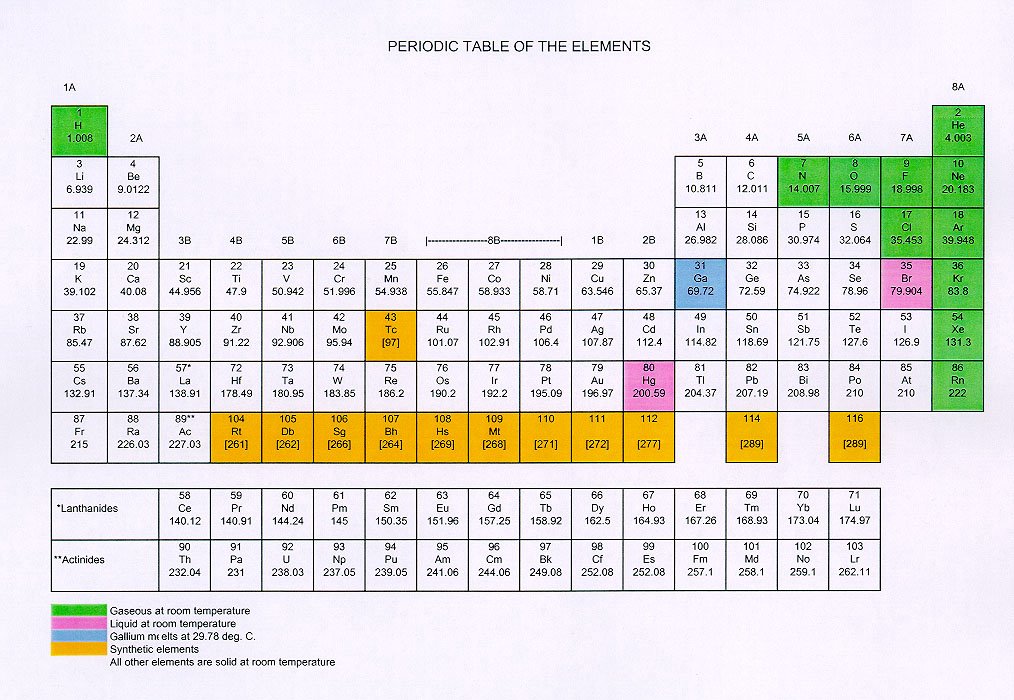
The BBC is airing short features on ten elements, ranging from krypton to cobalt. Each one minute segment is interspersed with clips from Tom Lehrer's song "The Elements". Enjoy!


Periodic Tales at the BBC.

Radar and the chocolate bar

Early in 1940, two British engineers, Harry Boot and John Randall, working under Australian physicist Mark Oliphant built a cavity magnetron, an efficient device for producing high power microwaves as part of an effort to develop better radar detection systems. In this they were eminently successful. By the middle of the year, radar could be used to locate a submarine periscope at six miles. After World War II ended, research on magnetrons continued. In 1946 Percy Spencer, an engineer working at Raytheon, walked through a room in which a magnetron was being tested and noticed that the chocolate bar in his pocket had melted. It occurred to him that the microwaves being generated by the magnetrons could be used to cook food. The next day he placed unpopped popcorn near an operating magnetron, and watched as fluffy white kernels flew around the room. He then tried to cook an egg in the shell, which cooked so quickly it blew up in his colleagues face. Raytheon and Spencer patented the microwave oven in 1950, arguing that it provided a tasty and more sanitary popcorn product. Microwave popcorn is now a ubiquitous part of lab life. In fact, researchers using physical chemistry to develop corn that pops better in the microwave!

Spencer never completed elementary school, but made major contributions to the development of magnetrons for radar and other applications.


Photo of Percy Spencer
Slide show about the microwave patent from PBS History Detectives.

: : :