Field of Science

Showing posts with label etymology. Show all posts

Weird words of science: scientist

Woman teaching geometry to men
illus. 14th century copy of Euclid's Elements
Scientist may not sound like a weird word, but when it was first coined, it was thought "unpalatable," along with (understandably) "nature-poker." Recently my sister tagged me in a Facebook post linking to a series of articles on women in science. She thought it interesting that the word had been coined to honor the work of a woman in science.
"Not only did Scottish mathematician, science writer, and polymath Mary Fairfax Somerville (December 26, 1780–November 28, 1872) defy the era’s deep-seated bias against women in science, she was the very reason the word “scientist” was coined: When reviewing her seminal second book, On the Connexion of the Physical Sciences, which Somerville wrote at the age of 54, English polymath and Trinity College master William Whewell was so impressed that he thought it rendered the term “men of science” obsolete and warranted a new, more inclusive descriptor to honor Somerville’s contribution to the field." — from Maria Popova and Lisa Congdon's 2013 project The Resurrectionists
Oddly enough, I'd read William Whewell's review of Somerville's On the Connexion of the Physical Sciences while writing an essay about the public conception of scientists, and my recollection was that the coining of scientist, while reported in this review, was not in fact spurred by Somerville's work.  So I went back and read it again.

Whewell was certainly impressed with Somerville and her book, but his tale of the creation of the word 'scientist' makes no mention of honoring Somerville or her contribution.  About the only person Whewell seems impressed with in this context is the "ingenious gentlemen," thought to be himself!
A curious illustration of this result maybe observed in the want of any name by which we can designate the students of the knowledge of the material world collectively. We are informed that this difficulty was felt very oppressively by the members of the British Association for the Advancement of Science, at their meetings at York, Oxford, and Cambridge, in the last three summers. There was no general term by which these gentlemen could describe themselves with reference to their pursuits. Philosophers was felt to be too wide and too lofty a term, and was very properly forbidden them by Mr. Coleridge, both in his capacity of philologer and metaphysician ; savans was rather assuming, besides being French instead of English; some ingenious gentleman proposed that, by analogy with artist, they might form scientist, and added that there could be no scruple in making free with this termination when we have such words as sciolist, economist, and atheist—but this was not generally palatable; others attempted to translate the term by which the members of similar associations in Germany have described themselves, but it was not found easy to discover an English equivalent for natur-forscher. The process of examination which it implies might suggest such undignified compounds as nature-poker, ornature-peeper, for these naturae curiosi; but these were indignantly rejected." [from the Quarterly Review, 1834, emphasis mine]
Interestingly, Wherwell does tackle the issue of women in philosophy/science:  "Our readers cannot have accompanied us so far without repeatedly feeling some admiration rising in their minds, that the work of which we have thus to speak is that of a woman."  It's a fascinating read, in which you can see the threads of imagery that is still current (and still unsupported by data) about the innate differences between the minds of men and women.

And in the end, scientist would catch on, by the early 20th century it was far eclipsed "natural philosopher" as the preferred general term.

Chemists are wildly polysemous

STO-3G//STO-3G calculated Raman spectrum of arsole
A few months ago this BBC news report - about the evacuation of a building because of a volatile compound got chemists on Twitter talking about language, particularly those words that mean one thing to chemists and something quite different to the rest of the world.  (Thanks @NatalieFey_NLS, ‏@stephengdavey and @stuartcantrill!) Like volatile (high vapor pressure vs. explosive) or to my mind the most overexposed chemical example and the inspiration for far too many t-shirts: mole.  One thing led to another, or at least, one comment by @stuartcantrill led to my Thesis column in  this month's Nature Chemistry.
Is RT retweet or 2.5 kJ/mol?

This piece was pure fun to write.  I enjoyed crowdsourcing examples of chemical double meanings. (List of 200 examples is here.) By far the favorite mechanism of formation for chemists is polysemy, where words share a common ancestor, but the meanings have drifted apart.  Take flush, as in flush a column, or flush a toilet or  flush game or even a straight flush.  All these senses derive from the Latin fluxus for flow.  (Don't see the connection to poker? The OED suggests you think of a flush as a "run" or flow of cards.)

Sometimes the two meanings sit close to the surface for chemists, other times we are pretty blind to the lexical ambiguity.  My youngest son is toying with the idea of a chemistry major, and when I read him examples from the list, he was quick to note both senses for many words: cell, salt, aromatic.  But when I got to molar, he wanted to know what else it meant beyond the concentration of a solution.  "Teeth?" I suggested.  He face palmed.  Whether he majors in chemistry or not, we've already messed with his mind.

Polysemy is productive — as the linguists would say — not just in terms of the language, but of new chemistry.  We ought not to discourage lexical play in chemists (not that one has much control over language in any case, IUPAC's gold book notwithstanding) it gives us a rich set of images to draw on and as I said in the essay, "we can't look for what our language doesn't let us imagine."


Read the essay here. ($)

Molecular Jek-yls and -hydes

Like Jekyll and Hyde, changing a functional group changes 
a molecule's behavior. Image from Library of Congress.
Chains of pure carbon and hydrogen, called hydrocarbons by chemists, are notoriously hard to get a chemical handle on.  One of the major driving forces in chemical reactions is "opposites attract" — in this case opposite charges.  Since carbon and hydrogen have essentially the same desire for electrons (negative charges), there is not much difference in charge around to drive a reaction. Swap out a hydrogen for something else that does have a relative charge —  chlorine, fluorine, oxygen, nitrogen — and suddenly you have something to react with.  Chemists call these riffs on a basic carbon framework "functional groups" - they are often the parts of a molecule's structure that drive its function.

Change up the functional group, and you change the molecule's behavior. Like Jekyl and Hyde.  Ethanol is something to drink on a Friday night, ethanal is found in the coffee you drink for the hangover the next morning (in an ironic twist, it's also produced as your body metabolized the ethanol.)

The first part of a chemical name tells the size of the carbon framework, the ending tells you about its function — or lack thereof.  Names that end in -yl or -ane mean a hydrocarbon chain without any fancy functionality.  Propane, a popular fuel, is a three carbon hydrocarbon chain.  Methyl mercaptan (added to odorless natural gas to make it smell, and make leaks quickly noticeable), has a one carbon long "chain" in it. Change -yl to -ol and you have made an alcohol, a chain with an -OH group on it (Ethanol is CH3CH2OH, sometimes written EtOH, a 2 carbon chain with an OH group on it.)

Knowing the functional groups means knowing something about the kinds of things a molecule can do.  Esters smell floral, carboxylic acids can remove a layer of skin, and are found in many lotions.

So to decode:
-ol means an alcohol (functional group = -OH) but not necessarily the kind of alcohol you drink 
-al means an aldehyde (-COH); these often smell sweetish 
-oxy means an ether (an oxygen sandwiched between two carbon chains) 
-oic acid or -ic acid means a carboxylic acid (pronounced "car-box-sill-ick") salicylic acid, often found in face washes 
-oate means an ester (a COO group sandwich between two chains); ethyl nonanoate smells like grape, the functional group is between a 2 carbon chain (ethyl) and nine carbon chain (nona) 
-one means a ketone, a CO group sandwiched in between two chains

Check out Andy Brunning's of Compound Interest's great graphic on functional groups and their names and Practically Science's map of molecules in food and their smells.

The Secret Language of Chemists: Why does butter make us think of four?

Butter and why it means "four" to chemists.
c. Michelle Shrank CC license
Every time I take a stick of butter out of the 'fridge I think of the number four.  No, it's not some odd form of synethesia, but a side effect of being a chemist.

Names of molecules and their structures are (sometimes) related to each other.  You can think of organic molecules (molecules that are principally built from carbon, hydrogen, oxygen and nitrogen) are constructed like Lego buildings.  There are blocks, each block has a name and you click them into place (that last isn't so simple in practice) to build a molecule. So knowing the secret language of chemistry gives you a window into the structure, which in turn is a clue how the molecule works and what it might be good for.

So why does butter make a chemist think of four?  The stem but — pronounced like "butte" the land formation  —  is used to indicate a four carbon building block.  It is a back-formation from butyric acid, responsible for the smell of rancid butter, which has four carbons in it.  (Butane, a flammable liquid used in lighters, is a four carbon chain.)

The rest of the secret code:

meth- 1 carbon
another back-formation, this time from methanol (wood alcohol) from the Greek root for wine (μέθυ ≡ methy)

eth- 2 carbons
from the Greek, ether, the uppermost reaches of the atmosphere; as seen in ethylene (the sweet smelling flammable gas produced by ripening fruit, particularly bananas.  It's technically a hormone!)

prop- 3 carbons
This one also comes from the Greek (surprise!) for proto and fat, as propionic acid was the first "fatty acid" (acid molecules that also behave like fats or oils); propane gas used in stoves and grills has three carbon atoms and 8 hydrogen atoms per molecule.

but- 4 carbons
From the rancid butter!

after four the prefixes are derived directly from the numbers in the chain
pent- 5
hex- 6
hept- 7
oct- 8
non-  9
dec-10
undec- 11
dodec- 12

So when you see references to the food additive BHA, which stands for butylated hydroxyanisole, one thing you can say about it is that it has a four-carbon unit in it somewhere.  Though, I admit, that's not much help in answering the important questions: What does it do, and how will affect me?


Chemists' Magic Decoder Ring

What if we gave out chemical name
decoders instead of periodic tables?
Vintage magic decoder ring.
Used under CC license. Source.

Earlier this week the Royal Society of Chemistry released a report on the public perceptions of chemistry.  It's a great set of data for those of us who write and talk about chemistry outside of the classroom environment. This infographic sums up the key findings, one of which is that people lack confidence in talking about chemistry.

Stuart Cantrill, chief editor of the journal Nature Chemistry (full disclosure, I contribute regularly to the editorial content of the journal), noted in the discussion which followed the presentation that chemistry uses a very "specific technical language...if you're not talking the same language as someone you are talking to, they can't engage with you...it's almost like a secret language that only chemists know." (Listen here starting at 25:45)

It made me wonder if we should hand out a cheat sheet on how to decode chemical names and functionality instead of the traditional and iconic periodic tables at events. It might make for less splashy t-shirts or shower curtains, but then again, Andy Brunning of Compound Interest makes amazing graphics on all sorts of chemical themes.

Next post:  the secret language of chemists and why butter makes me think of four!

Say that again? Why chemical names tangle on the tongue

Michael Pollan's Food Rules famously advises not eating anything with an ingredient a 3rd grader can't pronounce.  The rule is more about eating closer to the production point, about consuming things that are familiar to 3rd graders (like broccoli and eggs), than it is that chemicals that are hard to pronounce are inherently hazardous, though in some corners it's taken on just that sort of magical thinking.

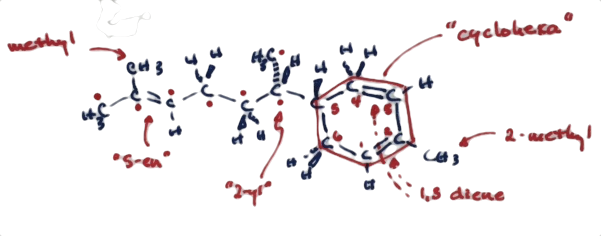
Why are chemical names so weird looking? Take 2-Methyl-5-(6-methylhept-5-en-2-yl)cyclohexa-1,3-diene for example.  It certainly doesn't sound like anything you would want to eat, but it is just the formal name for the compound that is the main component of ginger oil, and responsible for much of ginger's characteristic bite.  Like crystallized ginger, ginger tea, or a good stir fry?  You've eat this compound in significant quantities.

Chemical names can look like alphabet soup, but they are a way for chemists to paint a compact picture of the structure, or at least to point out key structural features.  Why is it so important to know what a molecule looks like?  The structure of a chemical is what determines its behavior, how it will react, in the body and in the environment.  It's key to understanding how things work on the molecular level:  structure determines function.  Period.

Formal chemical names, called IUPAC names (for the International Union of Pure and Applied Chemists, the body that decides on everything from what new elements will be called to the standards for drawing molecules), are in fact a code from which the full structure of the molecule can be unraveled.  Most of the time chemists call chemicals by a common name, which also gives clues to the structure, though not so many that the molecule could be unambiguously drawn.

So back to 2-Methyl-5-(6-methylhept-5-en-2-yl)cyclohexa-1,3-diene, which looks like


The "methyl"s (METH-ill) in the name refer to a CH3 group. What, you don't see any CH3's here?  This is a chemical line structure, where each intersection point (or end of a line) is a carbon atom, and the hydrogen atoms have almost all been left off.  A chemist sees this structure as 

with the methyls at either end.  The little red dots count off a seven membered chain, the "hept" in the name. The "cyclohexa" (sigh-clo-HEX-uh) points to a six membered ring, while "diene" (DIE-een) means it has two double bonds in it. The numbers tell you where to attach methyls and draw the double bonds.  The little "2-yl" (too-ill) means the seven membered chain is linked to the six membered ring at the second carbon in line.

So these tangled names to a chemist are codes, and once you can read the code, even a bit, you can begin to see a molecule taking shape in your mind when you read its name.

This pronounces as 2-METH-ill / 5, 6-METH-ill-hept 5 een 2 ill cyclo HEX uh 1 3 DIE-een.

There's probably a reason this is better known as zingiberene, which suggests its common origin (ginger or zingiber), but not much about its structure.

An element by any other name would smell as sweet


Elemental naming was as fraught in the 19th century as it can be today (though now the IUPAC has rules and committees). Alternate names and symbols for elements persisted not merely for decades, but in some cases more than a century.

I've recently skimmed a number of articles about glucinium (Gl). Not familiar? It has 4 protons and these days is known as beryllium for the gemstone beryl, in which it can be found. Beryllium salts can taste sweet, hence glucinium. Beryllium was suggested early on an option, since the sweet taste of its salts was not a unique characteristic. Other metals, including lead and yttrium, form sweet tasting salts. Still, in 1890 many authors were insisting that glucinium was the preferred name, suggesting that the arguments were continuing nearly a century after the initial discovery. It took more than 150 years for the chemistry community to settle on beryllium.

Other elements have endured dueling names, including colombium (now niobium) and the sounds-too-awkward-to-be-real jargonium (hafnium!).


In searching for an appropriate image, Google turns up lots of bathtubs, including this one. Not only does an antiquated elemental name appear in the description of this wild tub, but the term angstrom as well. Translation software, I'm sure, but what is being (mis)translated?

And I couldn't resist the post title, as one of my fellow Fellows at the Chemical Heritage Foundation is a Shakespeare scholar.

Weird Words of Chemistry: Frigorific


I ran across this word when my youngest, who I'm coaching for the thermodynamics event for Science Olympiad,asked me why the freezing point of water was 32o on the Fahrenheit scale. The Celsius/centigrade scale was originally pinned to the freezing point and boiling point of pure water at 1 atmosphere of pressure. (Now it's pinned to absolute zero and the triple point of water.) What physical property was 0o linked to? The freezing point of something other than water? I had to admit I didn't know and now that my curiosity was piqued, went off to hunt it down.

The zero of Fahrenheit's temperature scale was essentially pinned to the temperature of a "frigorific" mixture of ice, water and solid ammonium chloride in a 1:1:1 ratio, along with the freezing point of water and the temperature of the human body. Frigorific seems to have been coined by Robert Boyle to describe particles of cold that were transferred from body to body, and ultimately got attached to mixtures that achieved a particular temperature regardless of the starting temperatures of the materials. Wandering through the old chemistry literature, I found this table of frigorific mixtures "sufficient for all practical and philosophical purposes, in any part of the world in any season," useful in the days before refrigerators, still useful for those who need a constant temperature bath at low temperatures.

The size of a degree was set by bisecting the difference between the point at which ice and water were in equilibrium and body temperature six times, or 64 degrees (26). Binary was easier to use when you had to make your own instrument than decimal.

Frigorific has essentially vanished from the chemist's vocabulary, though it's still apparently alive and well in the engineering literature. As words of science go, it sounds awkward to my ears — as roughly sharp as heaved Arctic ice.


Nova has an excellent piece on the hunt for absolute zero. Thanks, Kathryn J for the reference!

For more on what I think about well-formed science words, you can read "Neolexia" at Nature Chemistry.

Writing Science: Science-speak - jargon or dialect?


How good is your ear? How does scientific language play in a piece written for a broad popular audience?

Writing prompt
You are headed for Mars, you may take 2 kg (not quite 4 and a half pounds) of personal gear. What would you take and why? Bear in mind that you will have varying gravity conditions during the trip. What could you not bear to run out of?

Reading
  • "Avoid Fancy Words" in Strunk, William, and E.B. White. The Elements of Style Illustrated. Penguin (Non-Classics), 2007. pp 111-113
  • "Do not use dialect unless your ear is good" in Strunk, William, and E.B. White. The Elements of Style Illustrated. Penguin (Non-Classics), 2007. pp 113
  • "Avoid Foreign Languages" in Strunk, William, and E.B. White. The Elements of Style Illustrated. Penguin (Non-Classics), 2007. pp 115
  • Carl Zimmer's list of words that should be banned from science writing (H/T ejwillingham)

Are scientists palatable?

In the early part of the 19th century, the word scientist had yet to be coined. As the scope of materials and phenomena that natural philosophers and historians dealt with increased, there was a growing sense that these terms were inadequate to describing the task of this new breed of inquirers. In the 1830s, the British Association for the Advancement of Science explored potential candidates, but ultimately rejected various proposed terms, including scientist:
"Philosophers was felt to be too wide and too lofty a term,..; savans was rather assuming,..; some ingenious gentleman proposed that, by analogy with artist, they might form scientist, and added that there could be no scruple in making free with this termination when we have such words as sciolist, economist, and atheist — but this was not generally palatable."
The need remained, however, and a decade later, William Whewell, a philosopher and biologist pushed the issue again: “We need very much a name to describe a cultivator of science in general. I should incline to call him a Scientist.” This time it stuck.

Once the name stuck, an image quickly became attached -- wild hair, lab coats and odd apparatus all became part and parcel of what it means to be a scientist. My most recent Thesis columnin Nature Chemistry -- Men of Mystery -- takes up popular images of scientists, and considers the impact the images might have on public discourse about science.

UPDATED: See Snail's Tails post about philosophy and philosophical instruments. The ad for the "philosophical instrument makers" is fascinating!

Unfortunate Acronyms: PUS

When I was lecturing on lasers this week, I was surprised to discover how many of my students were unaware that laser was an acronym (Light Amplification by Stimulated Emission of Radiation). Science is replete with acronyms - Ira Levine once essayed that if you knew enough acronyms you could pretend you knew computational chemistry - good, bad, really funny and occasionally unfortunate.

On my desk is a paper which refers (with as near as I can tell with a straight face) to "PUS research." Public Understanding of Science. I swear this is true.

If you've got a favorite one - funny, famous or truly unfortunate - leave it in the comments for all of us to enjoy...


Related Posts
Science in the kitchen: Jello lasers
Romancing the stone (steampunk lit and lasers)

Weird Words of Science: Azote

I was playing Scrabble online the other day and when a z materialized on my rack near the end of the game was desperate enough to try "azo". Good news, what I thought was chemist's shorthand, the dictionary thinks is a word. "Azo" has been part of my vocabulary since I was very young. My dad's graduate work was on azides - molecules that contain three linked nitrogen atoms (N3) tagged at the end and that are notoriously unstable (a fancy chemistry term for "could explode at any time" - at a dinner for his PhD adviser some 25 years later the number of people around the table lacking fingers was astounding). Azo compounds are molecular relatives of the azides - molecules that have an two linked nitrogens in the middle (R-N=N-R). Some azo compounds are brightly colored and generally they are more stable than azides.

As a rule of thumb, if you see "azo" in a compound's name, it's likely to have nitrogen in it somewhere. Why? French chemist Lavoisier dubbed the fraction of air that cannot support life "azote" from the Greek azotos: without + life. We now know that roughly 80% of the air we breathe is nitrogen gas - hence the connection between azo and nitrogen.

Lavoisier's alternate terms was "mephitic air" -- another Greek import, this time from the name of the goddess who prevented noxious smells from arising from sewers: Mephitis. Ironically, while many nitrogen compounds smell awful (dead fish anyone?), nitrogen gas, Lavoisier's mephitic air, is odorless. That goddess has lent her name to smellier pursuits though - the striped skunk's Latin name is Mephitis mephitis. I can personally attest to the smell.


Photo used under Creative Commons license. Credit to Kevin Bowman.

Sweet Stones

I was wandering the Cape Anne historical museum this winter and noticed in a 19th century ship's medical kit a vial labeled "sugar of lead." This is lead acetate, which tastes sweet -- and is reputed to have been used as a sweetener is days past. Other metal salts are sweet as well - yttrium salts and beryllium salts can both taste sweet.

Beryllium was first identified in 1798 by chemist Louis Vauquelin as an oxide in beryl and emeralds (emeralds are beryls with a bit of chromium added!). Since the chloride salt of the new element tasted sweet, the editors of the journal which published Vauquelin's findings suggested he call the oxide (or earth) glucina from the Greek, glyks (γλυκυς) for sweet. The elemental symbol used was Gl.

Beryllium was suggested as alternative once other sweet metal salts were found, for the gemstones in which the element was first identified. It took until 1949 for this to become the official IUPAC name of the element with four protons.

Beryls were used to make "reading stones," magnifying glasses, then eventually ground into lenses for eyeglasses.

Weird Words of Science: Hypsometer


Every time I write an exam, I think about this story, where a physics professor asks on an exam how to measure the height of a building using a barometer. A student answered that he would tie a string to the barometer, lower it down, then measure the length of the string. Given no credit, he protests, and the professor offers him a second chance to provide an answer that is both correct and demonstrates some knowledge of physics taught in the course. The student goes on to give several answers (in some versions the student is averred to be Niels Bohr - though the origin of the story is apparently in a textbook on the teaching of math and science by Alexander Calandra, and unrelated to Bohr) all demonstrating a knowledge of physics, and none the one he seems to know the professor is fishing for (which has to do with the - probably unmeasurably small - pressure differential between the ground and the top of the building).

Here is a chemistry exam question I sometimes ask - how would you measure the height of a mountain with a thermometer? This is a well-known technique,not a trick question, the apparatus is called a hypsometer, from the Greek for "height-measure". The underlying science is that the boiling point of a liquid changes in a known way with altitude. Hypsometers were used before portable aneroid barometers became widely available, and were used in high altitude balloon measurements of pressure as late as the 1960s.

Bonus question: Is it easier to drink a liquid using a straw at the top of Mt. Everest or on the beach in Florida? (Disregard temperature differences and explain your answer for full credit!)

All that glitters...may be tin


While medieval alchemists were searching for the secrets of turning base metals, such as lead and tin, into gold, medieval artists had already figured out how to do this. Gold was often applied to manuscripts in medieval Europe and the Middle East to “illuminate” them, an illuminated page would have the functional equivalent of little mirrors scattered across it, making the most of dim interior lighting. In addition to being reflective, gold does not corrode or oxidize, so gold will not discolor with time. There is a fine collection of medieval illuminated manuscripts at a library near me, and as you turn the pages of Book of Hours that is half a millenia old (wearing gloves, of course), the golden decorations wink at you as brightly as the day they were applied.

Gold is expensive, and hard to handle, particularly in the thin sheets necessitated by the cost. One alternative is to use a tin base, then brush on a saffron oil glaze. Polish it up and you might not notice. The glaze blocks out the oxygen and moisture in the air, preventing many of the chemical reactions which can cause the metal to discolor. The resulting preparation is called auripetrum - Peter’s gold. Peter had a good idea - whoever he was.

Does anyone know more about the source of this name? I'd love to know.

Allotropes and architects: buckminsterfullerene

Responding to an earlier post on inert gases, a commenter wondered if buckminsterfullerene might act as an inhalation anesthetic - given that, like xenon, it's a large, polarizable ball of electron density. It might, if you could get enough to inhale. At room temperature, the vapor pressure is 5 x 10⁻⁶ torr. Very roughly, that's about a billionth of atmospheric pressure. For comparison's sake, the pressure of xenon necessary to induce anesthesia is about 500 torr, or 65% of normal atmospheric pressure. If you want higher pressures, you need higher temperatures: buckminsterfullerene sublimes (goes directly from the solid to the gas phase, like dry ice) just above 1000F. Not great to breathe...

While likely impractical as an anesthetic, buckminsterfullerene has asthetic properties. It's a highly symmetric molecule - having iscosohedral symmetry. Kroto and Smalley discovered the new allotrope of carbon, C60, in vaporized graphite and named it for the architect (Buckminster Fuller) who made famous the geodesic domes it resembled. Two more familiar allotropes of carbon are graphite and diamond.

Allotropes are differing forms of the same element. The roots of the word are Greek - allos for different and tropos for "turn of mind". A different turn of mind? It's what Smalley needed to propose the now iconic structure, over a beer at his kitchen table.


Another allotrope of carbon is lonsdaleite - named for Kathleen Lonsdale, an Irish crystallographer who determined the structure of benzene and my brother-in-law's godmother.

Hydrazine: Hype or Hypergol?

Last week the US government announced that it believes it has successfully breached the fuel tank on a dead satellite, effectively destroying the toxic fuel stored on board: 1000 pounds of hydrazine. Hydrazine is a simple nitrogen compound, two NH2 groups joined by a NN single bond. How does such a simple compound power a rocket?

Hydrazine is a hypergolic propellant - one that ignites as soon as it comes into contact with an oxidant (something that will react with it to effectively strip away some electrons from the reactant and force the molecule to bond differently, the changes in the bonds between atoms are what release the energy). Hypergolic is apparently a term coined by the German rocket program from hyper (very) + ergon (Greek for work) + ol (from oleum, the Latin for oil). Hydrazine is that, a liquid (if not particularly oily one) that can be used to push satellites around in orbit - to do work.

Hydrazine is a solid in the satellite's tanks, and once thawed can be catalytically and rapidly decomposed. Almost any metal will do, though iridium is the usual choice. The reactions produce lots of very hot gases, which you can direct through a thruster:


3 N2H4 → 4 NH3 + N2
N2H4 → N2 + 2 H2
NH3 + N2H4 → 3 N2 + 8 H2

A little thermochemistry can quickly tell you just how much energy you might produce from 1000 pounds of hydrazine. The overall reaction is:

5 N2H4 → 5 N2 + 10 H2

which releases 50,000 Joules of energy per mole of hydrazine. A mole of hydrazine weighs about 32 grams, so you get enough energy to make a cold cup of coffee hot from just over an ounce of hydrazine (do NOT try this at home!). If all the hydrazine in that satellite went up at once, it would release about 8 billion Joules (enough to keep the average US citizen in energy for more than a week).


A photo of a standard satellite thruster.

Repackaging Vitamins: Niacin


Vitamins are small molecules (where small is relative to proteins!) that a living organism cannot synthesize, but are nevertheless required. The word vitamin was coined by a Polish biochemist, Kazimierz Funk by sandwiching together "vital" and "amine". Not all vitamins turned out to be amines (molecules with an NH2 group in them), however the name stuck.

One such non-amine "vital amine" has the structure shown below. It's a carboxylic acid (the COOH group). Originally designated as vitamin PP, it is now better known as the third of the B vitamin complex or B3. PP stood for pellagra preventing factor. Pellagra is a nutritional deficiency, once common in Italy, that results in rough skin - pella is Italian for skin.

The original common chemical name for B3 was nicotinic acid. (The synthetic form can be made by oxidizing nicotine with nitric acid.) In the late 1930s, niacin (NIcotinic ACid vitamIN) was adopted as the preferred name, to avoid confusion with nicotine. (I'm unclear why this was undesirable; smoking was pervasive.)

Repackaging scientific terms to make them less frightening for the general public is not just a historical phenomenon. Much more recently the application of NMR (nuclear magnet resonance) to medical imaging saw its "nuclear" dropped (thus forestalling any potential association with nuclear radiation) to become MRI (magnetic resonance imaging). It should be made clear, that like nicotinic acid, which contains no nicotine, NMR does not require nuclear radiation.

Ant-acids

I'm teaching general chemistry this semester. Acids and bases are currently on our agenda, in particular how to assess the strength of an acid based on its molecular structure. When dissolved in water, strong acids, such as hydrochloric acid (HCl) or sulfuric acid (H2SO4) always transfer their protons (H) to water. For example: HCl + H2O → Cl + H3O+. Weak acids result when only some acid molecules transfer their protons to water. Organic acids, containing only carbon, oxygen, hydrogen and nitrogen, are generally weak acids. The archetypical weak organic acid is acetic acid, better known as vinegar: CH3COOH. It's not the simplest organic acid, that would be formic acid: HCOOH.

Formic acid was first characterized in the late 17th century. Naturalists had observed that the vapors emitted by ant hills were acidic (using the equivalent of litmus paper), and in 1671 John Ray extracted the pure acid by distilling the crushed remains of red ants. Formica is Latin for ant, hence the name translates pretty literally as "ant acid". Formic acid is at least partially responsible for the sting in bee stings, ant bites and stinging nettles.

Even though chemists call formic acid weak, a 0.10 M solution has a pH of 2.4 (for comparison's sake, the same concentration of HCl has a pH of 1.0).


I remember find ants all over my Formica counter in my post-doc days. Does the ubiquitous counter-top material have any connection to ants? Apparently not. It was originally created as a substitute for mica insulators. For mica....

Weird Words of Science: calcium

The isolation of metallic calcium was reported by Humphrey Davy 200 years ago this year. The name comes from the Latin for lime: calx. Compounds of calcium are like duct tape – they hold lots of stuff together. Calcium carbonate keeps clams covered, calcium oxide (lime) is the mortar that held the Roman Colliseum together, and calcium sulfate (plaster of Paris) has been holding broken bones in place for more than a millennium. Calcium keeps us from being a puddle on the floor as well. More than 90% of the body's calcium stores are in the bones.