Field of Science
-
-
Change of address1 year ago in Variety of Life
-
Change of address1 year ago in Catalogue of Organisms
-
-
Earth Day: Pogo and our responsibility1 year ago in Doc Madhattan


Showing posts with label elemental tales. Show all posts
Showing posts with label elemental tales. Show all posts
The weight of water

While writing a piece for Nature Chemistry about the hidden depths of the periodic table (the more than 3000 isotopes that could be stacked onto their elemental spots), I wandered across an interesting set of papers on heavy water and isotopic tracing, which led to another piece for Nature Chemistry (The weight of water). In one of the papers, future Nobelist George de Hevesy deuterates goldfish by crowding some twenty (albeit tiny) goldfish into 60 ml of water, in another he reports making thousands of distillations of urine to recapture the water, measure its density and track deuterium through the human body.
Heavy water (D2O) is water where the hydrogens have been replaced with deuterium, an isotope of hydrogen that weighs about twice as much as standard hydrogen. Heavy water weighs just over 10% more than regular water, a tablespoon weighs only about a gram more, so it is probably not noticeable should you heft a glass of it.
And that's the question — should you heft a glass of it? In small amounts it is certainly safe to drink, and as I recently learned, used in human metabolic studies in doses of about 10 ml. An interesting question raised in the papers I read was about the taste of heavy water. One report suggests a burning sensation might be felt when drinking it, another (by Harold Urey, who discovered deuterium) suggests it tastes like undeuterated water. But other reports say it tastes sweet.
With a bit of help from my youngest son, I set up a repeat of Urey's blind taste test. And was surprised to find I could indeed taste the difference. It is sweet.
And for the next few weeks, until the last of the extra deuterium clears my systems, I'll be just a little bit heavier than usual.
Elements of revenge
I seriously can’t write fiction. I suspect it's not lack of imagination, but some odd form of writer’s block. Or perhaps it is too many years devoted to sifting defensible reality from experimental and computational data. Or is it that I’m unwilling to ask a reader to be confused about the real, the possibly real and the entirely imagined? Or maybe it is because the one and only piece of published fiction I wrote, came (almost) true within the year? Would any other fiction I wrote become real? That’s clearly a flight of fancy, but even with one data point, do I want to take the risk?
I was invited to write a commentary on the elements that scientists thought they'd discovered (but hadn't) for Nature Chemistry's issue celebrating the International Year of the Periodic Table. The IUPAC guideline for element names says that you can't re-use names already in circulation in the literature, even if they were ultimately discarded. Which got me thinking if that could be a way for an unscrupulous scientist to crush the dreams of a competitor of having an element named for them. Despite my demonstrated inability to write good fiction, I drafted an introduction to the essay that played out this idea.
In the end, I wrote a non-fictional introduction to the essay (which you can read here if you are of the mind to do so). But if I were to write a piece of fiction about the elements, it might begin like this:
_______________________________
 Prof. Exuvgen leaned back in her desk chair and wondered for the thousandth time why she’d ever signed that retirement agreement. Time was slipping through her fingers. In a month, she’d have to hand over the key codes and walk out the door. No access to her data and worse yet, no access to the tools she would need to analyze it, that idiot of a director had made it clear her account would be wiped — wiped — at midnight on the 30th, and anything left in her office trucked out to the dumpster. Tang Woh Kow, they maintained, was right. There were 243 elements in the universe and no more. When Tam Besper saw the traces of zuzenium in 2069, right in this building, that was the end of the era of the element hunters. The last chance to have your name remembered in every chemistry book in the solar system, if not the galaxy. Though if the Vulcans had their way, everyone would be using the systematic names.
Running her hands through her short grey hair, she turned again to the data on the screen. She’d spent thirty years working toward puncturing Kow's ceiling on the elements, the last ten racing Sabaxoar’s extravagantly funded group on the moon. What was it Maxine had said at that last meeting? Oh, right. Time. That she wasn't in a hurry, she had years to work on this, given lunar life expectancies. And with that Maxine shook her blonde curls and floated off. Would the director take her more seriously if she looked less weary, grey and face it, old?
Time. It's running out, was there enough to say, now, without a doubt, that they’d turned up an atom or two of 244 Sym in that last run? Maybe, though maybe that oxide of muscovium was rearing its ugly head, this wouldn't be the first umbral element sunk by 115. Certainly there was strong evidence of a new isotope of 243. Time, there just wasn't enough time.
She tapped the bud in her ear, and started composing the manuscript of one last paper. “We present here evidence for the creation of the 616 isotope of 243 Zz, half-life 82 msecs, along with traces of element 244, Uuq.” She glanced up at the list of proposed names for 244 her group had kept on the whiteboard, derived from the names of birthplaces and long dead mentors and far-flung galaxies and grinned wickedly. “…for which we propose the name sabaxorium, symbol Sx, in honor of our respected and long time competitor in this hunt, Maxine Sabaxoar.”
Four months later, Maxine wakes up to a tweetstorm of congratulations for having the first trans-zuzenium element named for her. She pulls up the paper and seeing the unmistakable traces of MvO in the accompanying supplementary data dump, shrieks, "I've been robbed.”
_____________________________________
Notes:
In the 1970s, Tang Wah Kow of New Method College in Hong Kong suggested (based on an odd theory about triads and octaves) that the upper level for an element was Z=243. Further, he proposed that when that element was ultimately discovered, it should be called zuzenium (Zz). The suggested name he said was, "...deduced from a Chinese idiom 'The name stands behind Zun Zen, who (Zun Zen) came last on the list of successful candidates in a royal examination." [In "An Octagonal Prismatic Periodic Table" J. Chem. Ed. 49, 59 (1972)]
I was invited to write a commentary on the elements that scientists thought they'd discovered (but hadn't) for Nature Chemistry's issue celebrating the International Year of the Periodic Table. The IUPAC guideline for element names says that you can't re-use names already in circulation in the literature, even if they were ultimately discarded. Which got me thinking if that could be a way for an unscrupulous scientist to crush the dreams of a competitor of having an element named for them. Despite my demonstrated inability to write good fiction, I drafted an introduction to the essay that played out this idea.
In the end, I wrote a non-fictional introduction to the essay (which you can read here if you are of the mind to do so). But if I were to write a piece of fiction about the elements, it might begin like this:
_______________________________

Running her hands through her short grey hair, she turned again to the data on the screen. She’d spent thirty years working toward puncturing Kow's ceiling on the elements, the last ten racing Sabaxoar’s extravagantly funded group on the moon. What was it Maxine had said at that last meeting? Oh, right. Time. That she wasn't in a hurry, she had years to work on this, given lunar life expectancies. And with that Maxine shook her blonde curls and floated off. Would the director take her more seriously if she looked less weary, grey and face it, old?
Time. It's running out, was there enough to say, now, without a doubt, that they’d turned up an atom or two of 244 Sym in that last run? Maybe, though maybe that oxide of muscovium was rearing its ugly head, this wouldn't be the first umbral element sunk by 115. Certainly there was strong evidence of a new isotope of 243. Time, there just wasn't enough time.
She tapped the bud in her ear, and started composing the manuscript of one last paper. “We present here evidence for the creation of the 616 isotope of 243 Zz, half-life 82 msecs, along with traces of element 244, Uuq.” She glanced up at the list of proposed names for 244 her group had kept on the whiteboard, derived from the names of birthplaces and long dead mentors and far-flung galaxies and grinned wickedly. “…for which we propose the name sabaxorium, symbol Sx, in honor of our respected and long time competitor in this hunt, Maxine Sabaxoar.”
Four months later, Maxine wakes up to a tweetstorm of congratulations for having the first trans-zuzenium element named for her. She pulls up the paper and seeing the unmistakable traces of MvO in the accompanying supplementary data dump, shrieks, "I've been robbed.”
_____________________________________
Notes:
In the 1970s, Tang Wah Kow of New Method College in Hong Kong suggested (based on an odd theory about triads and octaves) that the upper level for an element was Z=243. Further, he proposed that when that element was ultimately discovered, it should be called zuzenium (Zz). The suggested name he said was, "...deduced from a Chinese idiom 'The name stands behind Zun Zen, who (Zun Zen) came last on the list of successful candidates in a royal examination." [In "An Octagonal Prismatic Periodic Table" J. Chem. Ed. 49, 59 (1972)]
Eating periodically: is there thallium in your wasabi?
 |
| Wasabi, Iwasaki Kanen 1828 via Wikimedia Commons |
Could your wasabi peas be poisoning you? Short answer. Maybe.
Delish recently posted an article on thallium — a highly toxic metal — in kale, the quintessential healthy green. The Internet relished the irony of finding toxic metals in the highly touted greens. The piece points to an article in Craftsmanship magazine, which attempts to make a link between consumption of kale and thallium levels. This is not new news. There are dozens of reports, going back two decades, in the scientific literature of thallium in cruciferous vegetables, such as kale and brussell sprouts — and wasabi.
Thallium is definitely a nasty element, and has an infamous history of use as a poison in fact and fiction, starting with Ngaio Marsh's Final Curtain. Read Deborah Blum's hair-raisingly fascinating Poisoner's Handbook (or her short article at Wired about a recent murder case in Princeton). But as with everything, dose makes the poison, and the amounts of thallium in plants vary widely depending on the concentrations in the soil. In highly contaminated soils, plants can contain enough thallium to be hazardous. But if such highly contaminated soils were widespread, we'd have seen the effects already. (See this paper for some background.) (Also, you can leverage this ability and use it to clear out the thallium from a contaminated area.)
So how does thallium get into the plants? There is some evidence that thallium ions travel the same pathways as potassium ions (which play key roles in plant metabolism), and so might find their way into plants (and animals) though similar processes.
Thallium is also in the same column as boron, and elements in the same column of the periodic table often have similar behaviors, because their electrons are arranged in similar patterns. For example, strontium, which is underneath calcium, sneaks into the body by way of the same processes calcium does. Boron is found in plants (coffee is a good source, and plants in the same family as kale are also heavy absorbers of boron); it is believed to be critical to cell wall formation.
And if there is boron and thallium, indium - in the same column is another likely companion. And yes, indium has been detected in plants in the cabbage family.
As always, eating a wide variety of things is good advice, and it's key to remember that "natural" is not the same as "safe."
Eating periodically (not a quantum diet)

Answer #1
Carbon (Chocolate)
Hydrogen (CHocolate)
Oxygen (ChOcolate)
Holmium (CHocolate)
Cobalt (ChoColate)
Lanthanum (ChocoLate)
Astatine (Chocol(ChocolAte)
Tellurium (ChocolaTe)
So you could have: CHoCoLaTe or CHOCOLate or....
Answer #2
(Presuming the letters are not required to be used in order - and yes, I wrote a piece of code to give me this for any word)
All of the above and
aluminum (Al), chlorine (Cl), calcium (Ca), cerium (Ce), helium (He), actinium (Ac), Technetium (Tc), thorium (Th), thallium (Tl) and tantalum (Ta)
Answer #3
Elements that have been detected in chocolate (in this case dark chocolate, rough percent of my recommended dietary allowance in parentheses assuming I eat only a 100 gram bar).
Carbon, hydrogen, nitrogen, oxygen, potassium (why cocoa is detectably radioactive), calcium (about 5% of my RDA), iron (125%), magnesium (70%), phosphorous, potassium (almost a gram, 20%), sodium, zinc (40%), nickel, sulfur, silicon, cadmium, lead (yep, lead, mostly from dust contamination during transport), mercury, arsenic, uranium (trace amounts, but yes, more radioactivity), aluminum, copper (from pesticides, but on the plus side gives you your RDA for this element), and manganese
Nearly one fifth of the known elements have been detected in chocolate, which clearly should be the backbone of any periodic diet.
What other elements are you eating?
Just in case your chocolate doesn't have enough radioactivity for you:

Will bromine turn squirrels purple?
Most winters Punxatawney Phil is the furry face of Pennsylvania, but last year, he had competition: meet the purple squirrel of Jersey Shore (which should not be confused with either a television show or a town in New Jersey).
The news report offers a number of theories about the squirrel's unique coloration. A dye job seems the likely culprit, whether from the squirrel's nesting material or an inadvertent bath in a violet solution. Computer scientist Krish Pillai had a novel suggestion: "This is not good at all. That color looks very much like Tyrian purple. It is a natural organobromide compound seen in molluscs and rarely found in land animals. The squirrel (possibly) has too much bromide in its system."
Leaving aside that Tyrian purple (produced by a particular class of marine snail and to the best of my knowledge and research abilities by no mammal) is a much redder color, this assertion is roughly equivalent to saying that if I eat too much chloride, say from table salt, my body could start synthesizing Splenda, an organochloride. No, just, no.
Pillai is apparently extrapolating from reports that bromide (bromine anion - Br-) has been found contaminating wells near fracking sites. Calcium bromide is used in drilling fluids to increase density, by some estimates 20% of the bromine used in the US ends up in "clear brine fluids" — mixtures of various bromides. But it is a long way from bromine ions to 6,6′-dibromoindigo along very specific biochemical pathways. Which squirrels don't have. Or humans. (What can and does happen is that the bromide reacts with various chlorine compounds used in water purification to form organohalides, which aren't healthy to ingest....)

It's worth noting that direct ingestion of dyes can have interesting effects on pigmentation. Flamingos get their characteristic color from ingesting shrimp pigment, and you can change the color of a canary's feathers by feeding it paprika. Humans who eat too many carrots can develop carotenemia — they turn orange. These processes are reversible, stop eating the shrimp or carrots and feather or skin return to their normal coloration. Unfortunately consuming silver or gold can produce a permanent change in skin coloration, as in argyria.
An alternate definition of a purple squirrel via Urban Dictionary.
Red Dwarfs

A version of this was written as a guest post for an artist friend's blog.
If you see a colored compound in chemistry, you can almost bet that it will contain a transition metal. Though we think of metals as being a shiny grey hue (with a few exceptions, gold being one), metals are key elements in producing colors for artist. The visible frequencies of light are relatively low in energy, and conveniently correspond to the small gaps in energy that electrons can leap in metals (what chemists call d to d transitions). Cobalt blue, one of my favorite hues, is (as its name suggests) a cobalt salt: CoAl2O4. To get different colors, you have to use different metal salts. You can get a brilliant, though not long-lasting, yellow pigment using lead chromate, the same chrome yellow that Vincent Van Gogh made famous. Tweaking colors to get slightly different hues requires either mixing materials or finding a different salt altogether, the gaps that the electrons leap over when they absorb light aren't adjustable.
But there are other ways to capitalize on the properties of metals to create color. Red stained glass has been made for centuries by adding gold to molten glass and carefully controlling the temperature. The gold clusters together in small particles which then become evenly distributed and suspended in the glass.
 These tiny clusters are called nanoparticles, because they are 100 nanometers or less in size. One nanometer is 1 billionth of a meter, the period in this sentence is about a million nanometers across, the little gold balls in red glass are about 25 nanometers in diameter. (The prefix nano, comes from the Greek word for "dwarf," hence the title of this post.)
The gold nanoparticles are not dissolved in the glass, but form a colloid. And one property of colloids is that they scatter light. Different frequencies of light scatter differently, which is why the sky is blue, though the scattering of light by a colloid is a slightly different process. (Scattering isn't the only process involved in the color, but unless you really want to fly off the math cliff with me, let's leave talk of quantum dots and wavefunctions to another day.)
The color of light that a colloid scatters depends on the size and shapes of the particles dispersed. It turns out just by varying the size and shape of the particles involved you can tune your gold nanoparticles to be red, red-violet or even green and many colors in between!
If you are interested in knowing more about the history and chemistry of color, Bright Earth: Art and the Invention of Color by Philip Ball is a terrific introduction. He has a recent blog post about color here. For a readable introduction to nanoparticles, quantum dots and color, try this article in the NY Times.
An element by any other name would smell as sweet

Elemental naming was as fraught in the 19th century as it can be today (though now the IUPAC has rules and committees). Alternate names and symbols for elements persisted not merely for decades, but in some cases more than a century.
I've recently skimmed a number of articles about glucinium (Gl). Not familiar? It has 4 protons and these days is known as beryllium for the gemstone beryl, in which it can be found. Beryllium salts can taste sweet, hence glucinium. Beryllium was suggested early on an option, since the sweet taste of its salts was not a unique characteristic. Other metals, including lead and yttrium, form sweet tasting salts. Still, in 1890 many authors were insisting that glucinium was the preferred name, suggesting that the arguments were continuing nearly a century after the initial discovery. It took more than 150 years for the chemistry community to settle on beryllium.
Other elements have endured dueling names, including colombium (now niobium) and the sounds-too-awkward-to-be-real jargonium (hafnium!).
In searching for an appropriate image, Google turns up lots of bathtubs, including this one. Not only does an antiquated elemental name appear in the description of this wild tub, but the term angstrom as well. Translation software, I'm sure, but what is being (mis)translated?
And I couldn't resist the post title, as one of my fellow Fellows at the Chemical Heritage Foundation is a Shakespeare scholar.
Elemental tales: Strong waters
I ran across a reference to aqua fortis in one of the commentaries in Chemical News (1891). The conversation is about a suit in court where a chemist was injured when an inappropriately packaged bottle of aqua fortis spilled. (It had a cork, and according to the rather snarky commentator, the judge — and the chemist in question — should have known that aqua fortis should not be capped with a cork.)
Aqua fortis, literally strong water, was once the common name for nitric acid. Concentrated nitric acid is a strong oxidizing agent (I can still see the small scar on my mother's hand from a spill in her undergraduate days), and I imagine would rather quickly eat away any organic matter, such as a cork. Glass would obviously be the preferred medium for storage. The suit is a frivolous one!
The term aqua fortis has fallen out of fashion, but its companion term has not: aqua regia, the royal water that would dissolve even gold. Aqua regia, as any general chemistry text will tell you, is a mix of concentrated nitric acid and concentrated hydrochloric acid (a 1:3 ratio by volume). Neither acid alone with dissolve gold (or a variety of other hard to oxidize metals), but the trick lies in the shifting equilibria.
Nitric acid is able to oxidize small amounts of gold, turning elemental gold into ions, Au3+. These ions then react with the chloride ions from the hydrochloric acid to form the complex ion AuCl4—. As the gold ions are pulled into the chloroaurate complex, the nitric acid oxidizes a bit more elemental gold. This goes on until all the solid elemental gold has been turned in chloroaurate ions floating around in solution. Imagine putting out a bowl of pretzels, as the pretzels get eaten, you try to keep it full by adding more pretzels. Eventually you run out of pretzels. The trick of using complex ion formation to drive something that isn't very soluble into solution is a common one.
Arguably the most famous example of this happened when the Nazis invaded Copenhagen. Franck and von Laue had given their 23 karat Nobel prize medals to Bohr to prevent the Nazis from confiscating them. Bohr was reluctant to bury them, sure that wherever they were hidden, a search would eventually turn them up. A chemist on staff, de Hevesy, thought to use aqua regia to dissolve the medals. After the war the gold was precipitated out and recast into medals; Franck received his recast medal in the early 1950s. Those were strong waters indeed that Bohr and de Hevesy waded into.
You can read a bit more about the saving of Franck and von Laue's medals at the Nobel site and see a video of aqua regia in action here.
Aqua fortis, literally strong water, was once the common name for nitric acid. Concentrated nitric acid is a strong oxidizing agent (I can still see the small scar on my mother's hand from a spill in her undergraduate days), and I imagine would rather quickly eat away any organic matter, such as a cork. Glass would obviously be the preferred medium for storage. The suit is a frivolous one!
The term aqua fortis has fallen out of fashion, but its companion term has not: aqua regia, the royal water that would dissolve even gold. Aqua regia, as any general chemistry text will tell you, is a mix of concentrated nitric acid and concentrated hydrochloric acid (a 1:3 ratio by volume). Neither acid alone with dissolve gold (or a variety of other hard to oxidize metals), but the trick lies in the shifting equilibria.
Nitric acid is able to oxidize small amounts of gold, turning elemental gold into ions, Au3+. These ions then react with the chloride ions from the hydrochloric acid to form the complex ion AuCl4—. As the gold ions are pulled into the chloroaurate complex, the nitric acid oxidizes a bit more elemental gold. This goes on until all the solid elemental gold has been turned in chloroaurate ions floating around in solution. Imagine putting out a bowl of pretzels, as the pretzels get eaten, you try to keep it full by adding more pretzels. Eventually you run out of pretzels. The trick of using complex ion formation to drive something that isn't very soluble into solution is a common one.
Arguably the most famous example of this happened when the Nazis invaded Copenhagen. Franck and von Laue had given their 23 karat Nobel prize medals to Bohr to prevent the Nazis from confiscating them. Bohr was reluctant to bury them, sure that wherever they were hidden, a search would eventually turn them up. A chemist on staff, de Hevesy, thought to use aqua regia to dissolve the medals. After the war the gold was precipitated out and recast into medals; Franck received his recast medal in the early 1950s. Those were strong waters indeed that Bohr and de Hevesy waded into.
You can read a bit more about the saving of Franck and von Laue's medals at the Nobel site and see a video of aqua regia in action here.
Ephemeral Elements
 The late 19th and early 20th centuries were hotbeds of elemental discoveries (literally and figuratively). New elements came — and on occasion went. Some were known elements in unknown guises, such as previously unrecognized allomorphs. Others, like didymium, weren't elements at all, but mixtures of as yet to be identified elements (in this case neodymium and praseodymium). Some were more ephermeral than others.
Yesterday I ran across a description of the discovery of a new element in an 1890 issue of Chemical News: damarium, oddly enough reported in the Notes & Queries section and not among the research papers. The report of the gaseous element, collected in Damara Land (present day Namibia) was a bit over the top, even for a time when flowery prose was in style in scientific papers: "One of the party had in his hat a branch of a shrub, which in a very short time lost its green colour and assumed a violet blue..."
One contemporary report assumes it is a hoax, but several sources were not so quick to dismiss the claim, particularly in a period when elemental identity was in flux. At least one commenter wondered if it might be "helium" — an element as yet undiscovered on earth.
I wonder if it's worth tracking down the original cite if I can (the Chemiker Zeitung is available on microfilm at the Othmer). Ah...Google books has it here.
One contemporary report assumes it is a hoax, but several sources were not so quick to dismiss the claim, particularly in a period when elemental identity was in flux. At least one commenter wondered if it might be "helium" — an element as yet undiscovered on earth.
I wonder if it's worth tracking down the original cite if I can (the Chemiker Zeitung is available on microfilm at the Othmer). Ah...Google books has it here.
German chemical humor or not? What do you think?
Elemental Audio Visual
A chemistry friend shared this cover of Lehrer's classic litany of the elements:
It's worth the 85 seconds it takes to watch! The subtext is fascinating....when the elements flash by you can see the alternate searches Google is proposing. The searches for oxygen bars, I get, but how many people really need to know the price of lutetium? ($5.89 per gram for 99.9% pure lutetium metal here, or $13.99 per gram for "used" on eBay — your choice, act fast if you want to bid, though).
___
H/T to Dr. Lisa!
It's worth the 85 seconds it takes to watch! The subtext is fascinating....when the elements flash by you can see the alternate searches Google is proposing. The searches for oxygen bars, I get, but how many people really need to know the price of lutetium? ($5.89 per gram for 99.9% pure lutetium metal here, or $13.99 per gram for "used" on eBay — your choice, act fast if you want to bid, though).
___
H/T to Dr. Lisa!
Fiat Lux 1: On Fire for Quantum Mechanics

My sailboat's name is the Fiat Lux — "let there be light" in Latin — drawing from both my theological and scientific personae. I sail a Laser, an Olympic class racing dingy, which is an apt boat for a quantum mechanic. The ability to amplify light by stimulating an existing emission process was first predicted by quantum mechanics, then the apparatus to actually do it was built. Laser is really an acronym: Light Amplification by Stimulated Emission of Radiation. The radiation is electromagnetic radiation, not the radioactive radiation.
There's been a smattering of conversation about light production around my house this weekend between sailing the Laser, setting off fireworks and observing fireflies. One of my teen guests wondered how the fire in fire flies was different from the fire in fireworks. All light is not created in quite the same way....though there are some fundamental similarities.
There are really two fires in fireworks, the thermal explosives that send them skyward, and the "rockets red glare" — the glittering burst of color in the sky. The heat from the thermal explosion (usually blackpowder or a similar substance) is what trigger the colors.
If you ever done a flame test, putting a solid substance or a concentrated solution on a wire loop and placing it in a flame to see what color is produced, you've done the same chemistry. The extreme heat excites electrons in an atom or molecule, and as they fall back down to their lowest energy, or ground state, emitting a photon (a bit of light) that just exactly matches the difference in energy between the excited state and the ground state. An orange flame meant you had sodium on the wire, while a violet flame suggested potassium. More properly this technique is called atomic emission spectroscopy.
For atoms the picture you usually see in a high school text of this process is of a ladder, where electrons are shown moving from rung to rung. The larger the distance between the two rungs (or states) the higher the energy of the photon emitted. If the distance corresponds to photons in the visible region, you see a color, otherwise you have to use something fancier to figure out the energy of the photons being released.
Different atoms have different spacings between states and so the colors they emit when heated to high temperatures are likewise different. There are in fact many states, and so many types of photons can be emitted, but few are in the visible region.
If you click here, you can see a simulation of the photons you'd expect to see when an excited sodium atom returns to the ground state. Are you surprised that sodium can be used for yellow-orange in fireworks? Some urban legends suggest that lead (or radioactive barium) are used in fireworks, but if you look at the line spectrum of lead you can see why it can't be true -- there is no rung to rung jump in lead that corresponds to a visible photon. So a lead firework would be invisible! (Lead used to be used to make the fireworks "crackle"...)
(And it's true that barium salts are used in fireworks, but they are not radioactive. There are no naturally occurring radioactive isotopes of barium.)
Read more:
An article at C&E News on the chemistry of fireworks
Related posts:
Jello lasers
Romancing the stone (lasers in the plot line of a romance novel)
Image from Wikimedia.
The pressure to preserve

Stephen Davey, associate editor for Nature Chemistry, blogged at the Sceptical Chymist about visiting the National Archives and seeing the Declaration of Independence, the Constitution and the Bill of Rights. He was surprised to find that the documents were stored under helium as opposed to argon - and wondered why. That started me wondering as well, particularly since the inert gases are not interchangeable in all circumstances (you can use helium to dilute the air mixture for diving, but not argon, for example.)
Helium is both more expensive (not an issue in this context, the cost of the gas inside the cases has got to be the least expensive piece!) and difficult to work with than argon. It can leak out through materials that seem air and water "tight". That's why those latex balloons that looked so cheery on the day of the party are withered and droopy by the morning. They're waterproof, but not helium proof.
In the 1950s the US National Bureau of Standards (now NIST) was charged with deciding on the best way to preserve the Charters of Freedom (the three founding documents of the United States of America). (You can read the full report here.) Helium was chosen, despite its propensity to leak through many materials, partly because a high purity, local source was readily available but most because of its thermal conductivity.
The designers of the encasements wanted a way to measure the pressure of the helium within the cases without having to open them, or remove a sample. Since the thermal conductivity of helium is very different than that of air, changes in the thermal conductivity (how heat moves between the panes) could be used to detect leaks. Argon's thermal conductivity is similar to air, so if argon leaked out and air in, the change would be hard to detect.
New casements were designed about ten years ago, with argon as the gas of choice this time. Sapphire ports are embedded to allow the atmosphere inside the cases to be monitored spectroscopically - by passing a beam of light through the port. Since the new methods of monitoring don't require the inert atmosphere to have a different thermal conductivity, it allows argon - which can't wiggle its way out the way helium can - to be used.
The photo is from The Science News-Letter, vol. 62 (Dec. 6 1952), p. 359.
Weird Words of Science: Azote
 I was playing Scrabble online the other day and when a z materialized on my rack near the end of the game was desperate enough to try "azo". Good news, what I thought was chemist's shorthand, the dictionary thinks is a word. "Azo" has been part of my vocabulary since I was very young. My dad's graduate work was on azides - molecules that contain three linked nitrogen atoms (N3) tagged at the end and that are notoriously unstable (a fancy chemistry term for "could explode at any time" - at a dinner for his PhD adviser some 25 years later the number of people around the table lacking fingers was astounding). Azo compounds are molecular relatives of the azides - molecules that have an two linked nitrogens in the middle (R-N=N-R). Some azo compounds are brightly colored and generally they are more stable than azides.
As a rule of thumb, if you see "azo" in a compound's name, it's likely to have nitrogen in it somewhere. Why? French chemist Lavoisier dubbed the fraction of air that cannot support life "azote" from the Greek azotos: without + life. We now know that roughly 80% of the air we breathe is nitrogen gas - hence the connection between azo and nitrogen.
Lavoisier's alternate terms was "mephitic air" -- another Greek import, this time from the name of the goddess who prevented noxious smells from arising from sewers: Mephitis. Ironically, while many nitrogen compounds smell awful (dead fish anyone?), nitrogen gas, Lavoisier's mephitic air, is odorless. That goddess has lent her name to smellier pursuits though - the striped skunk's Latin name is Mephitis mephitis. I can personally attest to the smell.
Photo used under Creative Commons license. Credit to Kevin Bowman.
Sweet leads
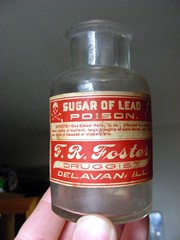

Horror of horrors - the Romans used lead to sweeten their fruit. No wonder Rome fell! Except that I was willing to read a 1883 paper (in German with healthy helpings of Greek and Latin) to discover that it may be lead and it may be sweet, but the lead doesn't lead it to be sweet.
In a time when mercury was regularly used as a remedy for maladies as serious as syphilis and as commonplaces as constipation, it doesn’t surprise me that lead compounds were in the pharmacopeia. (In all fairness, some modern antibiotics and most chemotherapy agents are at least as toxic as these less old remedies; they just have a better risk-benefit ratio.) Sugar of lead, or as it’s called in the 19th century medical literature, saccharum saturni, is lead acetate: Pb(CH3COOH)2. It was once prescribed for intestinal troubles, an odd choice, since one symptom of acute lead poisoning is an upset stomach. Lead poisoning is also known as painter's colic.
Sugar of lead really is sweet, roughly as sweet per spoonful as sugar. In the 18th and 19th century, lead shot was often dropped into bottles of port, purportedly to make it sweeter - though the more likely effect is anti-bacterial. Why? Lead does dissolve well in alcohol and juices (crystal decanters to store your port are a bad idea) - but I can't find anything that suggests solutions of lead ions are sweet.
The Romans were reputed to use lead acetate as a sweetener. They produced a syrup called sapa by boiling down mildly fermented grape juice in kettles made from lead alloys. (The hydrates of lead acetate are far less soluble in alcohol solutions - you are more likely to get a suspension of crystals in the syrup.) I am suggesting that it’s unlikely that the syrup was sweet because of the lead acetate it certainly contained. An 1883 analysis of sapa produced according to recipes dating from the classical Roman period, in kettles of similar metallic content to those found at Pompeii and other sites, suggested that the lead content of sapa was roughly 850 mg per liter. The equivalent amount of table sugar would be roughly a teaspoon - hardly enough to taste sweet in a liter of liquid. On the other hand, the sugars (glucose and fructose) in the concentrated grape must are the equivalent of 1 cup of table sugar per liter and would certainly swamp any sweetness coming from the lead acetate. It's still not all that sweet. To get a sense of how sweet this is, simple syrup, which has similar culinary uses to sapa, has about 4 cups of sugar in a liter.
I still wouldn't use sapa to poach my pears, but I think it unlikely that the sweet taste of sapa has much to do with lead.
Photo is c. 2009 John4kc. Used with permission.
Sweet Stones
I was wandering the Cape Anne historical museum this winter and noticed in a 19th century ship's medical kit a vial labeled "sugar of lead." This is lead acetate, which tastes sweet -- and is reputed to have been used as a sweetener is days past. Other metal salts are sweet as well - yttrium salts and beryllium salts can both taste sweet.Beryllium was first identified in 1798 by chemist Louis Vauquelin as an oxide in beryl and emeralds (emeralds are beryls with a bit of chromium added!). Since the chloride salt of the new element tasted sweet, the editors of the journal which published Vauquelin's findings suggested he call the oxide (or earth) glucina from the Greek, glyks (γλυκυς) for sweet. The elemental symbol used was Gl.
Beryllium was suggested as alternative once other sweet metal salts were found, for the gemstones in which the element was first identified. It took until 1949 for this to become the official IUPAC name of the element with four protons.
Beryls were used to make "reading stones," magnifying glasses, then eventually ground into lenses for eyeglasses.
All that glitters...may be tin

While medieval alchemists were searching for the secrets of turning base metals, such as lead and tin, into gold, medieval artists had already figured out how to do this. Gold was often applied to manuscripts in medieval Europe and the Middle East to “illuminate” them, an illuminated page would have the functional equivalent of little mirrors scattered across it, making the most of dim interior lighting. In addition to being reflective, gold does not corrode or oxidize, so gold will not discolor with time. There is a fine collection of medieval illuminated manuscripts at a library near me, and as you turn the pages of Book of Hours that is half a millenia old (wearing gloves, of course), the golden decorations wink at you as brightly as the day they were applied.
Gold is expensive, and hard to handle, particularly in the thin sheets necessitated by the cost. One alternative is to use a tin base, then brush on a saffron oil glaze. Polish it up and you might not notice. The glaze blocks out the oxygen and moisture in the air, preventing many of the chemical reactions which can cause the metal to discolor. The resulting preparation is called auripetrum - Peter’s gold. Peter had a good idea - whoever he was.
Does anyone know more about the source of this name? I'd love to know.
Weird Words of Science: Lemniscate Elemental Landscapes
 In reading an older paper about periodic tables, the author referred to the "lemniscate table of Gooch and Walker" - but didn't provide a figure, and I had to admit lemniscate was an unfamiliar descriptor. (It's not in the abridged Oxford English Dictionary on my iPod, either - so I don't feel all that ignorant!) Even a Google search was not particularly enlightening.
The full OED came to the rescue - "ribbon like", from the Latin for a ribbon. The term dates to the 17th century when Bernoulli used it to describe a set of curves. The term was new, the curves were not - Bernoulli's lemniscate was a special case of a set already described by Cassini.
 Once I located a figure of Gooch and Walker's table, I would agree "ribbon-like" is a good description and it is certainly reminiscent of Cassini's figure eight curves (to give credit where credit is due).
Figure of the periodic table from Outlines of inorganic chemistry by Frank Austin Gooch, Claude Frederic Walker, Macmillan:New York, 1905. Figure of Bernoulli's lemniscate is from here.

Allotropes and architects: buckminsterfullerene
 Responding to an earlier post on inert gases, a commenter wondered if buckminsterfullerene might act as an inhalation anesthetic - given that, like xenon, it's a large, polarizable ball of electron density. It might, if you could get enough to inhale. At room temperature, the vapor pressure is 5 x 10⁻⁶ torr. Very roughly, that's about a billionth of atmospheric pressure. For comparison's sake, the pressure of xenon necessary to induce anesthesia is about 500 torr, or 65% of normal atmospheric pressure. If you want higher pressures, you need higher temperatures: buckminsterfullerene sublimes (goes directly from the solid to the gas phase, like dry ice) just above 1000
While likely impractical as an anesthetic, buckminsterfullerene has asthetic properties. It's a highly symmetric molecule - having iscosohedral symmetry. Kroto and Smalley discovered the new allotrope of carbon, C60, in vaporized graphite and named it for the architect (Buckminster Fuller) who made famous the geodesic domes it resembled. Two more familiar allotropes of carbon are graphite and diamond.
Allotropes are differing forms of the same element. The roots of the word are Greek - allos for different and tropos for "turn of mind". A different turn of mind? It's what Smalley needed to propose the now iconic structure, over a beer at his kitchen table.
Another allotrope of carbon is lonsdaleite - named for Kathleen Lonsdale, an Irish crystallographer who determined the structure of benzene and my brother-in-law's godmother.
Inert gases aren't always inert
Earlier this week I posted about the intoxicating effects of nitrogen gas at high pressures, which leads divers to substitute helium for nitrogen. An astute reader wondered in the comments why argon wasn't used, as it is substantially cheaper. It turns out that argon is even more potent intoxicant than nitrogen at high pressures! But aren't argon and helium inert gases?
The elements in the last column in the periodic table comprise what IUPAC (the International Union of Pure and Applied Chemists is to chemists what the IOC is to sports) calls Group 18, but what most of us learned in high school to call the noble or rare, gases. Helium, argon, neon, krypton, xenon and radon are indeed all gases under standard conditions, but the modifier misses the mark by a bit.
Rare? Take a deep breath, you've just inhaled about 100 mg of argon. Almost 1% of the atmosphere is argon; there is almost three times as much argon in the air as there is CO2. "Noble" generally means "unreactive" to a chemist. The noble metals, such as gold and platinum are resistant to oxidation - they don't rust - unlike the "base" metals such as iron and copper. Much like gold and platinum, under the right conditions these inert gases can be made to react. The first noble gas compound - xenon hexafluoroplatinate - was synthesized in 1962, but there were earlier clues that these gases might not be completely unreactive. The anesthetic effect of xenon had been observed in the 1930s, and reports of its use in clinical settings appeared in the late 1940s.
The mechanism by which nitrogen, argon and xenon behave as anesthetics isn't completely understood. The best theories at the moment suggest that the gases interact with ion channels - but whether they binding chemically or physically is not clear.
The elements in the last column in the periodic table comprise what IUPAC (the International Union of Pure and Applied Chemists is to chemists what the IOC is to sports) calls Group 18, but what most of us learned in high school to call the noble or rare, gases. Helium, argon, neon, krypton, xenon and radon are indeed all gases under standard conditions, but the modifier misses the mark by a bit.
Rare? Take a deep breath, you've just inhaled about 100 mg of argon. Almost 1% of the atmosphere is argon; there is almost three times as much argon in the air as there is CO2. "Noble" generally means "unreactive" to a chemist. The noble metals, such as gold and platinum are resistant to oxidation - they don't rust - unlike the "base" metals such as iron and copper. Much like gold and platinum, under the right conditions these inert gases can be made to react. The first noble gas compound - xenon hexafluoroplatinate - was synthesized in 1962, but there were earlier clues that these gases might not be completely unreactive. The anesthetic effect of xenon had been observed in the 1930s, and reports of its use in clinical settings appeared in the late 1940s.
The mechanism by which nitrogen, argon and xenon behave as anesthetics isn't completely understood. The best theories at the moment suggest that the gases interact with ion channels - but whether they binding chemically or physically is not clear.
Weird Words of Science: calcium
The isolation of metallic calcium was reported by Humphrey Davy 200 years ago this year. The name comes from the Latin for lime: calx. Compounds of calcium are like duct tape – they hold lots of stuff together. Calcium carbonate keeps clams covered, calcium oxide (lime) is the mortar that held the Roman Colliseum together, and calcium sulfate (plaster of Paris) has been holding broken bones in place for more than a millennium. Calcium keeps us from being a puddle on the floor as well. More than 90% of the body's calcium stores are in the bones.
Subscribe to:
Posts (Atom)