Field of Science
-
-
Change of address1 year ago in Variety of Life
-
Change of address1 year ago in Catalogue of Organisms
-
-
Earth Day: Pogo and our responsibility1 year ago in Doc Madhattan


Showing posts with label archeological chemistry. Show all posts
Showing posts with label archeological chemistry. Show all posts
Sweet leads

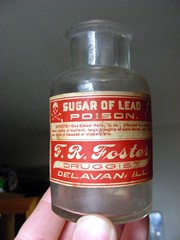
Horror of horrors - the Romans used lead to sweeten their fruit. No wonder Rome fell! Except that I was willing to read a 1883 paper (in German with healthy helpings of Greek and Latin) to discover that it may be lead and it may be sweet, but the lead doesn't lead it to be sweet.
In a time when mercury was regularly used as a remedy for maladies as serious as syphilis and as commonplaces as constipation, it doesn’t surprise me that lead compounds were in the pharmacopeia. (In all fairness, some modern antibiotics and most chemotherapy agents are at least as toxic as these less old remedies; they just have a better risk-benefit ratio.) Sugar of lead, or as it’s called in the 19th century medical literature, saccharum saturni, is lead acetate: Pb(CH3COOH)2. It was once prescribed for intestinal troubles, an odd choice, since one symptom of acute lead poisoning is an upset stomach. Lead poisoning is also known as painter's colic.
Sugar of lead really is sweet, roughly as sweet per spoonful as sugar. In the 18th and 19th century, lead shot was often dropped into bottles of port, purportedly to make it sweeter - though the more likely effect is anti-bacterial. Why? Lead does dissolve well in alcohol and juices (crystal decanters to store your port are a bad idea) - but I can't find anything that suggests solutions of lead ions are sweet.
The Romans were reputed to use lead acetate as a sweetener. They produced a syrup called sapa by boiling down mildly fermented grape juice in kettles made from lead alloys. (The hydrates of lead acetate are far less soluble in alcohol solutions - you are more likely to get a suspension of crystals in the syrup.) I am suggesting that it’s unlikely that the syrup was sweet because of the lead acetate it certainly contained. An 1883 analysis of sapa produced according to recipes dating from the classical Roman period, in kettles of similar metallic content to those found at Pompeii and other sites, suggested that the lead content of sapa was roughly 850 mg per liter. The equivalent amount of table sugar would be roughly a teaspoon - hardly enough to taste sweet in a liter of liquid. On the other hand, the sugars (glucose and fructose) in the concentrated grape must are the equivalent of 1 cup of table sugar per liter and would certainly swamp any sweetness coming from the lead acetate. It's still not all that sweet. To get a sense of how sweet this is, simple syrup, which has similar culinary uses to sapa, has about 4 cups of sugar in a liter.
I still wouldn't use sapa to poach my pears, but I think it unlikely that the sweet taste of sapa has much to do with lead.
Photo is c. 2009 John4kc. Used with permission.
Subscribe to:
Posts (Atom)