Field of Science
-
-
Change of address1 year ago in Variety of Life
-
Change of address1 year ago in Catalogue of Organisms
-
-
Earth Day: Pogo and our responsibility1 year ago in Doc Madhattan


Showing posts with label sweeteners. Show all posts
Showing posts with label sweeteners. Show all posts
The weight of water

While writing a piece for Nature Chemistry about the hidden depths of the periodic table (the more than 3000 isotopes that could be stacked onto their elemental spots), I wandered across an interesting set of papers on heavy water and isotopic tracing, which led to another piece for Nature Chemistry (The weight of water). In one of the papers, future Nobelist George de Hevesy deuterates goldfish by crowding some twenty (albeit tiny) goldfish into 60 ml of water, in another he reports making thousands of distillations of urine to recapture the water, measure its density and track deuterium through the human body.
Heavy water (D2O) is water where the hydrogens have been replaced with deuterium, an isotope of hydrogen that weighs about twice as much as standard hydrogen. Heavy water weighs just over 10% more than regular water, a tablespoon weighs only about a gram more, so it is probably not noticeable should you heft a glass of it.
And that's the question — should you heft a glass of it? In small amounts it is certainly safe to drink, and as I recently learned, used in human metabolic studies in doses of about 10 ml. An interesting question raised in the papers I read was about the taste of heavy water. One report suggests a burning sensation might be felt when drinking it, another (by Harold Urey, who discovered deuterium) suggests it tastes like undeuterated water. But other reports say it tastes sweet.
With a bit of help from my youngest son, I set up a repeat of Urey's blind taste test. And was surprised to find I could indeed taste the difference. It is sweet.
And for the next few weeks, until the last of the extra deuterium clears my systems, I'll be just a little bit heavier than usual.
Sweet leads
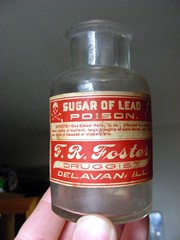
Horror of horrors - the Romans used lead to sweeten their fruit. No wonder Rome fell! Except that I was willing to read a 1883 paper (in German with healthy helpings of Greek and Latin) to discover that it may be lead and it may be sweet, but the lead doesn't lead it to be sweet.
In a time when mercury was regularly used as a remedy for maladies as serious as syphilis and as commonplaces as constipation, it doesn’t surprise me that lead compounds were in the pharmacopeia. (In all fairness, some modern antibiotics and most chemotherapy agents are at least as toxic as these less old remedies; they just have a better risk-benefit ratio.) Sugar of lead, or as it’s called in the 19th century medical literature, saccharum saturni, is lead acetate: Pb(CH3COOH)2. It was once prescribed for intestinal troubles, an odd choice, since one symptom of acute lead poisoning is an upset stomach. Lead poisoning is also known as painter's colic.
Sugar of lead really is sweet, roughly as sweet per spoonful as sugar. In the 18th and 19th century, lead shot was often dropped into bottles of port, purportedly to make it sweeter - though the more likely effect is anti-bacterial. Why? Lead does dissolve well in alcohol and juices (crystal decanters to store your port are a bad idea) - but I can't find anything that suggests solutions of lead ions are sweet.
The Romans were reputed to use lead acetate as a sweetener. They produced a syrup called sapa by boiling down mildly fermented grape juice in kettles made from lead alloys. (The hydrates of lead acetate are far less soluble in alcohol solutions - you are more likely to get a suspension of crystals in the syrup.) I am suggesting that it’s unlikely that the syrup was sweet because of the lead acetate it certainly contained. An 1883 analysis of sapa produced according to recipes dating from the classical Roman period, in kettles of similar metallic content to those found at Pompeii and other sites, suggested that the lead content of sapa was roughly 850 mg per liter. The equivalent amount of table sugar would be roughly a teaspoon - hardly enough to taste sweet in a liter of liquid. On the other hand, the sugars (glucose and fructose) in the concentrated grape must are the equivalent of 1 cup of table sugar per liter and would certainly swamp any sweetness coming from the lead acetate. It's still not all that sweet. To get a sense of how sweet this is, simple syrup, which has similar culinary uses to sapa, has about 4 cups of sugar in a liter.
I still wouldn't use sapa to poach my pears, but I think it unlikely that the sweet taste of sapa has much to do with lead.
Photo is c. 2009 John4kc. Used with permission.
Sweet Stones
 I was wandering the Cape Anne historical museum this winter and noticed in a 19th century ship's medical kit a vial labeled "sugar of lead." This is lead acetate, which tastes sweet -- and is reputed to have been used as a sweetener is days past. Other metal salts are sweet as well - yttrium salts and beryllium salts can both taste sweet.
Beryllium was first identified in 1798 by chemist Louis Vauquelin as an oxide in beryl and emeralds (emeralds are beryls with a bit of chromium added!). Since the chloride salt of the new element tasted sweet, the editors of the journal which published Vauquelin's findings suggested he call the oxide (or earth) glucina from the Greek, glyks (γλυκυς) for sweet. The elemental symbol used was Gl.
Beryllium was suggested as alternative once other sweet metal salts were found, for the gemstones in which the element was first identified. It took until 1949 for this to become the official IUPAC name of the element with four protons.
Beryls were used to make "reading stones," magnifying glasses, then eventually ground into lenses for eyeglasses.
Turning Sugar Inside Out
This week's worksheet in general chemistry asks my students to analyze the chemical kinetics (the speed) of this reaction:
C12H22O11 (sucrose or table sugar) + H2O (water) -> C6H12O6 (glucose) + C6H12O6 (fructose).
It's called the inversion of sucrose, and the resulting mix of glucose and fructose is tagged invert sugar. The name suggests that table sugar has been turned inside out or perhaps upside down, but in fact it's simply been split into two simpler sugars. The inversion is not of the sugar itself, but of the way it bends polarized light. If you pass a beam of polarized light through a solution of regular table sugar, the light will "rotate" or bend to the left. The mixture of glucose and fructose "inverts" the rotation, and bends the beam to the right.
Invert sugar is less like to crystalize than regular sugar, making it ideal for sweetening candy or jams. The reaction in the absence of a catalyst is slow at room temperature, but can be completed . The simplest way to catalyze the reaction is with an acid, often citric acid or ascorbic acid (Vitamin C), and many jam recipes call for one or the other.
So why do these compounds "bend" polarized light? Like many biological molecules, they are chiral or handed. The right handed or D form bends the polarized light toward the right, the left handed form (denoted L) left.
Another name for the D form of glucose is dextrose, named for the direction in which it bends polarized light.
C12H22O11 (sucrose or table sugar) + H2O (water) -> C6H12O6 (glucose) + C6H12O6 (fructose).
It's called the inversion of sucrose, and the resulting mix of glucose and fructose is tagged invert sugar. The name suggests that table sugar has been turned inside out or perhaps upside down, but in fact it's simply been split into two simpler sugars. The inversion is not of the sugar itself, but of the way it bends polarized light. If you pass a beam of polarized light through a solution of regular table sugar, the light will "rotate" or bend to the left. The mixture of glucose and fructose "inverts" the rotation, and bends the beam to the right.
Invert sugar is less like to crystalize than regular sugar, making it ideal for sweetening candy or jams. The reaction in the absence of a catalyst is slow at room temperature, but can be completed . The simplest way to catalyze the reaction is with an acid, often citric acid or ascorbic acid (Vitamin C), and many jam recipes call for one or the other.
So why do these compounds "bend" polarized light? Like many biological molecules, they are chiral or handed. The right handed or D form bends the polarized light toward the right, the left handed form (denoted L) left.
Another name for the D form of glucose is dextrose, named for the direction in which it bends polarized light.
Subscribe to:
Posts (Atom)