Field of Science

Showing posts with label atmospheric chemistry. Show all posts

First woman in 'space'


I keep checking to see how far away New Horizons is from Pluto (459,770 km at 0235 GMT) even though I know there's nothing to see at the moment, but I am a space junkie.

The first space launch I can remember seeing is the last of the Mercury missions, launched in May of 1963.  I was 5 and I was hooked on space.  In retrospect, I suspect my hours watching rockets erect on their launch pads, the vapor streaming off the only sign this was live TV,  fed my desire to do science as much as the biography of Marie Curie I chewed through while ill one summer or my parents' careers.

I'd be glued to the TV for every launch I could for the next decade, and I confess I can still be found streaming a launch in the corner of my screen while grading.  I'm still hooked on space.

S o I was delighted to discover the first woman to leave the atmosphere — at least the breathable part of it — was both a chemist and an alum of the college where I teach.  In October of 1934, Jeannette Ridlon Piccard, a licensed balloon pilot, flew a balloon with her husband on board to an altitude of 17.5 km, well into the stratosphere.  Her altitude record (for women) would not be broken until Russian astronaut Valentina Tereshkova's flight in June 1963.  You can watch the Piccards take off in this video and see the wreckage of the gondola after they crash landed.  Her first person account of the trip was published in the New York Times the next day, including her chagrin at such an inelegant landing.

Ridlon's entry in Bryn Mawr's Undergraduate Catalog of 1916, she
would concentrate on chemistry and physics over the next 2 years. 
Piccard was a Bryn Mawr College graduate, class of 1918, taking course work in chemistry and physics, as well as psychology and philosophy.  She went on to get her master's degree in chemistry from the University of Chicago and later a Ph.D. in education from the University of Minnesota.  All wonderful preparation for being an...executive secretary (those were not the days), pilot and stratospheric explorer.  Piccard's papers are the Library of Congress and I'd love to go read the experimental notes from that epic flight.


Piccard's grand-nephew Bertrand Piccard is one of the pilots on the Solar Impulse, a solar powered plane attempting to circumnavigate the globe.

My thanks to Bryn Mawr College's registrar, Kirsten O'Beirne, for figuring out how "majors" worked in the early 20th century.


Nitrogen in the snow

We are expecting another round of wintry weather tomorrow, and an article in the local paper noted that the snow and bitingly cold weather we have had recently are good for farmers.  The cold reduces the population of some pests, particularly the species making their way north.  The article also noted that snow contains nitrogen from the atmosphere, providing a little extra boost for lawns come spring.

The atmosphere is roughly 80% nitrogen, in the form of N2.  The form matters.  Nitrogen gas is very unreactive, so much so that it many "air sensitive" materials are packed under pure nitrogen.  (The part of the air that is reactive is molecular oxygen, O2.)  Snow certainly contains dissolved nitrogen gas.  Henry's law predicts the solubility of a gas in a solvent, water in this case, as a function of temperature.  It might seem at first glance counter intuitive, but gases are more soluble in cold solvents than in warm (the opposite is true of most solids, as anyone who has tried to dissolve sugar in cold ice tea knows).  An inch of snow contains about 7 milligrams of nitrogen gas per square foot, or about 1/3 of a kilogram in an acre of snow.  Given that fertilizers are spread onto fields at a field of roughly 300 kilograms per acre, it's not much.

The trouble is actually that this nitrogen isn't in a form that easily accessible to plants.  Nitrogen in the atmosphere must first be "fixed" or changed into a more reactive form, typically tetravalent nitrogen (ammonium) which is then converted to the nitrate ions that plants can use.  So where does the useful sort of nitrogen come from?

Industrially, nitrogen is fixed in the Haber process.  Since nitrogen is so unreactive, this requires pressures hundreds of times those of earth's atmosphere and temperatures more likely to be found on the surface of Venus (over 700oF).  Nitrogen is fixed in the biosphere by microbes, which undertake an elaborate enzymatic dance to do this at low temperatures and pressures (and yes, scientists are on the job of trying to figure out how to get the enzymatic processes to work at industrial scales.)

Lightening strikes also convert minuscule amounts of N2 in the atmosphere to nitrogen oxides, and industrial pollution has also injected nitrogen oxides into the atmosphere. Industrial pollutants are by far the biggest contributors. The nitrogen oxides become nitrate ions. These are the nitrogen sources that turn a blanket of snow into a gentle fertilizer.

To put it into perspective, snow and rain probably deposit about 5 kilograms total per acre over a year. It's not much, it's not quite all natural (the rates were much lower in pre-industrial days), but it's something.

Unbending the bends


Sometime before dawn this morning, we took our oldest son to the airport. He's bound for the Caribbean for a pre-orientation trip for college (learning to sail with a team of other freshmen). They will get the chance to do a little snorkeling, but when his dad asked him about whether or not they'd be doing any scuba diving, he replied enigmatically,"There is no hyperbaric chamber in the Virgin Islands. They'd have to fly you to Puerto Rico, I guess."

My first response was to wonder how they would do that, given that most aircraft are pressurized to something around 10,000 to 15,000 feet, which would certainly exacerbate the bends - the outgassing of nitrogen from the blood, which can cause embolisms (blockages) in your blood vessels and painful swelling in your joints.

Henry's law governs the amount of gas dissolved in a liquid: the amount of dissolved gas depends on the external pressure of the gas. For example as the pressure of carbon dixoide increases, so does the amount of dissolved carbon dioxide. Some portion of that dissolved CO2 turns into carbonic acid (H2CO3), and lowers the pH, which gives soda water it's characteristic bite. It also means that acidification of the ocean is a risk of fossil fuel burning, and the resultant carbon dioxide in the atmosphere. Climate deniers will say that there is no data linking CO2 levels with changes in the ocean pH, suggesting it's because the oceans aren't plain water, and that this will complicate the chemistry. True. But your blood is pretty chemically complicated, and this is essentially the system that is used to control your blood's pH.

So why would flying make the bends worse? As the external pressure of nitrogen falls with altitude, more nitrogren comes out of solution in your blood stream and joints. Neither are places where you want more bubbles. If possible, victims of the bends are evacuated on planes that can be pressurized to lower altitudes (an expensive proposition, and one often not covered by travel insurance).

Bariatric chambers allow the external pressure to be increased, and then slowly decreased to prevent the formation of large bubbles. It can take several "dives" to assuage the symptoms. I sat with my mother while she underwent treatment in a hyperbaric chamber, it's not for those with claustrophobia is all I will say.


Photo is from Wikimedia.

Elemental tales: Strong waters

I ran across a reference to aqua fortis in one of the commentaries in Chemical News (1891). The conversation is about a suit in court where a chemist was injured when an inappropriately packaged bottle of aqua fortis spilled. (It had a cork, and according to the rather snarky commentator, the judge — and the chemist in question — should have known that aqua fortis should not be capped with a cork.)

Aqua fortis, literally strong water, was once the common name for nitric acid. Concentrated nitric acid is a strong oxidizing agent (I can still see the small scar on my mother's hand from a spill in her undergraduate days), and I imagine would rather quickly eat away any organic matter, such as a cork. Glass would obviously be the preferred medium for storage. The suit is a frivolous one!

The term aqua fortis has fallen out of fashion, but its companion term has not: aqua regia, the royal water that would dissolve even gold. Aqua regia, as any general chemistry text will tell you, is a mix of concentrated nitric acid and concentrated hydrochloric acid (a 1:3 ratio by volume). Neither acid alone with dissolve gold (or a variety of other hard to oxidize metals), but the trick lies in the shifting equilibria.

Nitric acid is able to oxidize small amounts of gold, turning elemental gold into ions, Au3+. These ions then react with the chloride ions from the hydrochloric acid to form the complex ion AuCl4. As the gold ions are pulled into the chloroaurate complex, the nitric acid oxidizes a bit more elemental gold. This goes on until all the solid elemental gold has been turned in chloroaurate ions floating around in solution. Imagine putting out a bowl of pretzels, as the pretzels get eaten, you try to keep it full by adding more pretzels. Eventually you run out of pretzels. The trick of using complex ion formation to drive something that isn't very soluble into solution is a common one.

Arguably the most famous example of this happened when the Nazis invaded Copenhagen. Franck and von Laue had given their 23 karat Nobel prize medals to Bohr to prevent the Nazis from confiscating them. Bohr was reluctant to bury them, sure that wherever they were hidden, a search would eventually turn them up. A chemist on staff, de Hevesy, thought to use aqua regia to dissolve the medals. After the war the gold was precipitated out and recast into medals; Franck received his recast medal in the early 1950s. Those were strong waters indeed that Bohr and de Hevesy waded into.


You can read a bit more about the saving of Franck and von Laue's medals at the Nobel site and see a video of aqua regia in action here.

Cooling trends


In a previous piece about density and the insulating power of whipped cream, I mentioned that trapped "nothingness" was even better at insulating things than the trapped air in the whipped cream.

A hot object can transfer heat to its surroundings by conduction and convection, in other words by having molecules (or atoms) in the surroundings collide with the surface of the object, pick up some of its energy and move off. Imagine a little bucket brigade, stepping up to the object, grabbing a piece of heat (energy, really) and heading off to dump it elsewhere. Air doesn't conduct heat very well, and trapping it reduces convection (the bulk movement of the air - air currents), hence trapped air is an effective insulator.

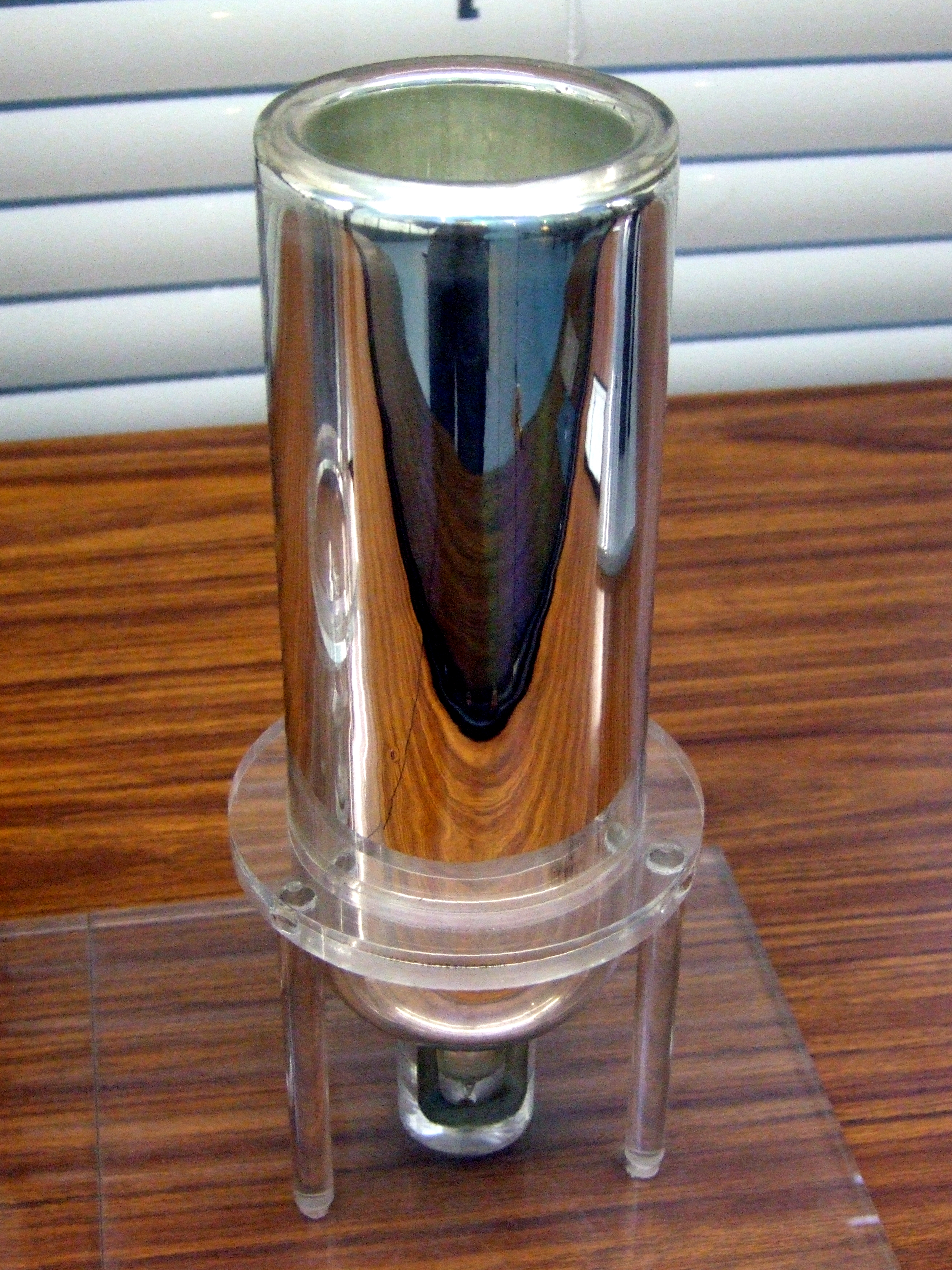
If you halt the bucket brigade - prevent any molecules from walking off with a chunk of energy, all the energy stays in the object and voila my cocoa stays hot. So if I could envelop my cocoa in a bubble of nothingsness — a vacuum — I could keep it from cooling via conduction and convection. (Of course, I'd have to put a vacuum tight lid on the thing, lest it instantly boil off — but that's another post…) A convenient way to do this is to use a vacuum flask, where a 'layer' of vacuum is enclosed between two walls. Originally glass walls were used. If you're my age, you might remember dropping your lunch box, and then opening your thermos at lunch to find shard of glass inside. These days stainless steel or plastic walls make lugging your milk to school a less risky proposition.

Chemists still use the glass walled version of a thermos. We call it a Dewar (for James Dewar, who invented the contraption in 1892).

But an object untouched by other molecules can still lose heat by radiation, by emitting infrared photons - light at wavelengths longer than visible light. Reflective wrappings, like metalized Mylar, keep the light - and the warmth - inside.

A friend recently wondered why clear weather was cold weather. The earth radiates some of its heat back out into the universe as infrared radiation. Clouds act as insulating wraps for the earth, the water molecules grabbing the heat before it radiates out into space and re-emitting some of it back toward the planet's surface. (This is the greenhouse effect — it's not up for debate.) On a clear night, no clouds, so less heat is retained. Suddenly the temperatures are well below freezing.

(Other molecules besides water help trap infrared radiation within the atmosphere, including carbon dioxide and methane.)


Photo is from Wikimedia.

Climate Change Skeptics

Paul Krugman has a piece on climate change on his blog at the NY Times. One commenter responds:

"One thing they are "gong" [sic] to do is point out that if the ppm increase in atmospheric CO2 is solely due to man-made combustion of fossil fuels, laws of chemistry and physics have been violated. For every molecule of carbon, two molecules of oxygen are consumed. Therefore, if the rise in CO2 is due to such combustion, then we should observe a decrease in atmospheric O2 by a factor twice as great. I have seen no evidence to suggest that global O2 is decreasing at all." (H. Muhlphart )


Ouch! My response:

No law of chemistry and physics has been violated by assuming that the increasing CO2 comes from combustion of fossil fuels. The reason no decrease in O2 is "noticed" is because the loss due to the formation of carbon dioxide is very small compared to the total amount of oxygen. If you increase the amount of CO2 by 100 ppm (more or less what's predicted in the next 50 years), the decrease in O2 is from 209,460 ppm to 209,360 ppm. That's the equivalent of being at the top of less than a 30 foot hill. You certainly don't notice any change in the oxygen levels between the basement and second floor of a house, do you?

And I didn't even bother with the notion that carbon dioxide "eats" two oxygen atoms no matter what carbon source you make it from - fossil fuel or respiration. Or that it's one carbon atom to one oxygen molecule. At this level of understanding of the basic science, you are not simply not entitled to an opinion on the matter.

The pressure to preserve


Stephen Davey, associate editor for Nature Chemistry, blogged at the Sceptical Chymist about visiting the National Archives and seeing the Declaration of Independence, the Constitution and the Bill of Rights. He was surprised to find that the documents were stored under helium as opposed to argon - and wondered why. That started me wondering as well, particularly since the inert gases are not interchangeable in all circumstances (you can use helium to dilute the air mixture for diving, but not argon, for example.)

Helium is both more expensive (not an issue in this context, the cost of the gas inside the cases has got to be the least expensive piece!) and difficult to work with than argon. It can leak out through materials that seem air and water "tight". That's why those latex balloons that looked so cheery on the day of the party are withered and droopy by the morning. They're waterproof, but not helium proof.

In the 1950s the US National Bureau of Standards (now NIST) was charged with deciding on the best way to preserve the Charters of Freedom (the three founding documents of the United States of America). (You can read the full report here.) Helium was chosen, despite its propensity to leak through many materials, partly because a high purity, local source was readily available but most because of its thermal conductivity.

The designers of the encasements wanted a way to measure the pressure of the helium within the cases without having to open them, or remove a sample. Since the thermal conductivity of helium is very different than that of air, changes in the thermal conductivity (how heat moves between the panes) could be used to detect leaks. Argon's thermal conductivity is similar to air, so if argon leaked out and air in, the change would be hard to detect.

New casements were designed about ten years ago, with argon as the gas of choice this time. Sapphire ports are embedded to allow the atmosphere inside the cases to be monitored spectroscopically - by passing a beam of light through the port. Since the new methods of monitoring don't require the inert atmosphere to have a different thermal conductivity, it allows argon - which can't wiggle its way out the way helium can - to be used.


The photo is from The Science News-Letter, vol. 62 (Dec. 6 1952), p. 359.

Inert gases aren't always inert

Earlier this week I posted about the intoxicating effects of nitrogen gas at high pressures, which leads divers to substitute helium for nitrogen. An astute reader wondered in the comments why argon wasn't used, as it is substantially cheaper. It turns out that argon is even more potent intoxicant than nitrogen at high pressures! But aren't argon and helium inert gases?

The elements in the last column in the periodic table comprise what IUPAC (the International Union of Pure and Applied Chemists is to chemists what the IOC is to sports) calls Group 18, but what most of us learned in high school to call the noble or rare, gases. Helium, argon, neon, krypton, xenon and radon are indeed all gases under standard conditions, but the modifier misses the mark by a bit.

Rare? Take a deep breath, you've just inhaled about 100 mg of argon. Almost 1% of the atmosphere is argon; there is almost three times as much argon in the air as there is CO2. "Noble" generally means "unreactive" to a chemist. The noble metals, such as gold and platinum are resistant to oxidation - they don't rust - unlike the "base" metals such as iron and copper. Much like gold and platinum, under the right conditions these inert gases can be made to react. The first noble gas compound - xenon hexafluoroplatinate - was synthesized in 1962, but there were earlier clues that these gases might not be completely unreactive. The anesthetic effect of xenon had been observed in the 1930s, and reports of its use in clinical settings appeared in the late 1940s.

The mechanism by which nitrogen, argon and xenon behave as anesthetics isn't completely understood. The best theories at the moment suggest that the gases interact with ion channels - but whether they binding chemically or physically is not clear.

Breathing Deeply

The tunnels deep beneath New York that bring crystal clear water from the reservoirs upstate to the city are aging. Divers are busy assessing the infrastructure - and it's literally a high pressure job. In order to avoid time consuming daily decompressions, the divers are living in a high pressure environment for weeks at time, almost 20 times normal atmospheric pressure. As AP reports, the pressures require that the men breathe a helium-oxygen mixture. Unfortunately, the reason given in the article for breathing the squeaky voice inducing mix: "the nitrogen in regular air is too heavy at 600 feet and their lungs could not handle the pressure." is utter nonsense.

Nitrogen does not weigh more under pressure, and the total pressure of the gas in the divers lungs is high, regardless of the identity of the gas (oxygen gas weighs more than nitrogen does, in fact). The real reason has to do with Dalton's law of partial pressures, and the fact that at high pressures, neither oxygen nor nitrogen are benign substances.

Dalton's law says that the pressure of each gas in a mixture is a function of the percentage of that gas and the total pressure of all the gases. For example, at 30,000 ft, where the total pressure is 0.3 atm and the fraction of oxygen in the air is 21%, the partial pressure of oxygen is 0.063 (humans need a partial pressure of about 0.1 atm to oxygenate their blood).

At the depth of the NYC tunnels, the total pressure is just over 18 atm, so the partial pressure of oxygen would be 3.8 atm. Above a partial pressure of roughly 1.5 atm oxygen gas is seriously toxic. The partial pressure of nitrogen 600 feet below the surface is about 14 atm. Nitrogen narcosis, rapture of the deep, sets in at pressures above 4 atm. At these depths, nitrogen is essentially an anesthetic!

Introducing an inert gas into the breathing mix, such as helium, reduces the percentage of oxygen and nitrogen in the air, thus reducing their partial pressure and reducing the danger of oxygen toxicity and nitrogen narcosis. The need for the specialized breathing mix has nothing to do with the heaviness of the nitrogen and everything to do with the toxic effects of these gases at high partial pressures.


Eliminating nitrogen completely from the mix can also reduce the potential for developing the bends (bubbles of gas that form in the tissues when pressure is reduced) - but that has to do with Henry's Law and ladies corsets, and is another blog post!

Carbon Dioxide Curiousities

  • It won't burn.
  • No matter how cold you make it, you can't turn it into a liquid at atmospheric pressures.
  • It sublimes, going directly from a solid (dry ice) to a gas (one way to make very creepy fog).
  • It's heavy. Burning 1 gallon of gasoline (weighing about 8 pounds) produced 25 pounds of CO2.
  • You can make a supercritical fluid out of it - a state of matter that is neither solid, liquid, nor gas.
  • It's a critical ingredient in chocolate chip cookies - produced in situ by the reaction of sodium bicarbonate and the potassium salt of tartaric acid.