Field of Science

Showing posts with label thermodynamics. Show all posts

A matter of degrees: when low temperatures were hot

Diagram of a thermometer similar to
the one describe by Leurechon, c. 1638.
Note that  hotter temperatures have 
smaller magnitudes degrees associated with 
them. Image from Wellcome collection, 
used under CC license.
We say the mercury is rising to mean it's getting hot out, despite the fact that most home thermometers have no mercury in them anymore.  Regardless of the liquid they contain, the level rises with increasing temperature in the iconic liquid thermometer.  But this was not always the case.

The word thermometer was first coined (in French) in a book of mathematical recreations written in 1626 by Jean Leurechon, SJ (writing as Hendrik van Etten).  In his description he notes the thermometer you can construct from a glass tube and small container of water (or other non-viscous liquid) can be used to quantify temperature by placing marks on the glass, associating each with some fraction of the classical four (or eight) degrees of hotness.  Such thermometers, he suggests, can be used to adjust the temperature of a room or a furnace, to record (and predict) the weather and to measure fevers in the ill.

But Leurechon's thermometer (and similar designs) were constructed such that as the temperature increased, the water level in the tube fell.  Increases in temperature caused the air trapped in the ball at the top of the tube to increase in volume, pushing the liquid down in the tube.  (These are air thermometers, in contrast to the familiar liquid thermometers in widespread use today.) A reading of 9 degrees on the thermometer shown in the sketch accompanying Leurechon's thermometer problem was colder than that of 2 degrees (see also the one in Robert Fludd's diagram, in the figure.)

A century later, Anders Celsius constructed a temperature scale based on water's phase changes which ran in the same direction.  Water on Celsius' scale boiled at 0 degrees and froze at 100 degrees. This reverse run didn't last long, two years later Carl Linnaeus (of taxonomic fame) used the scale to describe conditions in a greenhouse, but flipped it to the form in which we know it today, where 100 is the boiling point of water.

It is tempting to think that Celsius' scale ran in the direction it did because it mimicked the earliest marked thermometers. But Fahrenheit's scale, which preceded Celsius' by two decades, runs in the modern direction, things get hotter in the positive direction. This also parallels the classic notions of degrees of heat in play during the medieval period. There were four (or eight or six, depending on the source) degrees of heat, the first being more or less physiological temperature, the fourth being a blazing hot furnace.


The word degree has its roots in the Latin degradum, a down step.  This matches Leurechon and Celsius' use - 9 degrees is eight steps lower (colder) than 1 degree.

Weird Words of Chemistry: Frigorific


I ran across this word when my youngest, who I'm coaching for the thermodynamics event for Science Olympiad,asked me why the freezing point of water was 32o on the Fahrenheit scale. The Celsius/centigrade scale was originally pinned to the freezing point and boiling point of pure water at 1 atmosphere of pressure. (Now it's pinned to absolute zero and the triple point of water.) What physical property was 0o linked to? The freezing point of something other than water? I had to admit I didn't know and now that my curiosity was piqued, went off to hunt it down.

The zero of Fahrenheit's temperature scale was essentially pinned to the temperature of a "frigorific" mixture of ice, water and solid ammonium chloride in a 1:1:1 ratio, along with the freezing point of water and the temperature of the human body. Frigorific seems to have been coined by Robert Boyle to describe particles of cold that were transferred from body to body, and ultimately got attached to mixtures that achieved a particular temperature regardless of the starting temperatures of the materials. Wandering through the old chemistry literature, I found this table of frigorific mixtures "sufficient for all practical and philosophical purposes, in any part of the world in any season," useful in the days before refrigerators, still useful for those who need a constant temperature bath at low temperatures.

The size of a degree was set by bisecting the difference between the point at which ice and water were in equilibrium and body temperature six times, or 64 degrees (26). Binary was easier to use when you had to make your own instrument than decimal.

Frigorific has essentially vanished from the chemist's vocabulary, though it's still apparently alive and well in the engineering literature. As words of science go, it sounds awkward to my ears — as roughly sharp as heaved Arctic ice.


Nova has an excellent piece on the hunt for absolute zero. Thanks, Kathryn J for the reference!

For more on what I think about well-formed science words, you can read "Neolexia" at Nature Chemistry.

Psychrometry - or how to tell when it's crazy hot out


The heat index is 107 oF (42oC) at the moment. It's hot, and I'm procrastinating going outside by blogging.

My youngest son is doing summer theater, and their rehearsal space is not all air conditioned. So I bought him a cooling towel to help him stay comfortable. When he asked how it worked, I said it was like having a portable swamp cooler — a familiar item as my dad used one for years to cool his house.

The basic principle at work is that it takes energy to make water evaporate. Unless the relative humidity is 100% (in other words, the air has all the water it can hold), water will evaporate. If you keep running air past a wet surface (think a fan blowing past a damp towel, or the breeze blowing over your sweaty face), water will continue to evaporate as drier air is constantly being replenished. The energy to turn the water from a liquid into a gas has to come from somewhere, in this case, the surrounding air and the water itself. The air gets cooler. Whew!

The towel works similarly, there is a very large damp surface area (why the fancy $15 towel really does works better than a damp cotton lawn handkerchief, a much higher surface area than the smooth cotton weave) and as you move around, air moves past. The water evaporates, pulling energy from the water in the towel and makes it colder.

To get a sense of how much energy that is, it takes about 34,000 J to evaporate 15 grams of water (about a tablespoon). 34,000 J is roughly 8 nutritional calories. If you pulled all that energy out of a cup of water, the cup of water would cool off to about 41o F. (In practice, you don't get things this cool!)

This whole endeavor depends on the air being able to soak up some water, so if the humidity is too high, you are going to be crazy hot towel or no. Swamp coolers work great in desert areas (where my dad lives, for example), and are pretty much useless in New Orleans.

So how cool can you get? To figure it out you need the dry bulb temperature and the wet bulb temperature of the air. The dry bulb temp is just the temperature of the air measured in the usual way (being careful to keep the thermometer out of the sun). The web bulb temperature is obtained by blowing air over a thermometer whose bulb is fitted with a tiny damp sock. For that you can use a sling psychrometer (see the video).

Too hot to be slinging thermometers around? Look up the dew point (your favorite weather app will likely have it) and you can estimate the wet bulb temp this way:

1. Subtract the dew point from the ambient temperature (what your regular thermometer reads)
2. Divide what you get in step 1 by 3.
3. Subtract the result in step 2 from the ambient temperature.

Right now the thermometer outside my window reads 100o F, the National Weather Service says the dew point is 70o F, so I take 100-70=30; 30/3 = 10; so the approximate wet bulb temperature is 100-10 or 90o F.

Once you've got the wet bulb temp you can figure out just how much cooling you can get with a fan and a damp towel!

1. Subtract the wet bulb temp from the ambient temp (the dry bulb temperature)
2. Multiply the difference by 0.8 (assuming the process is about 80% efficient, which is a pretty reasonable estimate)

My calculations suggest that the best I could do to produce cool air in my study this afternoon would be 80% of *100-90) or 8 degrees of cooling. 100o F or 92o F? Both are way too hot...I think it's time to stop writing for the day and head for the pool!!


There are more sophisticated ways to do this, talk to the meteorologists if you want to know more.

Psychrometry comes from the Greek for cold ("psuchron") and should not be confused with anything psychiatric (unless you are talking about mad dogs and Englishmen...)

Cooling trends


In a previous piece about density and the insulating power of whipped cream, I mentioned that trapped "nothingness" was even better at insulating things than the trapped air in the whipped cream.

A hot object can transfer heat to its surroundings by conduction and convection, in other words by having molecules (or atoms) in the surroundings collide with the surface of the object, pick up some of its energy and move off. Imagine a little bucket brigade, stepping up to the object, grabbing a piece of heat (energy, really) and heading off to dump it elsewhere. Air doesn't conduct heat very well, and trapping it reduces convection (the bulk movement of the air - air currents), hence trapped air is an effective insulator.

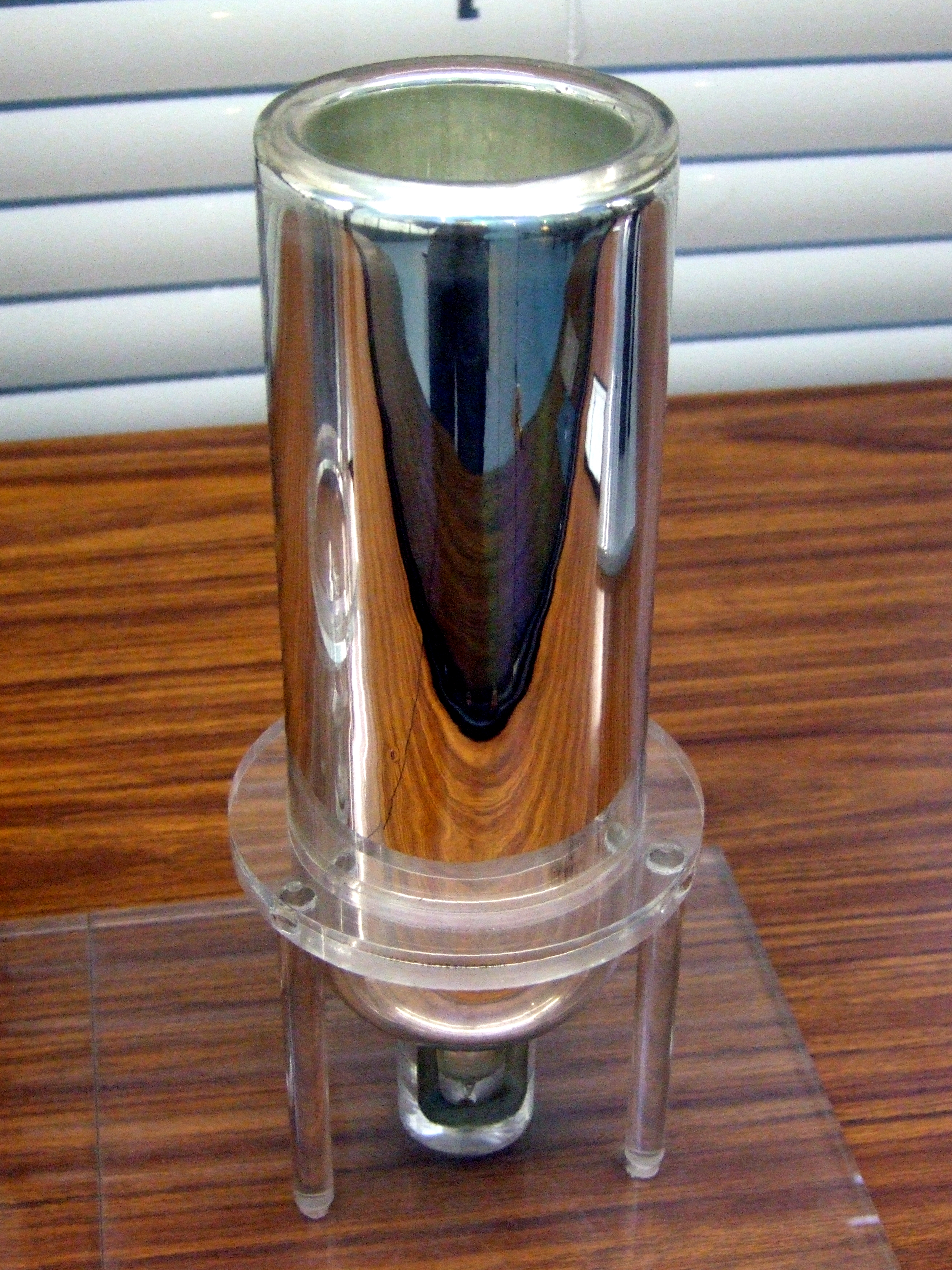
If you halt the bucket brigade - prevent any molecules from walking off with a chunk of energy, all the energy stays in the object and voila my cocoa stays hot. So if I could envelop my cocoa in a bubble of nothingsness — a vacuum — I could keep it from cooling via conduction and convection. (Of course, I'd have to put a vacuum tight lid on the thing, lest it instantly boil off — but that's another post…) A convenient way to do this is to use a vacuum flask, where a 'layer' of vacuum is enclosed between two walls. Originally glass walls were used. If you're my age, you might remember dropping your lunch box, and then opening your thermos at lunch to find shard of glass inside. These days stainless steel or plastic walls make lugging your milk to school a less risky proposition.

Chemists still use the glass walled version of a thermos. We call it a Dewar (for James Dewar, who invented the contraption in 1892).

But an object untouched by other molecules can still lose heat by radiation, by emitting infrared photons - light at wavelengths longer than visible light. Reflective wrappings, like metalized Mylar, keep the light - and the warmth - inside.

A friend recently wondered why clear weather was cold weather. The earth radiates some of its heat back out into the universe as infrared radiation. Clouds act as insulating wraps for the earth, the water molecules grabbing the heat before it radiates out into space and re-emitting some of it back toward the planet's surface. (This is the greenhouse effect — it's not up for debate.) On a clear night, no clouds, so less heat is retained. Suddenly the temperatures are well below freezing.

(Other molecules besides water help trap infrared radiation within the atmosphere, including carbon dioxide and methane.)


Photo is from Wikimedia.

A fluff piece on density

We're covering density in my introductory chemistry this week - which prompted this post.


Density is the ratio of mass to volume and often (though not always) one of the easiest physical properties of a substance to measure. Introductory chemistry labs often feature an exercise where the mass of an object is determined using an analytical balance or somesuch and the volume is determined by displacement (often in a graduated cylinder).

In certain of my teen-aged sons' circles it's in fashion to write in public - to take your notebook (computer or spiral bound) and head to the local coffee shop. You can write the scene while being seen. Personally, I write in public as a last resort. Last week, while waiting to meet a friend for coffee I did haul out my iPad to see if I could inhale some of the fumes of caffeine and inspiration wafting around and some first thoughts for a column hammered out. No coffee for me, hot chocolate - with a serious mound of whipped cream on top.

While I'm all for decadence when it comes to chocolate, hot or otherwise, the whipped cream was a practical touch. My friend is notoriously late, and I wanted the chocolate to stay hot until he arrived.

The ability of a material to conduct thermal energy - heat - depends to some extent on its density. On a molecular level, heat transfer is mostly about collisions between molecules. If you are a molecule with lots of thermal energy, you are generally stuck with it all until you collide with another molecule!

Air at 20oC (68oF) feels warm (yes, I know it's about 3oC here right now, but a girl can dream, can't she?) while water at the same temperature feels refreshingly cool. Water is about a thousand times denser than air, so there are many more molecules in contact with your body surface. The more molecules boucing off a surface, the more opportunities there are for energy transfer. If you're hot, you'll get cooler faster by fully immersing yourself than by standing in a cool room. Conversely, if you want something to stay hot, surround it with air, not water. Air is a good thermal insulator, relative to water, because it is far less dense.

The whipped cream atop my hot chocolate is full of air, which lowers the density and so it floats on top of the cocoa. Heat transfer to the airy cream isn't very efficient due to the low density. Since the air trapped inside the cream isn't moving around (and thereby not presenting fresh molecules to take away the energy presently in the liquid in my cup), the system quickly equilibrates, with most of the heat in the system staying there.

Trapped air (or other gas) is a great insulator, but trapped nothingness works even better. Put my cocoa into a vacuum chamber and it should stay nice and toasty (though there would be other complications - but that is another post!).