Field of Science

Showing posts with label chemical structures. Show all posts

Molecular Jek-yls and -hydes

Like Jekyll and Hyde, changing a functional group changes 
a molecule's behavior. Image from Library of Congress.
Chains of pure carbon and hydrogen, called hydrocarbons by chemists, are notoriously hard to get a chemical handle on.  One of the major driving forces in chemical reactions is "opposites attract" — in this case opposite charges.  Since carbon and hydrogen have essentially the same desire for electrons (negative charges), there is not much difference in charge around to drive a reaction. Swap out a hydrogen for something else that does have a relative charge —  chlorine, fluorine, oxygen, nitrogen — and suddenly you have something to react with.  Chemists call these riffs on a basic carbon framework "functional groups" - they are often the parts of a molecule's structure that drive its function.

Change up the functional group, and you change the molecule's behavior. Like Jekyl and Hyde.  Ethanol is something to drink on a Friday night, ethanal is found in the coffee you drink for the hangover the next morning (in an ironic twist, it's also produced as your body metabolized the ethanol.)

The first part of a chemical name tells the size of the carbon framework, the ending tells you about its function — or lack thereof.  Names that end in -yl or -ane mean a hydrocarbon chain without any fancy functionality.  Propane, a popular fuel, is a three carbon hydrocarbon chain.  Methyl mercaptan (added to odorless natural gas to make it smell, and make leaks quickly noticeable), has a one carbon long "chain" in it. Change -yl to -ol and you have made an alcohol, a chain with an -OH group on it (Ethanol is CH3CH2OH, sometimes written EtOH, a 2 carbon chain with an OH group on it.)

Knowing the functional groups means knowing something about the kinds of things a molecule can do.  Esters smell floral, carboxylic acids can remove a layer of skin, and are found in many lotions.

So to decode:
-ol means an alcohol (functional group = -OH) but not necessarily the kind of alcohol you drink 
-al means an aldehyde (-COH); these often smell sweetish 
-oxy means an ether (an oxygen sandwiched between two carbon chains) 
-oic acid or -ic acid means a carboxylic acid (pronounced "car-box-sill-ick") salicylic acid, often found in face washes 
-oate means an ester (a COO group sandwich between two chains); ethyl nonanoate smells like grape, the functional group is between a 2 carbon chain (ethyl) and nine carbon chain (nona) 
-one means a ketone, a CO group sandwiched in between two chains

Check out Andy Brunning's of Compound Interest's great graphic on functional groups and their names and Practically Science's map of molecules in food and their smells.

Say that again? Why chemical names tangle on the tongue

Michael Pollan's Food Rules famously advises not eating anything with an ingredient a 3rd grader can't pronounce.  The rule is more about eating closer to the production point, about consuming things that are familiar to 3rd graders (like broccoli and eggs), than it is that chemicals that are hard to pronounce are inherently hazardous, though in some corners it's taken on just that sort of magical thinking.

Why are chemical names so weird looking? Take 2-Methyl-5-(6-methylhept-5-en-2-yl)cyclohexa-1,3-diene for example.  It certainly doesn't sound like anything you would want to eat, but it is just the formal name for the compound that is the main component of ginger oil, and responsible for much of ginger's characteristic bite.  Like crystallized ginger, ginger tea, or a good stir fry?  You've eat this compound in significant quantities.

Chemical names can look like alphabet soup, but they are a way for chemists to paint a compact picture of the structure, or at least to point out key structural features.  Why is it so important to know what a molecule looks like?  The structure of a chemical is what determines its behavior, how it will react, in the body and in the environment.  It's key to understanding how things work on the molecular level:  structure determines function.  Period.

Formal chemical names, called IUPAC names (for the International Union of Pure and Applied Chemists, the body that decides on everything from what new elements will be called to the standards for drawing molecules), are in fact a code from which the full structure of the molecule can be unraveled.  Most of the time chemists call chemicals by a common name, which also gives clues to the structure, though not so many that the molecule could be unambiguously drawn.

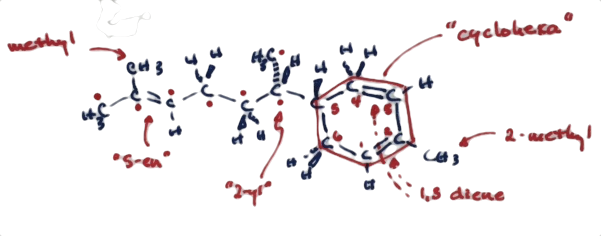
So back to 2-Methyl-5-(6-methylhept-5-en-2-yl)cyclohexa-1,3-diene, which looks like


The "methyl"s (METH-ill) in the name refer to a CH3 group. What, you don't see any CH3's here?  This is a chemical line structure, where each intersection point (or end of a line) is a carbon atom, and the hydrogen atoms have almost all been left off.  A chemist sees this structure as 

with the methyls at either end.  The little red dots count off a seven membered chain, the "hept" in the name. The "cyclohexa" (sigh-clo-HEX-uh) points to a six membered ring, while "diene" (DIE-een) means it has two double bonds in it. The numbers tell you where to attach methyls and draw the double bonds.  The little "2-yl" (too-ill) means the seven membered chain is linked to the six membered ring at the second carbon in line.

So these tangled names to a chemist are codes, and once you can read the code, even a bit, you can begin to see a molecule taking shape in your mind when you read its name.

This pronounces as 2-METH-ill / 5, 6-METH-ill-hept 5 een 2 ill cyclo HEX uh 1 3 DIE-een.

There's probably a reason this is better known as zingiberene, which suggests its common origin (ginger or zingiber), but not much about its structure.

The most Zen of molecules


Chemists are the Zen masters of science. Chemistry is a minimalist art. Its structures and mechanisms resemble the spare ink characters which trickle down scrolls. We seek elegant syntheses in which a few, carefully chosen pieces collapse into a whole. There is particular pleasure chemists take in crafting a molecule that strains the bounds of possibility — such as cubane — which evokes the aesthetic of Noh, where nearly impossible movements are made to look effortless. And despite our abilities to peer into the depths of a molecule with lasers or beams of neutrons, we haven't lost our connection our history. We are still distilling and crucibles are not merely historical artifacts. Zen sees a beauty in the old and well-used, a touch of wabi.

I've a piece in this month's Nature Chemistry on what makes a molecule beautiful (here, $), through the lens of the ten molecules that I consider to be most beautiful. I've already had a couple of emails suggesting gorgeous molecules that didn't make my list. What's on your list of elegant molecules?


My list of the ten most beautful molecules

azulene
carvone
ferrocene
ethanol
vanillin
penicillin
insulin
snoutane
cubane

A curious invention: drawing chemical structures


I am currently wending my way through fragile but fascinating volumes of Chemical News - a journal published by Sir William Crookes in the late 19th and early 20th century. It was a major journal at the time, looking rather like the current Nature in it's breadth of coverage. The society journals of the time typically reserved their pages for papers read by members and abstracts of papers thought to be of interest to them, while Chemical News and it's ilk included book reviews, reports of papers from a wide swath of journals in several languages and two robust arenas for conversation between scientists, readers and editors: Correspondence and Notes & Queries. They were a bit more open, too, to offer space to offbeat bits of science.

The volume I just finished (1890) has a rather contentious conversational thread winding through the Correspondence on what it means to be a FCS (Fellow of the Chemical Society) and should membership be more tightly policed vis a vis their chemical credentials. (At one point the secretaries of the Chemical Society accuse a former board member of having used fake letterhead to secure support for his position!) Many participants in the conversation resort to pseudonyms, some of which carry a bit of snark with them, and it's interesting that this controversy is playing out primarily in a commercial journal and not in organs internal to the Society.

My project involves tracking the correspondence around primary reports of research findings, so these raucous conversations, while fun reads, are of peripheral interest. I'll admit to finding other interesting tidbits to tag in my electronic notebook. It doesn't pay to be overly focussed when doing archive work, as long as I can avoid being completely dragged down the rabbit hole.

The Notes & Queries section appears just above the one page of adverts included in each issue, and yesterday this ad caught my eye: "The Benzene Nucleus. — An India-rubber Stamp in nickel-plated locket with ink-pad enclosed" 3s. At the top of the page, the last bit of editorial content appears — a report of a curious invention: a stamp for making benzene rings. The first benzene ring in a journal appeared in Chemical News (in 1879, eight years after the first graphical structure was used), so perhaps it's apt that it report this "little contriviance" in its pages. (And the inventor is a Fellow of the Chemical Society!)


Nowadays chemical structure drawing programs are commonplace, but when I was a graduate student chemical structures had to be hand drawn, using India ink (permanent, not water soluble!) on vellum. The Rapidograph pens used were expensive and notorious for getting clogged (irreversibly so). Rings were made using stencils, text added using mechanical lettering guides. Jiggle your hand and you had trouble that white-out might not be able to rescue you from. Blots? Argh.

I don't miss the days of chancy ink drawings for slide and papers, though I do miss the delight of pulling out pens and ink and paper. I do wonder, though, if note taking organic students would appreciate a little ink stamp of a benzene ring on the end of their pencil or pen?


Read about K&E lettering sets here.