Field of Science

Mysteries Revealed

We're discussing NMR (nuclear magnetic resonance) in physical chemistry this week. It's a standard technique for determining molecular structure in organic chemistry. (The same quantum mechanics is the basis for MRI.) Bloch and Purcell won the Nobel prize in 1952 for their pioneering work in NMR. The opening to Purcell's Nobel lecture is almost poetic in its intensity:

Professor Bloch has told you how one can detect the precession of the magnetic nuclei in a drop of water. Commonplace as such experiments have become in our laboratories, I have not yet lost a feeling of wonder, and of delight, that this delicate motion should reside in all the ordinary things around us, revealing itself only to him who looks for it. I remember, in the winter of our first experiments, just seven years ago, looking on snow with new eyes. There the snow lay around my doorstep - great heaps of protons quietly precessing in the earth’s magnetic field. To see the world for a moment as something rich and strange is the private reward of many a discovery.


I wonder if I have a richer view of the world for knowing something of its underlying structure? And how often do I stop to think about it?

From the small to the large


Nanoscience deals with the very small - hence the name from the Greek for "dwarf". Dimensions are often given in Angstroms. Interestingly, the man who gives his name to the very small, in fact studied the very large. Anders Angstrom (1817-1874) was a Swedish spectroscopist. In 1853 he published a careful study of the spectral lines for hydrogen, which was subsequently used by Balmer to develop his equation predicting atomic spectra. In 1867 he published a spectroscopic investigation of the aurora borealis (the first such), and a year later a large volume detailing more than 1000 solar spectral lines. Angstrom was the frist to observe hydrogen in the solar atmosphere. 1 angstrom = 0.1 nanometers.

Periodic Tales from the BBC


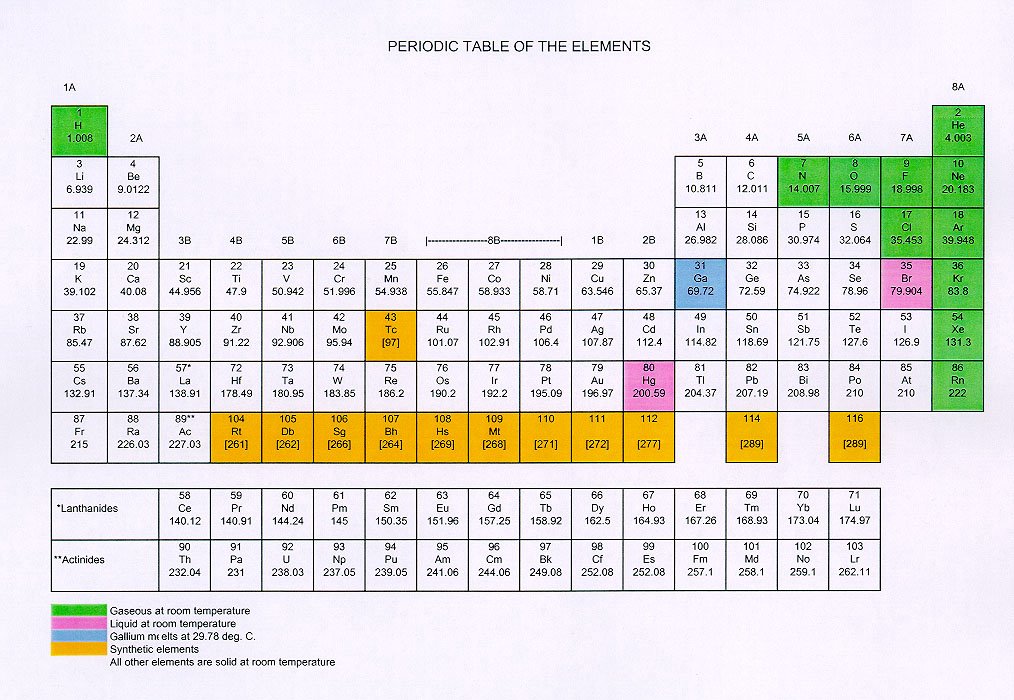
The BBC is airing short features on ten elements, ranging from krypton to cobalt. Each one minute segment is interspersed with clips from Tom Lehrer's song "The Elements". Enjoy!


Periodic Tales at the BBC.

Radar and the chocolate bar

Early in 1940, two British engineers, Harry Boot and John Randall, working under Australian physicist Mark Oliphant built a cavity magnetron, an efficient device for producing high power microwaves as part of an effort to develop better radar detection systems. In this they were eminently successful. By the middle of the year, radar could be used to locate a submarine periscope at six miles. After World War II ended, research on magnetrons continued. In 1946 Percy Spencer, an engineer working at Raytheon, walked through a room in which a magnetron was being tested and noticed that the chocolate bar in his pocket had melted. It occurred to him that the microwaves being generated by the magnetrons could be used to cook food. The next day he placed unpopped popcorn near an operating magnetron, and watched as fluffy white kernels flew around the room. He then tried to cook an egg in the shell, which cooked so quickly it blew up in his colleagues face. Raytheon and Spencer patented the microwave oven in 1950, arguing that it provided a tasty and more sanitary popcorn product. Microwave popcorn is now a ubiquitous part of lab life. In fact, researchers using physical chemistry to develop corn that pops better in the microwave!

Spencer never completed elementary school, but made major contributions to the development of magnetrons for radar and other applications.


Photo of Percy Spencer
Slide show about the microwave patent from PBS History Detectives.

: : :

Friday Random 10: Chemistry

A Random 10 for Bill Carroll's National Chemistry Week Extreme Tour

Chemistry (Chemistry)
Modern Chemistry (Motion City Soundtrack)
Chemistry (The Dygmies)
Delicious Chemistry (Juliet Kelly)
Chemistry (Semisonic)
Strong Chemistry (David Wilcox)
Chemistry of Spiders (Corcovado)
Relative Chemistry (Doctor L)
Bad Chemistry (Donna Regina)
Chemistry Lessons (Frenchmen)

:

Extreme Chemistry

Tomorrow Bill Carroll, the president of the American Chemical Society, heads out on the National Chemistry Week Extreme Tour. Bill is out to show how much fun chemistry can be, by highlighting this year's NCW theme: The Chemistry of Toys. He's also raising money for Project SEED which supports summer lab research experiences and college scholarships for economically disadvantaged students. Project SEED is in its 37th year and more than 8000 students have been supported.

Check out Bill's progress at the Extreme Tour Blog or catch the Tour's tunes. You can also sponsor one of Bill's many miles by donating to Project SEED.

: :

Smooth Operators

The formulation of quantum mechanics in terms of operators lends it dash of elegance compared to the stodgy differential equations of Newtonian physics. In 1932 John von Neumann brought operator algebra to bear on quantum mechanics. von Neumann was unusually social, for a mathematician, and his home in Princeton the venue for many parties. He was also gifted across a wide range of field in mathematics, doing fundamental work in both my field and that of my husband (and our work is not connected in any way!).

What's an operator? The basic definition is a rule that changes one function into another. A more sophisticated one is a mapping between two function spaces. A function space is a collection of functions, each point in the same corresponds to a function. The functions are collected according to a set of rules, different function spaces have different rules associated with them. For example, the set of all functions that are real-valued on the interval 0 to 1 and have continuos 2nd derivatives would constitute a function space. A famous function space for quantum mechanics is Hilbert space.


You can, of course, construct classical physics in terms of operators as well; and quantum mechanics in terms of differential equations! The pedagogical approach to quantum mechanics generally brings operators explicitly to the table very early one, while the introduction of classical physics is often done without recourse even to the calculus.

Tags: , , ,

It's a joke, right?

Some physical chemistry jokes collected by one of my p-chem students:

How many physical chemists does it take to wash a beaker?

None. That's what organic chemists are for!

A physical chemist is a student who goes to university thinking he might
want to be a physicist, but gets intimidated by the math.

Physical Chemistry is research on everything for which the negative
logaritm is linear with 1/T -- D.L. Bunker


Thanks to Alessandra!
On a historical note, D.L. Bunker is Don Bunker, a professor of physical chemistry at my alma mater, University of California, Irvine. He died suddenly during my freshman year.

Cracking the Top 100 Podcasts

I found out today, quite by accident, that the podcast of my quantum mechanics lectures has been hovering in Apple iTunes Top 100 list! My students are not subscribing through iTunes (they are using other feed aggregators) - so is quantum chemistry suddenly fashionable?

Let's hope!

When is red yellow?

I promised my class that by the end of the semester they'd know why flamingos are pink and Cheetos are orange. In that vein, last week's quiz included a question asking them to figure out which of two labels belonged on a bottle of reddish violet solution and which went on the yellowish solution.

One student correctly labled the bottles, but wondered if my choice of compounds was a red herring. She noted that the name of the compound that she predicted would produce the reddish solution (canthaxanthin) meant "yellow" in Greek. I told her that, in fact, I hadn't known that xanthin meant yellow and wasn't trying to mislead them!

This sent me on a hunt to discover why a reddish compound was named for "yellow". Turns out canthaxanthin is named for the mushroom species from which it was first extracted (Cantharellus cinnabarinus) and the Greek for yellow (xanthin). Cantharus is Latin for a two horned drinking cup, which the fungus resembles. The color can tend toward the orange, so that may be the source of the "yellow" in the name.