


James Clerk Maxwell was a Scottish mathematician and physicist. He is perhaps most famous for his extension and refinement of Faraday's equations describing magnetic and electric fields. He reduced the necessary set of equations to four simple partial differential equations, the eponymous Maxwell equations, publishing the work in 1873.
He also worked in thermodynamics, lending his name to another set of four key differential relationships (the Maxwell relations). He also independently derived the Boltzmann distribution of the kinetic energies of gas molecules. Maxwell's demon, a "finite being" who opened a door between to a box of molecules, letting them in and out depending on the amount of energy they had was a rhetorical device Maxwell used to show that entropy and heat flow were, at their core, statistical phenomena.
Lord Kelvin (aka William Thomson) applied the demon tag, Maxwell used the term "finite being"!
Field of Science
-
-
Change of address1 year ago in Variety of Life
-
Change of address1 year ago in Catalogue of Organisms
-
-
Earth Day: Pogo and our responsibility1 year ago in Doc Madhattan
Made from sugar, so it tastes like sugar

I was reading the South Beach Diet book the other night (never mind why!) and noticed that the author recommends (without giving an explicit brand name) an artificial sweetener derived from sugar. A friend on the diet will only use sucralose, saying that the only one that "works right" with the diet. (The SB book itself says it doesn't matter, it's just personal preference.) A recent ad campaign claims, "Made from sugar so it tastes like sugar". As a chemist, I read this and cringe!
Sucralose is made by chlorinating sugar, that is replacing 3 of the 8 hydroxyl (OH) groups with chlorine atoms. [Ed: Yes, I know, chlorine gas, Cl2 is poisonous, but this doens't mean that anything contains a chlorine atom is a poison, despite the claims here. But that's another post!] Such a substitution can utterly change the properties of the molecule, including it's taste. For example, replacing the OH group on ethanol (the alcohol we drink) produces an effective refrigerant (it's used as a local anesthetic, in fact), but not a good drink! An even smaller change, the inverting of two groups on the molecule that makes up spearmint oil, changes it into caraway oil (and you certainly would never say that mint tea tastes like rye bread). Bottom line, there is no reason that any given derivative of sugar will taste anything like sugar!
Much is actually known about the molecular characteristics necessary for sweetness.
Sucralose is made by chlorinating sugar, that is replacing 3 of the 8 hydroxyl (OH) groups with chlorine atoms. [Ed: Yes, I know, chlorine gas, Cl2 is poisonous, but this doens't mean that anything contains a chlorine atom is a poison, despite the claims here. But that's another post!] Such a substitution can utterly change the properties of the molecule, including it's taste. For example, replacing the OH group on ethanol (the alcohol we drink) produces an effective refrigerant (it's used as a local anesthetic, in fact), but not a good drink! An even smaller change, the inverting of two groups on the molecule that makes up spearmint oil, changes it into caraway oil (and you certainly would never say that mint tea tastes like rye bread). Bottom line, there is no reason that any given derivative of sugar will taste anything like sugar!
Much is actually known about the molecular characteristics necessary for sweetness.
Weird words of science 4
statins Anyone who reads the newspaper, listens to the news or watches TV will clearly associate the word statin with cholesterol, but in fact the source of the common name of this class of drugs comes from another biochemical pathway entirely. The suffix -statin was coined in 1973 in an article in Science by Brazeau: "We propose to name the peptide described here somatostatin, from somato(tropin), a pituitary factor affecting statural growth, and stat(in), from the Latin 'to halt, to arrest'." The cholesterol stopping statins were isolated around the same time (there are trends in scientific names, just as there are in baby names) and made use of the new suffix. A quarter century later in common use we've forgotten that there are other statins, such as somatostatin and nystatin, with no structural or theraputic relationship to the profitable cholesterol lowering agents.
For an intersesting take on trends in baby names, see Freakonomics, serialized here at Slate.
For an intersesting take on trends in baby names, see Freakonomics, serialized here at Slate.
Crestor, grapefruits and Italian towns have what in common?
In the current issue of the journal Circulation, there is a study supporting concerns that Crestor (known to chemists as rosuvastatin) is riskier than other statins. When you take most statins you can't drink grapefruit juice, which sounds like an odd prohibition, but for which there is a biochemical basis. Crestor is unusual, in that grapefruit juice does not affect the metabolism of the drug. So what is it in grapefruit juice that mucks up the behaviors of the statins?
Imbibing grapefruit juice (but not orange juice) raises the blood levels of the statins, making them more potent in terms of lowering cholesterol, but also more toxic. A component of the grapefruit juice apparently inhibits an enzyme responsible for the breakdown of the statins in the liver. One possible culprit is bergamottin.
If you drink Earl Grey tea, scented with oil of bergamot, this name may seem familiar to you. Etymologically, bergamottin is derived from the same source as bergamot, both stem from a citrus tree Citrus Bergamia , named for a town in Italy, Bergamo, where such trees presumably grow.
The cholesterol-lowering statins were first isolated from molds. The first (Lovastatin aka Mevacor) was isolated in the 70s from Aspergillus terreus .
Imbibing grapefruit juice (but not orange juice) raises the blood levels of the statins, making them more potent in terms of lowering cholesterol, but also more toxic. A component of the grapefruit juice apparently inhibits an enzyme responsible for the breakdown of the statins in the liver. One possible culprit is bergamottin.
If you drink Earl Grey tea, scented with oil of bergamot, this name may seem familiar to you. Etymologically, bergamottin is derived from the same source as bergamot, both stem from a citrus tree Citrus Bergamia , named for a town in Italy, Bergamo, where such trees presumably grow.
The cholesterol-lowering statins were first isolated from molds. The first (Lovastatin aka Mevacor) was isolated in the 70s from Aspergillus terreus .
Better Breathing Through Chemistry
Dr. Andy has posted about the marketing of an asthma control assessment by Glaxo-Smith-Kline (who not coincidently markets Advair as a treatment for asthma). I haven't seen any of the commercials, but I fairly sure my 8 year old has. He showed up in the kitchen last week and asked if he should take a test about his asthma and take it to his doctor. His asthma is mild and well controlled and I simply reminded him that if he had questions about it, he could ask at his next check-up. I wondered where he got the idea about the test, and since I don't watch TV, it took Dr. Andy's blog to point me in the right direction. The marketing is effective.
Last night sleep here was interrupted, in fact, by an asthma attack. Things resolved well using albuterol, but at 3 am I couldn't help wondering what I would have done 100 years ago, besides worry. Turns out inhalation devices for the treatment of asthma have been around since the 19th century at least. See examples here. Albuterol, a β-agonist, dates to the 1970s and is the most commonly used inhaled agent in its class in the United States. On the molecular level, it activates the β-2 receptor on the muscles surrounding the airways, relaxing them. It is fast acting, which was certainly a benefit last night. The structure is relatively simple.
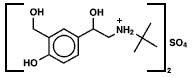
The molecule is chiral and albuterol is marketed both as a single stereoisomer and (most commonly) as the racemic mixture.
Last night sleep here was interrupted, in fact, by an asthma attack. Things resolved well using albuterol, but at 3 am I couldn't help wondering what I would have done 100 years ago, besides worry. Turns out inhalation devices for the treatment of asthma have been around since the 19th century at least. See examples here. Albuterol, a β-agonist, dates to the 1970s and is the most commonly used inhaled agent in its class in the United States. On the molecular level, it activates the β-2 receptor on the muscles surrounding the airways, relaxing them. It is fast acting, which was certainly a benefit last night. The structure is relatively simple.
The molecule is chiral and albuterol is marketed both as a single stereoisomer and (most commonly) as the racemic mixture.
I Wish I'd Made You Angry Earlier
Yesterday was Max Perutz's 101st birthday. Perutz won the Nobel in 1962 for his work in x-ray crystallography. I recently found a collection of essays he'd written (I Wish I'd Made You Angry Earlier: Essays on Science, Scientists, and Humanity and given the family history (both of my husband's parents were crystallographers of some note) picked it up to read.
The title essay is about Perutz's graduate research, where he and a colleague come close to unlocking the secret of the α-helix. Two things struck me in this essay. First was the origin of the terms α-helix and β-sheet. Bill Astbury, a crystallographer working with the Wool Research Associate in England had taken two crystal structures of a sample of kertain. The first diffraction experiment (the α sample) showed a simple and characteristic diffraction pattern, the β experiment, done after heating and stretching the sample gave a different pattern. Astbury concluded that the first pattern must arise from a coiled structure, the second from straight strands of amino acids laid out in a repeating pattern. Thus, theubiquitous α-helix and β sheet.
Perutz and Kendrew tried to crack the problem of figuring out just how the amino acids wound into the coil by building a model using a broomstick with nails hammered into to indicate the repeat (5.1 A). Even with all the sophisticated computer visualization (literally) at my fingertips, there is something about a tangible model that beats it all, even if I end up resorting (as I have) to using chickenwire. A few years ago, I solved a structural mystery by making a paper-doll like model of the molecule of interest.
The title? Pauling and Corey solved the mystery of the α-helix before Perutz and Kendrew. Reading the paper so angered and frustrated Perutz that he was able to design and execute the crucial experiment that proved beyond a doubt that Pauling and Corey were correct. Bragg, Pertuz's Ph.D. advisor told him that he'd wished he'd make him angrier earlier!
The title essay is about Perutz's graduate research, where he and a colleague come close to unlocking the secret of the α-helix. Two things struck me in this essay. First was the origin of the terms α-helix and β-sheet. Bill Astbury, a crystallographer working with the Wool Research Associate in England had taken two crystal structures of a sample of kertain. The first diffraction experiment (the α sample) showed a simple and characteristic diffraction pattern, the β experiment, done after heating and stretching the sample gave a different pattern. Astbury concluded that the first pattern must arise from a coiled structure, the second from straight strands of amino acids laid out in a repeating pattern. Thus, theubiquitous α-helix and β sheet.
Perutz and Kendrew tried to crack the problem of figuring out just how the amino acids wound into the coil by building a model using a broomstick with nails hammered into to indicate the repeat (5.1 A). Even with all the sophisticated computer visualization (literally) at my fingertips, there is something about a tangible model that beats it all, even if I end up resorting (as I have) to using chickenwire. A few years ago, I solved a structural mystery by making a paper-doll like model of the molecule of interest.
The title? Pauling and Corey solved the mystery of the α-helix before Perutz and Kendrew. Reading the paper so angered and frustrated Perutz that he was able to design and execute the crucial experiment that proved beyond a doubt that Pauling and Corey were correct. Bragg, Pertuz's Ph.D. advisor told him that he'd wished he'd make him angrier earlier!
Philatelic takes on famous scientists of this era (and others)
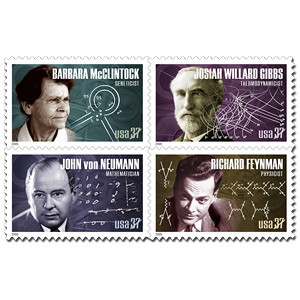
Earlier this month the USPS released a new set of stamps honoring four scientists: "some of the greatest scientists of our time, their pioneering discoveries still influence our lives today," according to John F. Walsh of the U.S. Postal Service's Board of Governors. Well, maybe! The four scientists are Barbara McClintock (geneticist), Richard Feynman (physicist), Josiah Willard Gibbs (thermodynamicist) and John von Neumann (mathematician/computer scientist). McClintock, Feynman and von Neumann are all more or less our contemporaries (their careers covered much of the last century)-- but Gibbs has been dead more than 100 years and I certainly would not count him "of our time".
Gibbs' name is familiair to almost any chemistry student - through the Gibbs free energy. J. Willard Gibbs (1839-1903) was the son of a Yale professor of sacred scripture, and himself worked at Yale. Gibbs was not paid a salary for the first 9 years of his job at Yale. It was only once he had a job offer from Johns Hopkins University in Maryland that Yale began to pay him. He gained little recognition for his work during his lifetime mainly because of his inability to communicate his ideas so that others could understand the concepts he was discussing.
With thanks to Tony Addison of Drexel for pointing me to the stamps.
Gibbs' name is familiair to almost any chemistry student - through the Gibbs free energy. J. Willard Gibbs (1839-1903) was the son of a Yale professor of sacred scripture, and himself worked at Yale. Gibbs was not paid a salary for the first 9 years of his job at Yale. It was only once he had a job offer from Johns Hopkins University in Maryland that Yale began to pay him. He gained little recognition for his work during his lifetime mainly because of his inability to communicate his ideas so that others could understand the concepts he was discussing.
With thanks to Tony Addison of Drexel for pointing me to the stamps.
Multiple Personalities 1: Wrists and snow
Decoding the eponyms of science and medicine offers a quick history lesson. The same names sometime surface in multiple contexts. Some are Renaissance men, others come out of scientific dynasties (think the Thompsons) , still others are just cases of "mistaken identity" (Fischer projections and Fischer carbenes).
Today is the birthday of Marcel De Quervain, a Swiss geologist who has done significant work on the physical properties of snow. A recent paper on the application of manure (really!) to snow and its effect on the melting of the ice pack refers to De Quervain's work.
If you have wrist problems, you may have heard of Fritz De Quervain who in 1895 described the tenosynovitis that bears his name.
Any relation? Not to my knowledge. Connections? You can aggravate your De Quervain's tenosynovitis if you ski...in the snow.
Today is the birthday of Marcel De Quervain, a Swiss geologist who has done significant work on the physical properties of snow. A recent paper on the application of manure (really!) to snow and its effect on the melting of the ice pack refers to De Quervain's work.
If you have wrist problems, you may have heard of Fritz De Quervain who in 1895 described the tenosynovitis that bears his name.
Any relation? Not to my knowledge. Connections? You can aggravate your De Quervain's tenosynovitis if you ski...in the snow.
The Invisible College
I spent part of today preparing for a talk for I'm giving at Drexel on Wednesday, for their E-Learning Lecture Series. Jean-Claude Bradley (whose lecture is linked to the posts on chirality) is my host. He's been constructing on-line courses in chemistry, that are also taught in real-time. By the end of term, most of the students are not present in the classroom, but are invisible in some sense to the lecturer. The web allows us to construct an invisible university, where neither chronological nor spatial constraints apply to the community of scholars.
This is nothing new. In the 17th centure, Robert Boyle, whose name we associate with the inverse relationship between pressure and volume, was part of an institutuion known as the Invisible College. The Invisible College was group of natural philosophers working in England, which Boyle joined in the 1650s. This group eventually became the Royal Society of London for Improving Natural Knowledge, still operating nearly 400 years later.
Interesting tidbits about Boyle: He identified himself as an alchemist and believed that base metals (such as iron) could be "transmuted" into more precious metals such as gold. The study of the properties of gases is the precursor of "scientific chemistry", and was an active field in the 17th century (think balloons!). Even though general chemistry books refer to Boyle's Law, it is also attributed in some texts (principally in Europe) to Mariotte. Boyle authored The Skeptical Chemist, where he encouraged experimentation and observation, and Some Considerations Touching the Usefulnesse of Experimental Natural Philosophy, where he strongly supported the teaching of experimental science in schools (if you don't enjoy lab, blame Boyle).
This is nothing new. In the 17th centure, Robert Boyle, whose name we associate with the inverse relationship between pressure and volume, was part of an institutuion known as the Invisible College. The Invisible College was group of natural philosophers working in England, which Boyle joined in the 1650s. This group eventually became the Royal Society of London for Improving Natural Knowledge, still operating nearly 400 years later.
Interesting tidbits about Boyle: He identified himself as an alchemist and believed that base metals (such as iron) could be "transmuted" into more precious metals such as gold. The study of the properties of gases is the precursor of "scientific chemistry", and was an active field in the 17th century (think balloons!). Even though general chemistry books refer to Boyle's Law, it is also attributed in some texts (principally in Europe) to Mariotte. Boyle authored The Skeptical Chemist, where he encouraged experimentation and observation, and Some Considerations Touching the Usefulnesse of Experimental Natural Philosophy, where he strongly supported the teaching of experimental science in schools (if you don't enjoy lab, blame Boyle).
Weird Words of Science 3
quantophrenic
A term used for an obsession with and exaggerated reliance upon mathematical methods or results. (Source Oxford English Dictionary). For a long time, chemists considered quantum theorists (of which I am one) to be quantophrenics. The following quote summed it up well: "Every attempt to employ mathematical methods in the study of chemical questions must be considered profoundly irrational and contrary to the spirit of chemistry. If mathematical analysis should ever hold a prominent place in chemistry - an aberration which is happily almost impossible - it would occasion a rapid and widespread degeneration of that science." Auguste Comte, Cours de Philosophie Positive, 1830. Fortunately, quantum chemists persisted, and the methods they developed to treat chemical systems have become powerful tools for chemists in many areas.
A term used for an obsession with and exaggerated reliance upon mathematical methods or results. (Source Oxford English Dictionary). For a long time, chemists considered quantum theorists (of which I am one) to be quantophrenics. The following quote summed it up well: "Every attempt to employ mathematical methods in the study of chemical questions must be considered profoundly irrational and contrary to the spirit of chemistry. If mathematical analysis should ever hold a prominent place in chemistry - an aberration which is happily almost impossible - it would occasion a rapid and widespread degeneration of that science." Auguste Comte, Cours de Philosophie Positive, 1830. Fortunately, quantum chemists persisted, and the methods they developed to treat chemical systems have become powerful tools for chemists in many areas.
Subscribe to:
Posts (Atom)